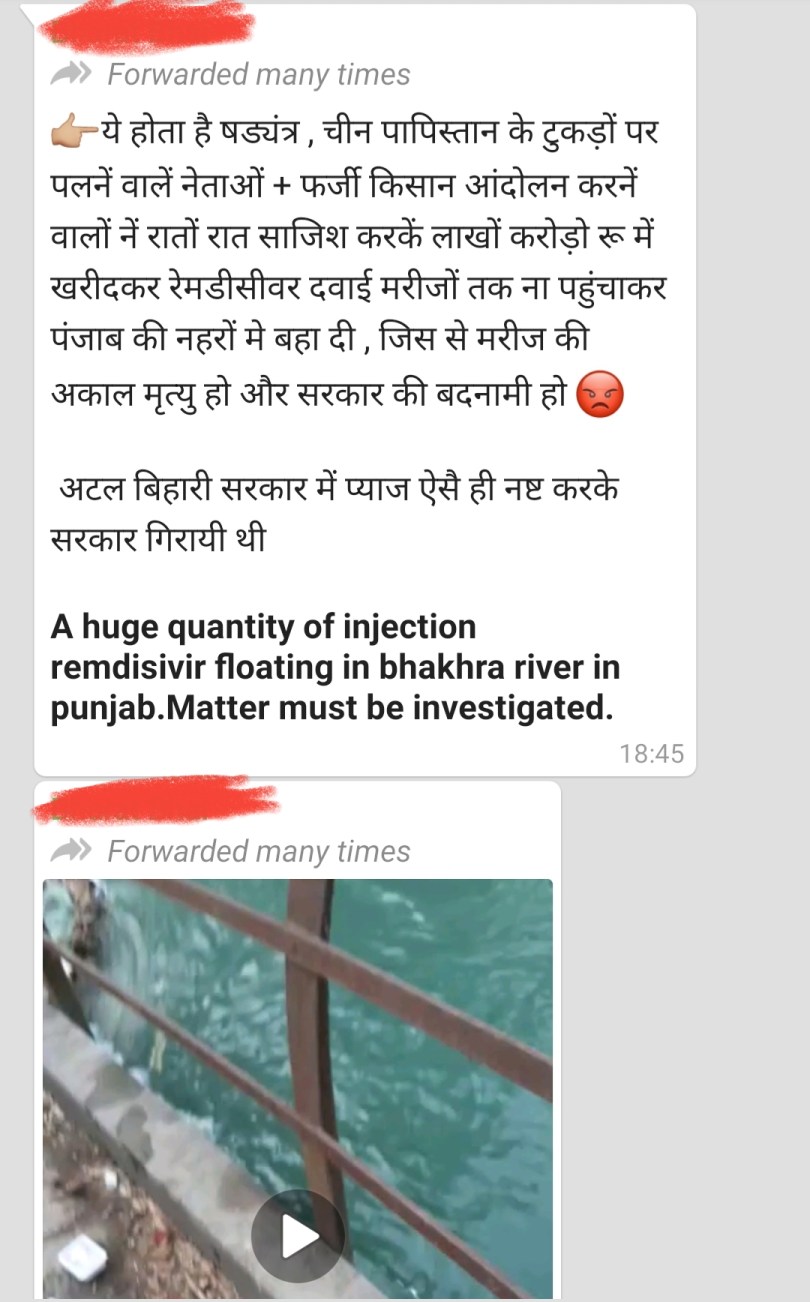
A video of medicines and vials of injections floating in Punjab’s Bhakra canal is doing the rounds on social media. BJP spokesperson Sambit Patra tweeted the video and rebuked the Punjab government by saying, “Respected CM Punjab, This is abhorring & Criminal While patients struggle for essential medicines in Punjab ..thousands of vials of Injection Remdesivir are found dumped in the Bhakra canal! Who’s responsible for this criminal act? Why’s the Punjab Govt silent?”. At the time of writing this article, Patra’s tweet garnered close to 1,300 retweets.

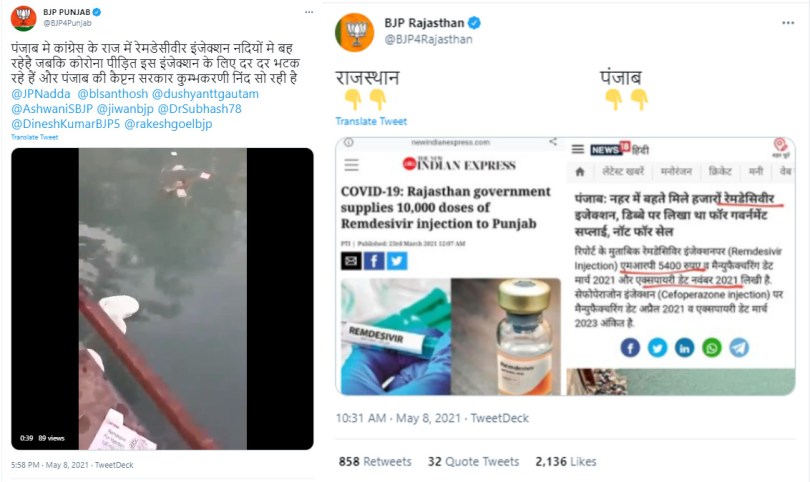
BJP Punjab and BJP Rajasthan also criticised the Punjab government while sharing the video and a screenshot of two reports – one on the Rajasthan government supplying 10,000 doses of Remdesivir injection to Punjab and the other on Remdesivir vials recovered from Bhakra canal.

One Ravikant Pandey also shared the video on the Facebook Group Pushpendra Kulshrestha. The user claimed that the vials were thrown as a conspiracy against the central government.

The text shared along with the video reads, “ये होता है षड्यंत्र , चीन पापिस्तान के टुकड़ों पर पलनें वालें नेताओं + फर्जी किसान आंदोलन करनें वालों नें रातों रात साजिश करकें लाखों करोड़ो रू में खरीदकर रेमडीसीवर दवाई मरीजों तक ना पहुंचाकर पंजाब की नहरों मे बहा दी , जिस से मरीज की अकाल मृत्यु हो और सरकार की बदनामी हो”.

The video is also circulating with the same text on WhatsApp.

Drug Control Office says vials were fake

Alt News found that the video is indeed from the Bhakra canal in Punjab but Drug Control Officer said that the vials were fake. The Tribune reported on May 6, 2021 that as many as 621 fake Remdesivir vials were found dumped in the Bhakra canal. Along with Remdesivir, hundreds of Cefoperazone injection vials were seized by the police team led by the Chamkaur Sahib DSP. They were accompanied by health officials.

“In all, 621 Remdesivir and 1,456 Cefoperazone vials were seized from the two spots. In addition, 849 unlabelled vials were recovered. Drug Control Officer Tejinder Singh said prima facie the medicines were fake. The labels on vials did not match with those of original vials of the same company,” reported The Tribune.

Alt News contacted Ropar SSP Akhil Chaudhury who informed, “On the basis of the recovery, an investigation has been initiated. An FIR has been registered. We are examining all the aspects of the case. We have the leads but there hasn’t been a breakthrough yet. A team led by an SP-rank officer is investigating the matter.”

When asked if the Remdesivir vials were fake he said, “As per the Drug Control Officer, the labels of the recovered vials do not match with the original vials from the company, hence it apparently looks fake.”

On April 26, Delhi police DCP Crime Monika Bhardwaj had tweeted images pointing out the difference between the label of fake Remdesivir vials with the real one.

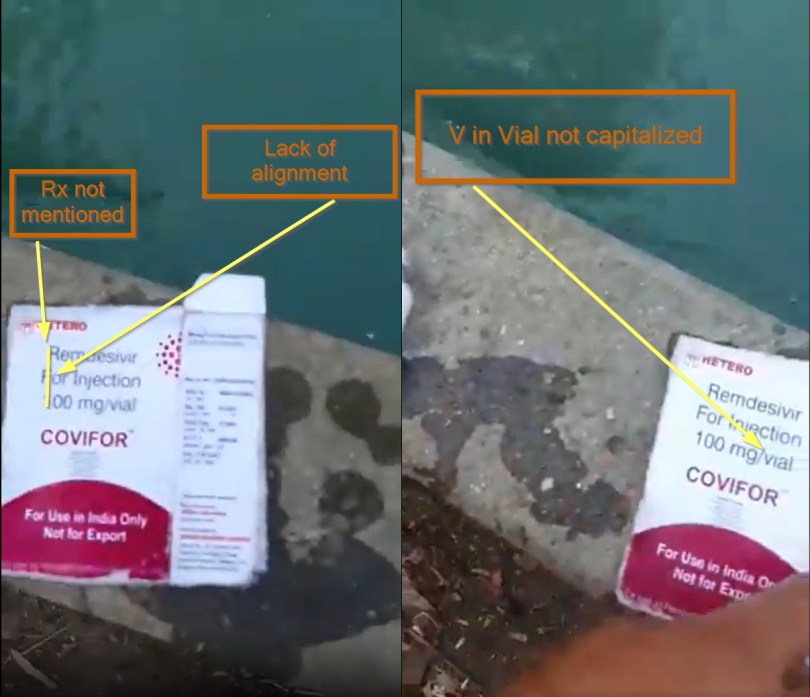
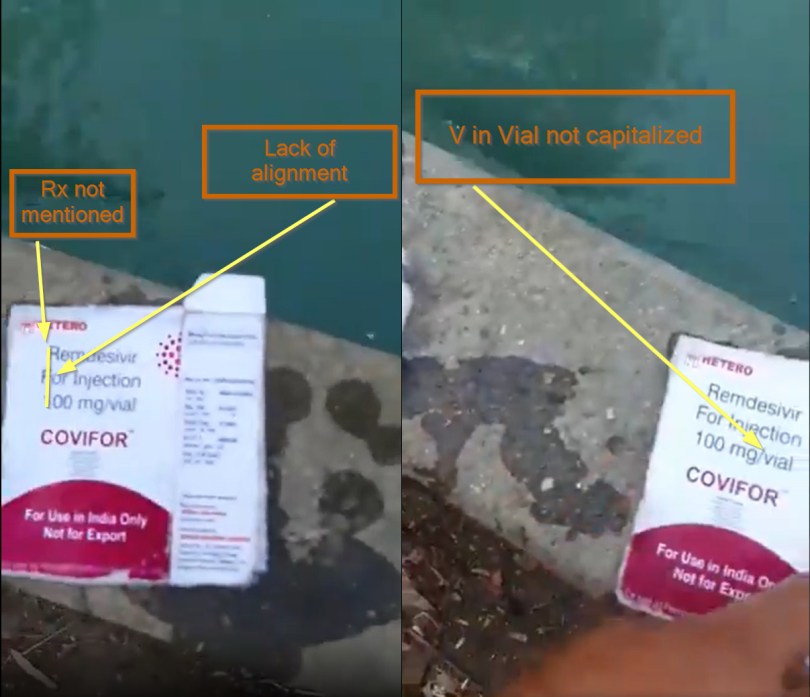
We also noticed a few discrepancies in the vials recovered from Bhakra canal – ‘Rx’ before Remdesivir is missing, lack of alignment in the text inscribed on the label and the ‘v’ in ‘Vial’ is not capitalized.

An image of the label of a genuine Remdesivir vial manufactured by Hyderabad-based Hetero company has been posted below.

It is also noteworthy that the News18 article that BJP Rajasthan shared has now been updated to reflect that the vials recovered were duplicates. The title of the initial report said, “Punjab: Thousands of Remdesivir injections found floating in canal, the box said ‘for government supply, not for sale’.” The updated headline says, “Punjab: Remdesivir injections recovered floating in canal, probe finds they were fake, police registers case”.

Alt News has reached out to the drug manufacturer for comment on the label of the vials. We will update the report if and when they respond. At present, the Drug Control Officer has stated that the vials were fake. The packaging of the vials recovered from the Bhakra canal matches the packaging of fake vials.

[Warning: This report may be distressing for some. Reader discretion is advised.]

A disturbing clip of a group of people slitting a young boy’s throat has gone viral on social media. Given its visceral imagery, we will not be including the video in the article. The footage is being circulated on WhatsApp as an incident of poll violence following the West Bengal assembly election results.

Accompanying the video is a viral caption that states, “#Intellectual_Bengal In West Bengal’s Birbhum, TMC workers mercilessly beat Sudip Biswas to death and posed with his corpse afterwards. Biswas’s only crime was supporting and campaigning for the opposing party. This is akin to the photos hunters take while posing with the animal’s dead body. In today’s India, even an animal wouldn’t be treated with so much cruelty. The sad part is that local intellectuals are justifying these rapes and murders. Political differences are indeed an integral part of democracy. There are hundreds of political parties in the country, so it’s only natural that each will have its own workers with different viewpoints. If 10 candidates are contesting for a seat, you can only support and vote for one of them. Does this mean that the remaining nine can resort to committing physical harm and murder?”

It was also posted on Twitter with the following message, “Sorry to upload this video. TMC workers are attacking BJP workers like animals. This is a highly condemnable and sad clip. What’s going on in West Bengal is nothing more than ‘jungle raj’. One could never have imagined that politics would take such a dark turn. What does such an attack on Hindus indicate? #TMCTerror #tmcgoons”

This slideshow requires JavaScript.

Apart from this, we received a few requests to verify the video on the Alt News official WhatsApp number (+917600011160) and mobile app (Android, iOS).

This slideshow requires JavaScript.

Old video from Venezuela

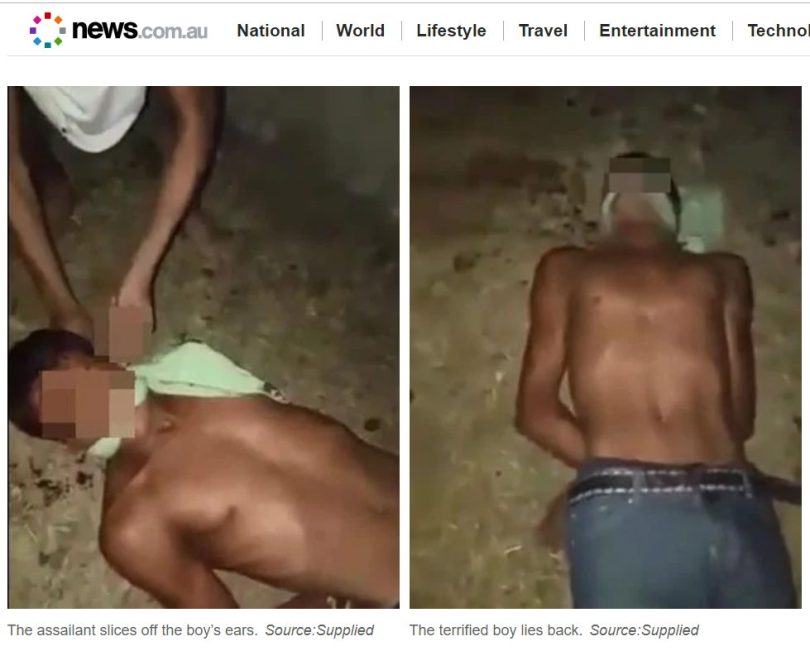
We performed a reverse image search of the video stills on Yandex, which led us to a 2018 news report on news.com.au. The story dated February 6, 2018, says that the incident took place in Venezuela, a country in North America. The boy in the clip was kidnapped by a rival drug mafia gang and strangled to death at an unknown location. The gang filmed the incident and shared the footage online. The article also contains some frames from the video.

On February 6, 2018, Daily Mail also published a report on the incident. It stated that the boy was a victim of the dreaded ‘megabandas’ gang that formed in Venezuelan prisons. The group was said to specialize in kidnapping, extortion and murder. The clip first came to light after being published in news.com.au, which attributed the murder to a local gang. Crime expert and journalist Javier Ignacio Mallorca told media outlet Efecto Cocuyo in March 2017 that at least 19 such gangs were active in Venezuela.

The Sun also reported on the gruesome murder in February 2018. Stating that news.com.au first broke the story, it mentioned that the Venezuela prison system was one of the most violent in the world, with almost 6,500 murders committed in custody between 1999 and 2014. According to The Sun, the ‘megabandas’ gang was one of the largest in the area, operating alongside another syndicate known as the ‘Cartel of the Suns’. Together, they smuggled drugs from Colombia into the United States.

Therefore, an old video of a brutal execution at the hands of a Venezuelan drug cartel was falsely shared as an incident of poll violence following the announcement of the West Bengal assembly election results.

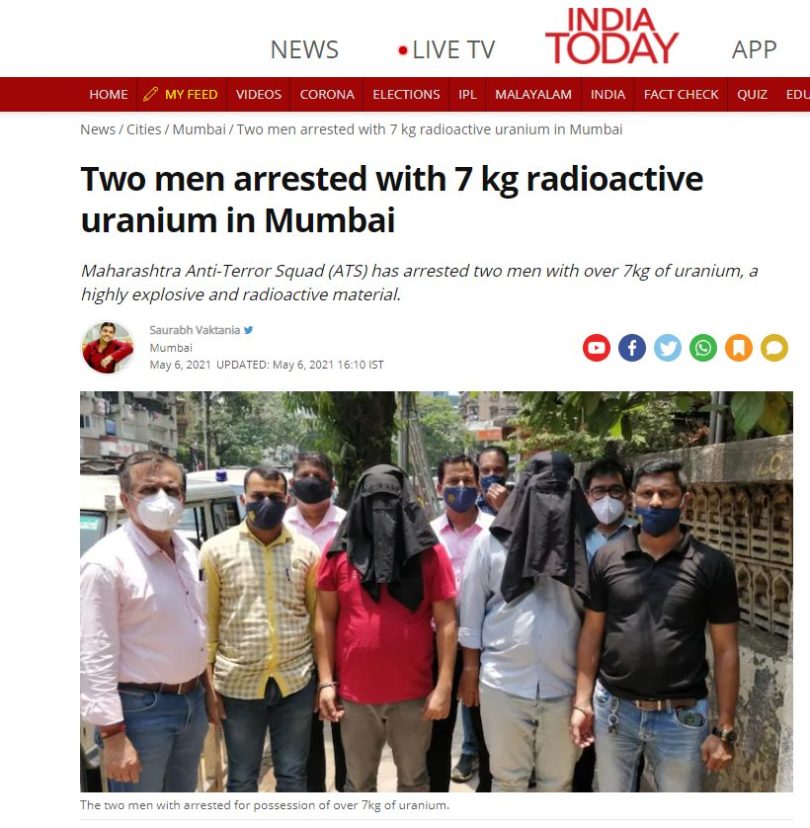
In a recent tweet, BJP Yuva National Convenor Devang Dave claimed that the Anti-Terror Squad (ATS) arrested two people, including a man named Abu Tahir, for illegal possession of 7 kg of uranium in Nagpada, Mumbai. Devang is also the founder of the Facebook page ‘I Support Narendra Modi’.

BJP supporter and advocate Prashant Patel Umrao also tweeted that the ATS apprehended two individuals, both purportedly Muslims, for illegal possession of uranium. He identified the two accused as Abu Tahir Afzal Hussain and Mohammad Jigar.

News Nation Consulting Editor Deepak Chaurasia identified one accused as Abu Tahir Afzal Hussain and the other as Jigar. Arun Pudur also posted a similar tweet, though he mentioned that the other accused’s name is Jagir.

Twitter user @MeghUpdates wrote that there were two accused, but named only Abu Tahir.

This slideshow requires JavaScript.

The handle @PNRai1 quote-tweeted Chaurasia’s tweet, adding, “Uranium Jihad. Obviously, this wasn’t done out of good intentions. Good that these men were caught in Maharashtra, otherwise liberals and Congress supporters would have spun it as Hindus harassing Muslims.”

Facebook user Sunil Kumar Pandey claimed that three individuals were arrested in this case and all of them hailed from the Muslim community.

Misleading posts add a communal spin

On May 6, ATS officials reported the arrest of two people for illegal possession of 7 kg of uranium worth over Rs. 21 crores in Maharashtra. Uranium is a highly radioactive substance that can prove to be fatal if handled without proper care. India Today reported that on February 14, officials received a tip about a man named Jigar Pandya who was trying to sell pieces of uranium. The police arrested him on the same day. It was found during their investigation that he had obtained the uranium from a Mankhurd resident named Abu Tahir. The police immediately raided Tahir’s home and arrested him as well.

The Wire identified the second accused Abu Tahir as Abu Tahir Afzal Hussain Chaudhary. Meanwhile, News18 reported that his full name was Abu Tahir Hussain Chaudhary.

This slideshow requires JavaScript.

This led to confusion. Since different media outlets reported different names of Abu Tahir, social media users began claiming that there were three accused and not two.

Furthermore, Twitter user @MeghUpdates did not mention Jigar Pandya’s name and Prashant Patel claimed his name was ‘Mohammed’ Jigar thus giving the incident an anti-Muslim spin.

ANALYSIS: By Phil Thornton

As chaos flows in Burma, journalists are being forced to hide in plain sight by the Burmese military, writes senior journalist and Myanmar expert Phil Thornton.


Journalists in Myanmar are being hunted and arrested by the country’s military for trying to do their job. Independent media outlets have been raided, licences revoked and offices closed.

To avoid arrest, independent journalists have gone into deep hiding, taken refuge in ethnic controlled regions or fled to neighboring countries. The military and its paid informers trawl through neighborhoods, coffee shops and scan social media for evidence to justify arresting journalists.

The military appointed State Administration Council revised and inserted a clause in the penal code, specifically tailored to gag its critics, politicians, activists and journalists.

Clause 505a of the penal code carries a sentence of three years in prison for actions, criticism or comment that question the coup, cause fear, spread false news or “upsets” government workers.

To stop journalists, photographers and activists sending reports and images of security forces abusing and killing civilians, the military coup leaders ordered telecommunication companies and internet services to shut down their social media platforms.

Brigadier General Zaw Min Tun fronts the military’s press conferences – a list of his titles is impressive: Deputy Minister of Information, head of the armed forces True News Information Team and boss of the military appointed State Administration Council’s media team.

A look at his name card reveals a much darker role – Zaw Min Tun has working directly for coup leader and Commander-in-Chief, General Min Aung Hlaing. Not only does the card boast that General Zaw Min Tun is Directorate of Public Relations, but he is also head of the army’s Psychological Warfare department.

Deceitful work
A Reuters report in 2018 gave an indication of the deceitful work his department of public relations and psychological warfare gets up to when it revealed a book it published on the Rohingya, had used “fake” photographs to claim Muslims were killing Buddhists.

The Reuters investigation into the origin of the photograph “showed it was actually taken during Bangladesh’s 1971 independence war, when hundreds of thousands of Bangladeshis were killed by Pakistani troops”.

The tactic might have been clumsily executed, but it worked, and helped ignite deadly racist attacks against Rohingya people and supported ultra nationalist views at a critical time.

In a more recent move, the Ministry of Information warned on May 4, viewers who watch or receive outside satellite broadcasts were now doing so illegally and were a threat to national security.

The military cautioned viewers on the state-owned television station, MRTV, that “satellite television is no longer legal. Whoever violates the television and video law, especially people using satellite dishes, shall be punishable with one-year imprisonment and a fine of 500,000kyat (US$320).”

Without the support of the shuttered, independent media outlets, getting paid work has been difficult to find, but many journalists took the tough decision to keep reporting, despite fear of arrest and of having internet and phone restrictions imposed on them.

Journalists who spoke to the International Federation of Journalists (IFJ for this article vowed to find a way to keep working and to continue to find ways to deliver news to people both inside the country and to the international community.

Witness to a revolution
Since the coup began on February 1, independent press freedom has been destroyed. The Assistance Association for Political Prisoners (AAPP) estimates 84 journalists have been detained and as of May 3, 50 are currently detained, 25 of these have been persecuted and arrests warrants have been issued for 29.

An AAPP report on May 6 said that 772 people have been killed, 4809 arrested and 1478 are now on the run, since the beginning of the coup.

Despite journalists being jailed, tortured and spied on, Naw Betty Han, a journalist with the magazine, Frontier Myanmar, is determined to keep reporting and explained to IFJ why that is, “In the current political situation, it is very difficult for a journalist to live and work in the country. But I will not stop doing my job.

“We’re witness to a revolution. I want to remain at the front of these developments, report on human rights violations and hopefully see the end of the military dictatorship.”

Naw Betty stressed the freedom to report, despite the dangers, is why she keeps working. “Journalism is much more than my job, it’s my mission. I’m willing to take the risk to keep reporting.”

Reporters, citizen journalists, activists and householders have all recorded police and army patrols shooting at and beating unarmed young men and women, ransacking shops and firing live ammunition into homes regardless of who might be hit.

Naw Betty said the military wants to stop any proof of its violence being recorded, “Police and soldiers are everywhere, at temporary checkpoints, on patrols…they check phones, if they find proof of protesting, being a journalist, a photo or a news item that supports the CDM movement… a social media post… they immediately beat and arrest them.”

No journalist identification
Naw Betty said she and her colleagues still working can no longer identify as journalists, “We have to delete our phone data when we go out in the field gathering news. Police and soldiers break open houses at night to surprise check the guest list. If you do not open the door, they will break in and arrest you anyhow.

“A former DVB reporter was beaten last week at his home after a search of his home and no evidence was found.”

Naw Betty is well aware of the risks of being arrested. In 2020 while investigating a multibillion-dollar Chinese investment on the Thai Burma border she and a photographer colleague were detained by a Burma Army sponsored militia – masked, handcuffed, driven to a rubber plantation and beaten, before finally being released.

“I am scared of being arrested and faced with the violence in interrogation. But I am positive, I am more afraid that I would not be able to continue as a journalist. I know that I am in danger of being arrested, but I want to keep working as a reporter.”

Naw Betty told IFJ the military, aided by its paid informers, are systematically increasing its crackdown on its opponents, squeezing their ability to move and forcing them into taking more dangerous risks, not knowing who to trust.

Naw Betty said “I’m worried about them [informers], I moved to a different place as soon as the coup happened, hopefully I can stay safe. Journalists in Myanmar are now trying to be as low profile as possible, but when there is a compelling situation, we have to go out to report and take risks.

“We are targets…74 journalists have been arrested and charged under 505 (A). Arrested journalists face physical and mental violence during interrogation before being sent to prison.”

We’re willing and ready
The military’s revoking of licenses and outlawing independent outlets has made it hard for many journalists to find paid work. Naw Betty said journalists have turned to freelance to try to earn a living from their reporting, “Many journalists I know are now faced with financial problems as they have no regular income anymore.

“Some photojournalists have tried to string for international news agencies, but the opportunities are limited – most are struggling with no income.”

A scan of social media postings by advocates offers links to what could become stories of interest to international media, but military refusal to give unfettered access to verify or follow-up accusations of corruption, rumours of security forces looting and bomb attacks has made it to difficult to follow-up.

Naw Betty encourages international media organisations to hire local journalists: “Give locals the chance to work on part-time assignments. We all are willing and ready to support on the ground reporting with international and foreign journalists – we can work together.”

Our priority is to keep broadcasting
Than Win Htut, a senior executive with Democratic Voice of Burma, now working from the edges of a neighboring country, said his priority, after his Yangon DVB operation was shutdown and outlawed, was to get back to operating at full capacity.

“Many journalists are on the run or in hiding. We have to review our network. When they closed us down we lost a lot of our capacity to broadcast – our newsroom, studio, talk show, on-line, research and data analysis.

“We now have to reorganise, rebuild and reintegrate. We need a new studio, live reporting, get journalists on the street, it won’t be easy.”

Than Win Htut’s operation has a whole range of challenges posed by the geography and weather. The monsoon wet season is about to hit his new mountainous location, flooding small rivers into deep, fast flowing hard-to-cross torrents.

The wet season brings dengue fever, malaria and dysentery, difficult at the best of time, but highly dangerous when the nearest medical help is a day away.

Than Win Htut said while searching for new premises maintaining security is of critical importance during forced exile. “They’ve cracked down on mobile phone services, internet is limited, the independent flow of information is blocked, arresting journalists, they won’t stop. We have to take our security serious. Many young journalists don’t have the experience of having to work in secret, going underground. Constantly changing your name, location, passwords, sim-cards, even your phone.”

Than Win Htut is worried sophisticated cyber surveillance equipment and technology the military acquired from Russia, China, Israel, US and Europe is now being used by the military to track and hunt its opponents.

Risks taken
“We have to take the position, the more you know the more the risk you are to yourself and to others. If a journalist gets arrested, you don’t know what they’ve been forced to give up during interrogation.

“We also have to now reconsider how we use photographs and footage of people protesting and of journalists.”

Than Win Htut stressed, international correspondents can endanger local journalists by not knowing the context, especially when following up leads on those arrested.

“You might be trying to help, but the arrested will be trying hard to not identify as a journalist or activist, but by running stories and photos you might be confirming the military’s suspicion someone is a journalist – that makes it dangerous.”

Than Win Htut is concerned the unity between journalists who went to neighbouring countries and those who stayed behind doesn’t divide. “We mustn’t let divisions stop us being united. We need to support each other, whether we are working from inside or outside the country, we’re all in this together.”

You’re either underground or with them
Toe Zaw Latt, an Australia citizen and production director of DVB, spent more than 80 days covering the military coup. With the help of the Australian Embassy in Myanmar, Toe Zaw Latt managed to leave his Yangon place of hiding and return to Australia last week.

Now in the middle of his 14-day quarantine in Adelaide, Toe Zaw Latt talked with IFJ about the ongoing anti-coup protests and the hounding of journalists by security forces.

Since the beginning of the coup, Toe Zaw Latt has been in daily contact with IFJ. He explained: “Most of the independent media have been closed down. Only independent papers left on the street before I left were Eleven Media and Standard Times. Journalists have to face a new threat from plainclothes Special Branch using stolen civilian cars to patrol neighborhoods.

“They turned up at a freelance journalist’s house to arrest her. She wasn’t there, so they took her husband instead. If they can’t arrest the journo it looks like they’ll just take a family member in their place.”

Toe Zaw Latt explained how journalists cannot do anything that identifies them to the police or army.

“No cameras, no notebooks, disguise yourself each time and what you are doing, make sure you carry nothing that can be used to identify you as a journalist and learn how to hide your phone.

“Smart phones are still good in the field, but we need to train young journalists to become more adept with using them to report and they need to know how to get footage out to be broadcast.”

International media interest
“Toe Zaw Latt is concerned that international media continues to maintain an interest in what’s happening with the daily civilian protests and they buy content from local providers.

“It’s important international media agencies keep employing or buying footage from local sources. Freelancers are risking their lives to get footage, they should be paid for it.

“Media news agencies should make a paid contribution and not just lift content off the internet. Journalists are helping each other. Those who are getting paid are sharing with those who aren’t.”

Toe Zaw Latt is impressed by the enthusiasm and resilience shown by activists and students to publish and broadcast news despite military threats of long prison sentences.

“Lots of underground media has emerged since the coup. Student activists fighting the military’s internet blackout have published newsletters – Molotov, Toward and Revolution. The National Unity Government are planning Public Voice TV, underground ethnic youth are running Federal FM and ethnic Mon media produce Lagon Eain.

“I respect their courage in fighting the military’s version of the truth and rejecting their misinformation.”

A senior ethnic journalist spoke to IFJ about the restriction she faces on a daily basis.

“No one can work in the military government-controlled areas. Special Branch have our photographs and our personal details. We’ve put up with it for years. Our houses have been visited, family interrogated.

Risks too stressful
“Some of our colleagues resigned, because the risks were too stressful. They felt they’d be no use to their families if they were in jail.”

The senior journalist explained news coverage now has to be underground.

“It’s either that or you report according to their instructions and that’s total rubbish, just propaganda. All they want is for journalists to legitimise the coup. If you stand up to that your only choice is to go underground.

“Some might play the margins, start by not covering anything sensitive.”

The senior journalists said media could be split into two groups.

“Those willing to be mouthpieces for the military. They don’t run stories upsetting the military and use terms dictated by the State Administration Council. Then there’s what the military classify as radicals.

Our websites are usually blocked, our reporters cannot operate on the surface, we have to go underground and anyone against the military is a target.”

Ethnic journalist difficulties
To give an indication of the difficulties ethnic journalists are working under, from March 27 to May 5, the Karen National Union report its soldiers were involved in 407 armed battles with the Burma Army.

Ethnic journalists told IFJ fighter jets have flown into Karen controlled territory 27 times and dropped 47 bombs , killing 14 civilians wounding 28 and forcing as many as 30,000 people into makeshift jungle camps.

“This is an emergency, it needs reporting and international aid. Villagers’ rice stores have been destroyed as well as homes, schools and clinics.

“To report we have to avoid landmines, army patrols that shoot on sight and the military’s paid informers and special branch who we have to think have our photographs.”

Phil Thornton is a journalist, author and senior adviser to the International Federation of Journalists in South East Asia.
Print Friendly, PDF & Email

Asia Pacific Report newsdesk

Journalists are fearful that increased harassment, abuse and violence directed towards them during the covid-19 pandemic could become the new normal, says the union for Australian media workers.

Releasing its 2021 report into the state of press freedom in Australia, Unsafe at Work – Assaults on Journalists, the Media, Entertainment & Arts Alliance says attacks on journalists increased both globally and and in Australia throughout 2020.

MEAA has been cataloguing the decline of press freedom in Australia now for 20 years.

MEAA says political polarisation caused by the pandemic was behind much of the rising animosity towards journalists, particularly through social media.

But the union also warns that law enforcement agencies have become more heavy-handed in their treatment of journalists.

According to MEAA’s 2021 press freedom survey – the fourth year it has been conducted – Australian journalists are fearful of an increasingly hostile working environment where physical assaults, online abuse and harassment by law enforcement agencies are becoming common.

Although most working journalists who completed the survey said they had not been physically attacked or harassed themselves, 88.8 percent said they were fearful that threats, harassment and intimidation was on the rise.

Assaults on journalists
A quarter of all journalists surveyed said they had been assaulted at least once during their career, and one-in-five said they had been harassed by police while reporting over the past 12 months.

A larger number – 35 percent – have been subjected to threats to their safety online and 70 percent said they did not believe their employer provided sufficient training or support in situations where they faced threats or assaults.

MEAA chief executive Paul Murphy said an MEAA media release that the survey results were unsettling.

“Journalists know that their work will always be under scrutiny and expect it to be criticised, but they are entitled to a safe workplace like all other workers,” he said.

“But in recent years, and encouraged by politicians, journalists are being exposed to much more than an acceptable critique of their work.

“They are threatened and sometimes assaulted at public events, while social media has now evolved into a vehicle for abuse, harassment and threats against journalists. Sometimes these attacks are one-offs but increasingly they are part of a torrent of abuse, which is a weapon to hurt and to harm.

“The polarisation of politics is a key feature in much of this abuse.

Urgent action needed
“Urgent action is needed to ensure journalists can carry on their duties to our communities free from abuse, harassment, arrests and violence.”

Overall, MEAA says that there has been little improvement in press freedom in Australia over the past 12 months, although the union welcomed the decision by the Australian Federal Police not to prosecute three journalists on national security grounds following raids in 2019.

MEAA is hopeful that reform is slowly approaching towards a national uniform defamation regime, and there are positive signs that the Queensland government will finally adopt journalist shield laws, bringing it into line with all other jurisdictions.

MEAA will release its 2021 report into the state of press freedom in Australia, Unsafe at Work – Assaults on Journalists, on UNESCO World Press Freedom Day today – Monday, May 3.

The annual report catalogues MEAA’s press freedom concerns in Australia, and the region.

Print Friendly, PDF & Email

Asia Pacific Report newsdesk

Journalists are fearful that increased harassment, abuse and violence directed towards them during the covid-19 pandemic could become the new normal, says the union for Australian media workers.

Releasing its 2021 report into the state of press freedom in Australia, Unsafe at Work – Assaults on Journalists, the Media, Entertainment & Arts Alliance says attacks on journalists increased both globally and and in Australia throughout 2020.

MEAA has been cataloguing the decline of press freedom in Australia now for 20 years.

MEAA says political polarisation caused by the pandemic was behind much of the rising animosity towards journalists, particularly through social media.

But the union also warns that law enforcement agencies have become more heavy-handed in their treatment of journalists.

According to MEAA’s 2021 press freedom survey – the fourth year it has been conducted – Australian journalists are fearful of an increasingly hostile working environment where physical assaults, online abuse and harassment by law enforcement agencies are becoming common.

Although most working journalists who completed the survey said they had not been physically attacked or harassed themselves, 88.8 percent said they were fearful that threats, harassment and intimidation was on the rise.

Assaults on journalists
A quarter of all journalists surveyed said they had been assaulted at least once during their career, and one-in-five said they had been harassed by police while reporting over the past 12 months.

A larger number – 35 percent – have been subjected to threats to their safety online and 70 percent said they did not believe their employer provided sufficient training or support in situations where they faced threats or assaults.

MEAA chief executive Paul Murphy said an MEAA media release that the survey results were unsettling.

“Journalists know that their work will always be under scrutiny and expect it to be criticised, but they are entitled to a safe workplace like all other workers,” he said.

“But in recent years, and encouraged by politicians, journalists are being exposed to much more than an acceptable critique of their work.

“They are threatened and sometimes assaulted at public events, while social media has now evolved into a vehicle for abuse, harassment and threats against journalists. Sometimes these attacks are one-offs but increasingly they are part of a torrent of abuse, which is a weapon to hurt and to harm.

“The polarisation of politics is a key feature in much of this abuse.

Urgent action needed
“Urgent action is needed to ensure journalists can carry on their duties to our communities free from abuse, harassment, arrests and violence.”

Overall, MEAA says that there has been little improvement in press freedom in Australia over the past 12 months, although the union welcomed the decision by the Australian Federal Police not to prosecute three journalists on national security grounds following raids in 2019.

MEAA is hopeful that reform is slowly approaching towards a national uniform defamation regime, and there are positive signs that the Queensland government will finally adopt journalist shield laws, bringing it into line with all other jurisdictions.

MEAA will release its 2021 report into the state of press freedom in Australia, Unsafe at Work – Assaults on Journalists, on UNESCO World Press Freedom Day today – Monday, May 3.

The annual report catalogues MEAA’s press freedom concerns in Australia, and the region.

Print Friendly, PDF & Email

By Yogi Ernes in Jakarta

Indonesian police have seized 15 Papuan students among scores arrested at a May Day rally in central Jakarta on the ground that they did not have a permit to demonstrate.

“Yes, 15 people were secured and taken to the Metro Jaya regional police [headquarters]. They wanted to protest without a permit,” said Metro Jaya regional police spokesperson Senior Commissioner Yusri Yunus.

The students were arrested yesterday as they marched past the US Embassy on Jl Medan Merdeka Selatan in central Jakarta. They were taken to the Metro Jaya headquarters.

According to Yunus, when they were questioned by officers at the location, the Papuan students were unable to produce a permit for the action.

Yunus said that the 15 students were not carrying any suspicious objects and because of this they had now been sent home.

“We’ve now sent them home. Earlier we just collected data on them,” said Yunus.

The rallies in Jakarta were centred on the Horse Statue area.

Thousands took to streets
Thousands of workers from various different trade unions took to the streets to convey their aspirations.

The workers took up a number of demands, one of which was cancelling the Job Creation Law which they say harms workers.

CNN Indonesia reports that up to 300 people were arrested in rallies near the Horse Statue and the International Labour Organisation (ILO) offices in central Jakarta.

The figures on the arrests were obtained by summarising statements made by police up until the May Day actions ended at 5.05 pm.

The first arrests were the 15 Papuan students.

Following this, police arrested 12 anarchists.

Senior Commissioner Yunus said that the group was arrested as they wanted to join protesting workers in front of the ILO office.

“12 young anarchists were arrested,” said Yunus.

Yunus said they were arrested because it was suspected that they wanted to “create a riot” during the labour protests.

“As is usual with them there were suspicions they wanted to create a riot, so we secured them, we questioned them”, said Yunus.

Thirty students from the Indonesian Association of Catholic Students (PMKRI) were also arrested.

Central Jakarta District police deputy chief Assistant Superintendant Setyo Koes Hariyanto said the students were arrested as they tried to incite chaos by setting fire to tyres.

Women protesters arrested
In Medan, North Sumatra, CNN Indonesia reports that Medan metropolitan district police (Polrestabes) arrested 14 protesters seven women and seven men – the from the People’s Resistance Alliance for the Destruction of Tyranny.

Medan Legal Aid Foundation (LBH) labour and urban poor division head Maswan Tambak said there were no grounds for the repressive action by police against the peaceful protest.

In addition, the protesters did not violate covid-19 health protocols.

Protesters from the Medan People and Workers Accumulation of Anger Alliance (AKBR) acused rogue police officers of intimidating and sexually harassing them.

“There were police who recorded demonstrators by sticking their mobile phones in the face of women protesters. It really wasn’t ethical, and we consider that threatening,” said the founder of Women Today (PHI), Lusty Ro Manna Malau.

“The actions of these rogue police cannot be allowed to become normalised.”

Translated by James Balowski for Indoleft News. The original title of the article was “Polisi Amankan 15 Mahasiswa Papua di Demo Hari Buruh di Jakarta”.

Print Friendly, PDF & Email

By Talebula Kate in Suva

Fiji has reported no new case of coronavirus infection after the screening of 7560 Fijians and 1212 tests conducted by the Ministry of Health and Medical Services.

However, at this evening’s covid-19 daily press briefing, Health Secretary Dr James Fong stressed that there was no need to celebrate.

Dr Fong said it did not mean there were no further cases in Fiji – it meant that none have been detected over the past 24 hours.

“We are certain there are more cases that will develop or – worryingly – that an unconfirmed case of the virus has already developed into a highly-contagious disease,” he said.

“Our biggest fear right now is that someone, with symptoms, has not reported to a screening clinic or called 158.”

As of today, Sunday, May 2, 2021, there are still 49 active confirmed covid-19 cases in isolation, 16 of which are border quarantine cases, with 31 locally transmitted cases and two currently still under being investigated to determine the source of transmission.

Print Friendly, PDF & Email

COMMENT: By Matt McCarten

It’s time for progressive activists to step up. The working class needs you.

On May Day – International Workers Day – we have launched a new union: UTU for Workers Union. Our mission is to build a working class, grassroots, campaigning movement to stop exploitation and end workplace abuse in Aotearoa-New Zealand.

The international trade union movement is in a fight for relevancy to the majority of the working class. Decades of relentless attacks on the workers’ movement have been devastating.

In New Zealand, out of more than 1.5 million private sector workers, less than one in fourteen (7 pecent) are members of a union. If we exclude the large private companies, unionisation in the private sector is effectively non-existent.

More than half of the workers employed in the private sector do not even have the option to join a trade union nor be covered by a collective agreement.

Despite the good work the present unions do for their own members, the rest of the working class has lost ground in terms of income and protections.

Non-unionised workers have no power to improve their position. They are at the mercy of their boss.

As a result, when workers in non-unionised workplaces have an employment dispute, they must seek support from an expensive lawyer, lay advocates, or a friend. Most exploited private sector workers receive no access to justice. Unscrupulous bosses know this.

The increase in vulnerable migrants and widespread casualisation, along with the growth of labour hire companies and dependent sole contractors, has seen the number of precariat workers in New Zealand explode.

This has led to a culture of fear and isolation. As a result, workers’ power, incomes, job security and self-confidence have declined.

The situation is similar in most Western countries, and if we don’t shake it up, the international union movement in the private sector will descend into irrelevancy.

It is unacceptable that we morph into a network of staff associations for relatively better-off workers. That would be a betrayal of our history and all the working-class fighters who came before us.

A new activist movement
The old ways no longer work for the overwhelming number of private sector workers. The only question any serious worker rights activist must consider, is not if we protect and organise all workers, but only: how?

It is clear we need new forms of organisation.

I have been part of the One Union project group for the last three years. We have been actively trialing various models in our attempt to find a sustainable and effective way to meet the new challenge.

We believe we now have the solution. Today we announce the formation of the UTU for Workers Union.

The mission of UTU for Workers Union
Our purpose is to build a mass movement to stop exploitation – migrant and non-migrant – and end unchecked workplace abuse that non-unionised workers routinely suffer.

The use of UTU is deliberate. We summarise it in Māori terms – justice. When a victim is exploited or abused, their mana has been diminished and it must be restored. That is UTU.

As the first step, we have to actually help individual workers with their immediate problem. For the last year we have been providing representation to any worker from non-unionised workplaces who needs help.

The jungle of predator employment advocates and lawyers scamming vulnerable workers is sickening. They get screwed by the boss, and then again by their advocates, some of whom do sweetheart deals with bosses.

The advocate gets their fee, but the worker is forced to accept a few crumbs. Simply outrageous.

The good news is that when we have backed up our representation with a direct campaign, through picketing or media exposure, the exploitative boss has realised the power of the worker feeling they have got justice.

More careful in future
The boss knows to be more careful in the future. We have had some success in having bosses agree to ongoing compliance monitoring.

We have found that workers want to join a union. In almost all occasions, there is no union. If there is, they don’t use their resources to help non-members.

That might make sense if you look at unions as business units, but completely wrong if you see them as a justice movement for workers. There are only two categories of workers – those in unions, and those we must get into unions.

Up until now we have not asked workers to join us. From today we will accept workers as members and supporters.

Our membership is open to everyone, whether they are employees, or dependent contractors. We will help any worker who is in distress.

What must unite us is not what work we do, or who our boss is. Instead, we have to join together as a working class.

The old and true clarion call, “an injury to one, is an injury to all”, is as relevant today as it ever was. All unionists must fight for justice for all workers.

If any applicant is from a unionised site or sector covered by another union, then of course they must join that union. It must be noted that we are solely focused on the vast majority of non-unionised private sector workers who are exploited and abused in the non-unionised world.

By having an inclusive and broad strategy, we believe many workers and allies will step up to build a powerful workers movement dedicated to stopping exploitation and workplace abuse.

How do we rebuild working class confidence?
We can do this in three phases.

Help victims first
If we claim to be pro-worker, we have to earn the right. Our first priority is to resolve individual workers’ immediate problems. This is the most important thing to anyone. Support any victim, and they become a union ally – and in time, an activist.

We currently force exploiters to pay thousands of dollars of unpaid wages and backpay legal underpayments. We have prevented unfair sackings, stopped harassment and bullying, and won compensation and fair outcomes for hundreds of workers.

In the last year alone, we have won hundreds of thousands of dollars for victims. This is only the tip of the iceberg. We need more people to help. Until they do, exploitation will continue.

Our case work is now carried out by the One Union Trust, which operates in partnership with the union. The trust has a dedicated legal team of three lawyers led by a former senior trade union official.

Confront criminal bosses directly
We have a dedicated UTU Squad. We hold UTU Vigils for Justice actions directly outside the businesses and homes of exploiters and abusers. Every community needs a local UTU Squad.

We name criminal bosses and expose injustices on our union website, utu.org.nz, and our Facebook page, @UTUForWorkersUnion.

We host a weekly radio programme on 104.6 Planet FM, Wednesdays at 12.40pm. We tell the truth about these exploiters and abusers.

We organise online Action Station petitions to mobilise support for victims, and let communities know about their local exploiters.

Build solidarity
After a boss has been found to breach minimum employment standards, we monitor compliance and enforce legal minimum codes. Thousands of workers in small workplaces don’t get their minimum entitlements. We can fix that through constant vigilance.

We also monitor visa compliance. 350,000 workers are reliant on a boss for their visas.
Workers will feel safer by regular check ins. Over time, we will patiently build a more collective confidence in their workplace.

Migrant exploitation
The most exploited and abused group of workers are migrant workers on temporary visas. Any project to eliminate worker exploitation in New Zealand must include campaigns that focus on migrant workers. We are judged as unionists on our commitment to the most vulnerable members of the working class.

The Migrant Workers Association partners with us and leads this work. The One Union Trust provides practical case representation for victims. MWA and UTU spearheads campaigns that rally the community against specific cases of injustice. Their fight is our fight.

A call to action
Progressive activists have to step up now. We need action. Go to this page for 8 practical steps you can do right now.

Matthew “Matt” McCarten is a New Zealand political organiser and trade unionist, of Ngāpuhi descent. He has been involved with several leftist or centre-left political parties, most prominently as the leader of the Alliance.

.pf-button.pf-button-excerpt { display: none; }

By Thierry Lepani in Port Moresby

Only seven governors out of Papua New Guinea’s 21 provinces and Bougainville attended a meeting in the capital Port Moresby to discuss issues surrounding the covid-19 pandemic crisis and the National General Elections due next year.

However, while Prime Minister James Marape confirmed seven had attended, only four were counted at the event. They were NCD Governor Powes Parkop, Enga Governor Sir Peter Ipatas, Chimbu Governor Michael Dua and Gulf Governor Chris Haiveta.

The meeting on Thursday was held with Health Minister Jelta Wong and Secretary Dr Osbourne Liko to discuss the covid-19 crisis with the vaccine roll out also on the agenda.

At least 10,997 cases have been recorded in Papua New Guinea with 107 deaths and the nation’s health system has been severely stretched. Less than 1 percent of the population of almost 9 million have been vaccinated.

Issues have been raised about the lack of cohesion over covid policy between the national government and provinces.

Discussions were also held with Electoral Commissioner Simon Sinai about plans for next year, and how the provinces will prepare for the ballot.

Poor turnout
But, the poor turnout of governors as they face various hardships back in their provinces raised concerns about how aligned the government’s strategy will be implemented.

The Post-Courier spoke to the West New Britain Governor Sasindran Muthuvel who said: “I was aware of the meeting but needed to travel back home for launching of several projects.”

He added that he needed to discuss the vaccination roll out with provincial officials as they had received doses just last week.

West Sepik Governor Tony Wouwou told the Post-Courier that he was not even informed that such a meeting was taking place.

Marape said moving forward the provinces would be empowered to “tailor make” their solutions, as the government will not micromanage.

He urged all provinces to provide their own response plan to the government as a uniformed approach is not possible given the unique sets of challenges facing each province.

Thierry Lepani is a PNG Post-Courier reporter.

Print Friendly, PDF & Email