Advocates for press freedom responded with outrage after the Washington Post reported Friday that former President Donald Trump’s Justice Department secretly obtained the phone records and attempted to obtain the email records of three Post journalists who covered Russia’s interference in the 2016 presidential election.
“The Department of Justice should immediately make clear its reasons for this intrusion into the activities of reporters doing their jobs.”
—Cameron Barr, Washington Post
According to the newspaper, Post reporters Ellen Nakashima and Greg Miller and former Post reporter Adam Entous all received letters from the Justice Department earlier this week alerting them that “pursuant to [a] legal process” that reportedly took place in 2020, the DOJ had acquired “toll records associated with” the three journalists’ work, home, or cell phone numbers between April 15, 2017 and July 31, 2017.
“We are deeply troubled by this use of government power to seek access to the communications of journalists,” said Cameron Barr, the acting executive editor of the Post. “The Department of Justice should immediately make clear its reasons for this intrusion into the activities of reporters doing their jobs, an activity protected under the First Amendment.”
The records taken include the numbers, times, and duration of every call made to and from the targeted phones between mid-April and late July 2017, but do not include what was said, the newspaper reported. DOJ officials also obtained, but did not execute, a court order to access the reporters’ work email accounts. Those records would have indicated the dates and addresses of emails sent to and from the journalists during that three and a half month period.
“The letter does not state the purpose of the phone records seizure, but toward the end of the time period mentioned in the letters, those reporters wrote a story about classified U.S. intelligence intercepts indicating that in 2016, Sen. Jeff Sessions (R-Ala.) had discussed the Trump campaign with Sergey Kislyak, who was Russia’s ambassador to the United States,” the Post noted.
According to the Post:
Justice Department officials would not say if that reporting was the reason for the search of journalists’ phone records. Sessions subsequently became President Donald Trump’s first attorney general and was at the Justice Department when the article appeared…
It is rare for the Justice Department to use subpoenas to get records of reporters in leak investigations, and such moves must be approved by the attorney general. The letters do not say precisely when the reporters’ records were taken and reviewed, but a department spokesman said the decision to do so came in 2020, during the Trump administration. William P. Barr, who served as Trump’s attorney general for nearly all of that year, before departing Dec. 23, declined to comment.
Officials in President Joe Biden’s Justice Department, tasked with notifying the reporters about records that were obtained during the Trump administration, tried to justify the collection of journalists’ phone records, claiming that it was part of what department spokesperson Marc Raimondi called “a criminal investigation into unauthorized disclosure of classified information.”
“The targets of these investigations are not the news media recipients but rather those with access to the national defense information who provided it to the media and thus failed to protect it as lawfully required,” said Raimondi.
Also, and this is key, the **BIDEN** Justice Department “defended [the Trump Justice Department’s] decision to subpoena Post reporters’ records” https://t.co/am9OZEEnTU
— jeremy scahill (@jeremyscahill) May 8, 2021
First Amendment advocates were highly critical of the DOJ’s decision to seize journalists’ communications records in an attempt to identify the sources of leaks, saying the practice dissuades citizens from sharing information that can help reveal the truth, hold the powerful accountable, and improve the common good.
“This never should have happened,” the American Civil Liberties Union tweeted. “When the government spies on journalists and their sources, it jeopardizes freedom of the press.”
The Justice Department shouldn’t go spying on journalists at the whims of an administration.
This should never have happened.
When the government spies on journalists and their sources, it jeopardizes freedom of the press. https://t.co/V6BLYidxF2
— ACLU (@ACLU) May 8, 2021
The Post noted that “both the Trump and Obama administrations escalated efforts to stop leaks and prosecute government officials who disclose secrets to reporters.”
As the newspaper explained:
During the Obama administration, the department prosecuted nine leak cases, more than all previous administrations combined. In one case, prosecutors called a reporter a criminal “co-conspirator” and secretly went after journalists’ phone records in a bid to identify reporters’ sources. Prosecutors also sought to compel a reporter to testify and identify a source, though they ultimately backed down from that effort.
In response to criticism about such tactics, in 2015, Attorney General Eric H. Holder Jr. issued updates to the rules about media leak investigations aimed at creating new internal checks on how often and how aggressively prosecutors seek reporters’ records.
In response to Trump’s concerns, Sessions and others discussed changing the rules to seek journalists’ phone records earlier in leak investigations, but the regulations were never changed.
However, “in early August 2017—days after the time period covered by the search of the Post reporters’ phone records—Sessions held a news conference to announce an intensified effort to hunt and prosecute leakers in government,” the Post noted.
Bruce Brown, executive director of the Reporters Committee for Freedom of the Press, called on the Justice Department to explain “exactly when prosecutors seized these records, why it is only now notifying the Post, and on what basis the Justice Department decided to forgo the presumption of advance notification under its own guidelines when the investigation apparently involves reporting over three years in the past.”
Rep. Ted Lieu (D-Calif.), meanwhile, described the seizure of the three Post journalists’ phone records as “a direct attack on the First Amendment by the Trump Justice Department.”
“Anyone who was involved in this authoritarian style intimidation and is still at the Justice Department should be fired,” the lawmaker said, adding that “history… is not going to be kind to Bill Barr.”
A rebel army and a local militia have killed 40 Myanmar junta soldiers in two days of fighting this week in regions near the country’s northern and western borders, witnesses reported, in what would be the largest number of casualties inflicted on security forces since the Feb. 1 military coup.
The killing of 30 regime troops by the Kachin Independence Army (KIA) in the northernmost state of Kachin, and of 10 junta soldiers in the neighboring Sagaing region by a newly formed township militia were reported by villagers Friday and have not been confirmed by the rebels or the military regime.
The rise in casualties inflicted on the far better armed junta comes as the fledgling National Unity Government (NUG) tries to unify the numerous local “People’s Defense Forces” that have sprung up across Myanmar under a nationwide army to fight the State Administration Council (SAC), as the regime calls itself.
The NUG, a shadow government made up of members of leader Aung San Suu Kyi’s National League for Democracy (NLD) government that was deposed by the military in February and ethic region leaders, was launched on April 16, and unveiled the “People’s Defense Force” (PDF) on May 5.
The shadow government intends to build the PDF into a Federal Union Army that combines militias formed by majority ethnic Bamars (Burmese) across central Myanmar with the country’s many ethnic armed organizations, such as the KIA, to fight the well-trained but widely loathed junta military forces.
The fighting in Kachin state, which borders China, Thursday and Friday flared up as junta forces staged major attacks to try to retake a military camp at Alawbwan that was captured by the KIA in April.
“They were using aircraft and heavy weapons. Their main target is to retake Alawbwan Camp, which the KIA occupied last month. They are now trying hard to get it back but the KIA is still holding onto it,” Colonel Naw Bu, the KIA’s information officer, told RFA’s Myanmar Service.
“There’s been fighting every day in the Myothit and Konglaw areas. The situation is very tense,” he added, referring to villages in Momauk township at the center of the fighting. “There were casualties but we cannot tell you the details yet.”

10 bombing runs by junta
A resident of Sihat village, where three military troops were killed when the KIA downed a helicopter on Monday, told RFA that KIA troops clashed with junta soldiers at nearby Towerdine Hill, killing about 30 soldiers.
“The fighting has intensified. Yesterday three or four aircraft came to bomb the Towerdine area nearly 10 times,” the villager said on Friday.
“My brother, who is a construction worker, was traveling along Myitkyina-Bhamo road and saw them carrying the dead. ‘There must be about 30 bodies,’ he told me,” said the villager, who declined to be named for security reasons.
“The military aircraft came almost every day, but not today,” he added.
Fighting in Kachin state, which flared up two weeks after the Feb. 1 coup, has entailed about 100 clashes, including at least 60 airstrikes by the junta military, Kachin sources told RFA, military analysts.
More than 12,000 people have been displaced by the fighting, and two Buddhist monks and 15 other civilians have been killed, they said.
“We farmers are facing great difficulties. We cannot go back to the fields to tend the crops and we are worried they will all be destroyed,” said a woman in Sihat village.
“We have invested so much in them and now we cannot harvest them. They shoot at us whenever we go to the fields,” she added.
RFA calls to junta spokesman Maj. Gen. Zaw Min Tun were not answered Friday. The junta has not released any reports of the Kachin fighting.

Battalion commander reported killed
To the southwest of Kachin in Sagaing region, three clashes in three villages between the junta forces and members of the Kani Township People’s Defense Force on Thursday killed at least 10 regime troops, while two local residents died, villagers told RFA.
Sagaing-based Khit Thit News reported that Major Thant Sin Myint, the acting commander of the 404th Artillery Battalion was among junta soldiers killed in the Kani clashes.
More than 100 junta soldiers came to the town after an informant tipped them about the local forces, a member of the Kani Township People’s Defense Force said.
“There was a shootout between our local forces and the military near the hills behind Thamingyan village. We haven’t suffered any casualties so far. We had retreated back a little because they were firing heavy weapons at us,” he said.
“We used home-made landmines seven times. They have informants who told them about our location. All we have are Tumee handmade weapons,” he said, referring to crude hunting rifles rural residents have wielded against junta troops in
Sagaing, a territory bordering India and populated mostly by majority Bamars.
In Sagaing’s Tamu, a city of 44,000 people, local fighters using the black powder rifles killed 14 soldiers in late March and early April, local reports said, but the defense against violent crackdowns from soldiers invited more brutality from the junta.
“We would be so happy if the ethnic armies could help us with some weapons. And we want to ask people in all parts of the country to fight back the junta in every way possible,” said the Kani fighter.

‘We can get rid of them’
The Sagaing militiaman’s plea for arms and help on Friday came as Khin Ma Ma Myo, the NUG deputy defense minister, said People’s Defense Force township-level units across the France-sized country of 54 million were working on linking up and sharing information.
“What is happening in the country right now is that the commander-in-chief has abused his power and abused the country. We urge the people and the ethnic armed groups to join forces and fight back,” he said, referring to junta leader Min Aung Hlaing.
“Gradually, if we all unite to resist we can get rid of them,” said Khin Ma Ma Myo.
“I would like to appeal to all ethnic armed groups and the people as well as members of the armed forces and police to work with us and build the future of our country,” he said.
A member of the local township militia in Kalay, another Sagaing town where local fighters have inflicted casualties on government troops, said his group is willing to join the NUG national force.
“We have not joined them yet, but it will be more convenient if we can join them and work under their command,” said the militiaman.
“Right now we joined forces among our villages when (junta soldiers) came, working as a guerrilla unit,” he said. “It’s not a large organization yet, but we want to cooperate as soon as possible.”
However, not all opponents of the military junta in ethnic areas appear willing to join the nationwide army in a country where the people of ethnic minority regions have been badly treated by Myanmar’s central government for decades.
“There has been no communication (with NUG). If they do not contact us, we don’t care,” said a member of the Hakha township unit of the Chinland Defense Force (CDF), which was formed on April 4 in Chin State, a rugged, underdeveloped area on Myanmar’s border with India and Bangladesh.
The Chinland Defense Force, which has units in nine townships of the a state organized on tribal lines, has reported that the CDF in Mindat township killed at least 20 junta soldiers in a battle from April, while the Hakha killed nine regime troops early this week.
“We will give support to the CDF, and if a separate armed group is to be set up here, it will have to be discussed again,” said the Hakha CDF fighter.
Reported by RFA’s Myanmar Service. Translated by Khin Maung Nyane. Written in English by Paul Eckert.
 According to the U.S. Department of Education, 1,654 charter schools closed between 2010-2011 and 2016-2017. That is an average of 236 charter school closures per year, which is a big bite out of the total number of charter schools in a short period of time. Today there exist roughly 7,300 charter schools, which is less than 7% of all schools in the U.S. Given the endless problems with transparency and open accurate reporting in the charter school sector it is not unreasonable to assume that the number of charter schools that have closed in this time period is actually larger than what the U.S. Department of Education reports.
Privately-operated charter schools are notorious for over-promising and under-delivering on many commitments and assurances. The chasm between charter school rhetoric and charter schools reality has always been large. The massive onslaught of disinformation about privately-operated charter schools has created a situation where facts like the closure of thousands of charter schools over the years have been drowned out by never-ending happy news about charter schools. The pressure to not engage in a conscious act of finding out what is really transpiring in the unstable charter school sector has left many at a disadvantage that harms everyone. Only systematic research and analysis can arm a person to see and appreciate this persistent gap between charter school words and charter school deeds.
For decades the public has been told by charter school promoters and their allies that public schools are lousy and incapable of “saving” students, particularly minority students. The public has been repeatedly told that charter schools are a silver bullet that will deliver a bigger bang for the buck and be more accountable than public schools.
Instead, corruption, fraud, arrests, poor performance, school closures, shady real estate deals, scandalous headlines, and more have increased alongside the surge in charter schools. More segregated charter schools run by unelected individuals has meant more problems for everyone, including charter schools themselves.
To be sure, charter schools have failed thousands of minority families, distorted the economy, undermined nation-building, and increased many inequalities. No amount of hullabaloo or hype can conceal these realities.
Privately-operated charter schools have not reduced poverty, inequality, or structural racism. They have not closed the “achievement gap” or stopped the school-to-prison pipeline. They have siphoned money from public schools and intensified segregation, controversy, de-unionization, secrecy, and competition. Cyber charter schools in particular have taken fraud and scandal to levels not seen in even the most irresponsible large corporations.
If high scores on punitive, time-consuming, expensive, educationally unsound high-stakes standardized tests produced by big for-profit corporations is the measure of a “good education,” then thousands of charters schools have failed to provide a “good education.” More than 3,000 privately-operated charter schools have closed since 1992.
No doubt, many more charter schools will fail and close in the coming years, leaving even more minority families abandoned and angry. It does not matter much if the reason for closure is financial malfeasance, mismanagement, or poor academic performance, the result is still the same: the public deprived of billions of dollars and thousands of minority families betrayed and left out in the cold. The same worn-out “failure narrative” used by neoliberals and privatizers to justify a private takeover of America’s public schools applies to charter schools themselves.
Neoliberal school reform has proven time and again to be a major block to progress in education and, by extension, society, the economy, and the nation.
Charter schools must be prohibited from accessing any public school funds, resources, and buildings. These belong to the 100,000 public schools that serve the nation, economy, society, and public interest. This precious wealth produced by workers must not find its way into the hands of the non-profit and for-profit corporations that run charter schools.
[Warning: This report may be distressing for some. Reader discretion is advised.]
A disturbing clip of a group of people slitting a young boy’s throat has gone viral on social media. Given its visceral imagery, we will not be including the video in the article. The footage is being circulated on WhatsApp as an incident of poll violence following the West Bengal assembly election results.

Accompanying the video is a viral caption that states, “#Intellectual_Bengal In West Bengal’s Birbhum, TMC workers mercilessly beat Sudip Biswas to death and posed with his corpse afterwards. Biswas’s only crime was supporting and campaigning for the opposing party. This is akin to the photos hunters take while posing with the animal’s dead body. In today’s India, even an animal wouldn’t be treated with so much cruelty. The sad part is that local intellectuals are justifying these rapes and murders. Political differences are indeed an integral part of democracy. There are hundreds of political parties in the country, so it’s only natural that each will have its own workers with different viewpoints. If 10 candidates are contesting for a seat, you can only support and vote for one of them. Does this mean that the remaining nine can resort to committing physical harm and murder?”
It was also posted on Twitter with the following message, “Sorry to upload this video. TMC workers are attacking BJP workers like animals. This is a highly condemnable and sad clip. What’s going on in West Bengal is nothing more than ‘jungle raj’. One could never have imagined that politics would take such a dark turn. What does such an attack on Hindus indicate? #TMCTerror #tmcgoons”
Apart from this, we received a few requests to verify the video on the Alt News official WhatsApp number (+917600011160) and mobile app (Android, iOS).
Old video from Venezuela
We performed a reverse image search of the video stills on Yandex, which led us to a 2018 news report on news.com.au. The story dated February 6, 2018, says that the incident took place in Venezuela, a country in North America. The boy in the clip was kidnapped by a rival drug mafia gang and strangled to death at an unknown location. The gang filmed the incident and shared the footage online. The article also contains some frames from the video.
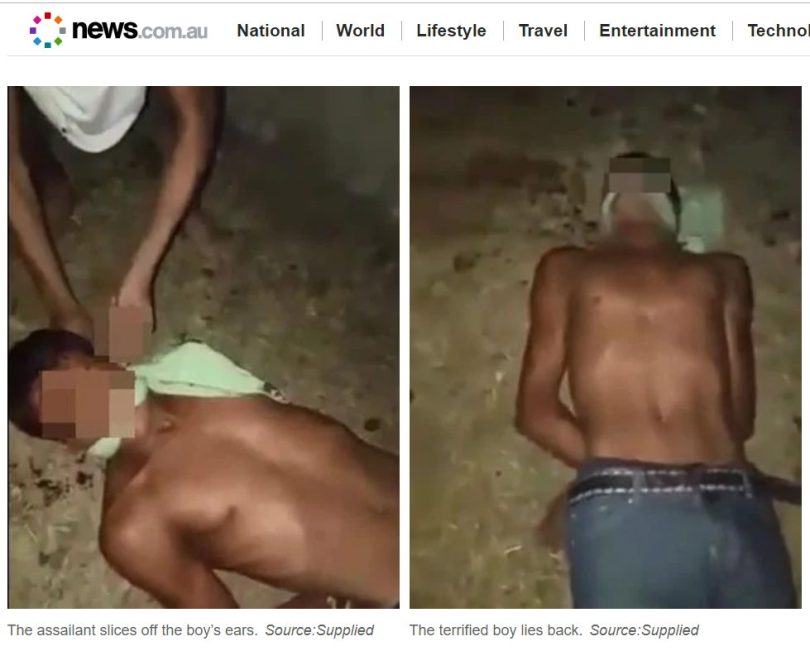

On February 6, 2018, Daily Mail also published a report on the incident. It stated that the boy was a victim of the dreaded ‘megabandas’ gang that formed in Venezuelan prisons. The group was said to specialize in kidnapping, extortion and murder. The clip first came to light after being published in news.com.au, which attributed the murder to a local gang. Crime expert and journalist Javier Ignacio Mallorca told media outlet Efecto Cocuyo in March 2017 that at least 19 such gangs were active in Venezuela.


The Sun also reported on the gruesome murder in February 2018. Stating that news.com.au first broke the story, it mentioned that the Venezuela prison system was one of the most violent in the world, with almost 6,500 murders committed in custody between 1999 and 2014. According to The Sun, the ‘megabandas’ gang was one of the largest in the area, operating alongside another syndicate known as the ‘Cartel of the Suns’. Together, they smuggled drugs from Colombia into the United States.
Therefore, an old video of a brutal execution at the hands of a Venezuelan drug cartel was falsely shared as an incident of poll violence following the announcement of the West Bengal assembly election results.
Biden’s militarized response to migrants seeking refuge in the United States is putting their lives in danger.