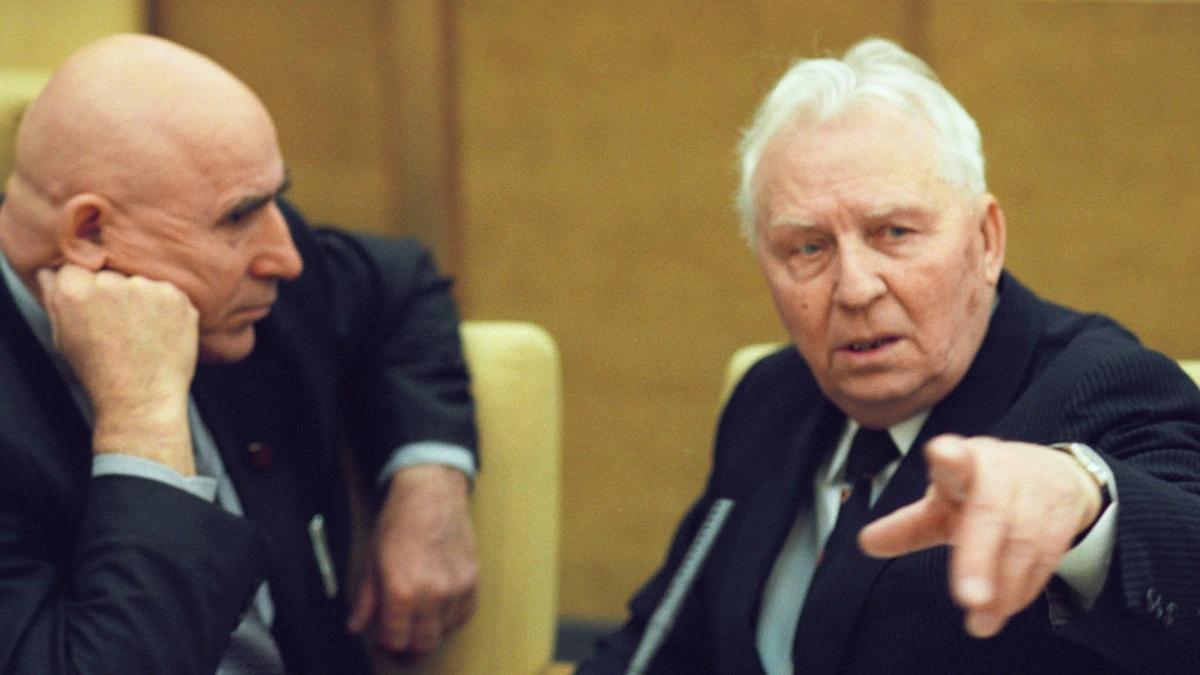
Yegor Ligachyov, a former member of the Soviet Communist Party’s Politburo who was once seen as Kremlin leader Mikhail Gorbachev’s right-hand man, has died at the age of 100.
Ligachyov, who in November 2020 became the first former top Soviet official to reach the century mark and was known for coming up with Gorbachev’s hugely unpopular anti-alcohol campaign, died in a Moscow hospital in the evening of May 7.
He was considered in the late 1980s as the second-most-powerful official in the Soviet Union after President Gorbachev, with whom he initially was seen as a close ally.
Ligachyov later became associated with anti-perestroika forces and was excluded from the Central Committee of the party in 1990.
After the collapse of the Soviet Union in 1991, Ligachyov expressed regret for supporting Gorbachev and joined the leadership of the Communist Party.
Ligachyov was a lawmaker from 1999 to 2003.
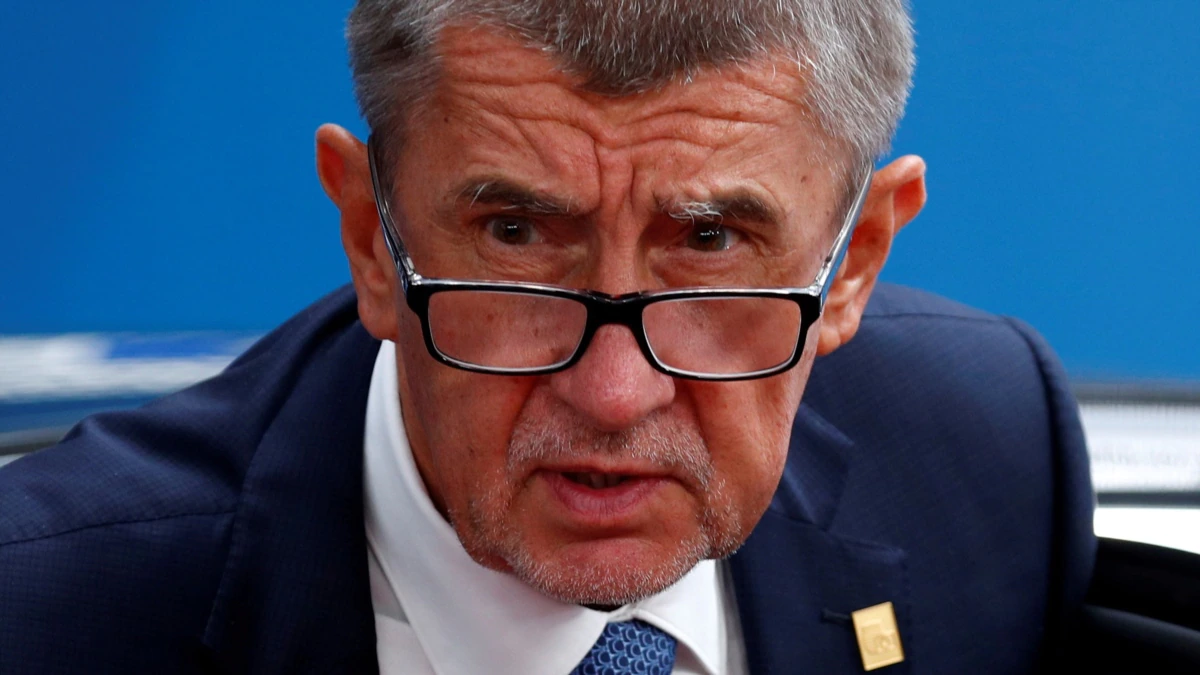
Czech Prime Minister Andrej Babis has said that he has asked the European Council to condemn Russia for its involvement in the deadly explosion of an arms depot on Czech soil in 2014.
Asked whether he had brought up the explosion during an informal two-day summit of EU leaders taking place in Portugal, Babis told journalists on May 8 that he had “called for the [European] Council to condemn and declare such actions as unacceptable” when it presents its concluding statements at an EU summit scheduled to take place in Brussels later this month.
Babis said that he called on the council to make it clear “that it is impossible to accept such actions, and that we must view an attack on one [EU] member state as an attack on all.”
Babis on April 17 announced that investigators from the Czech intelligence and security services had provided “unequivocal evidence” that there was “reasonable suspicion regarding a role of members of Russian military intelligence GRU’s unit 29155 in the explosion of the munition depot in Vrbetice in 2014.”
Two men were killed in the blast.
In response, the Czech government announced the expulsion of 18 Russian diplomats it considered to be spies, setting off a string of tit-for-tat moves between Prague and Moscow.
Russia has denied involvement in the explosion.
Shontel Brown’s campaign for Congress is blaring one of the least subtle messages sent to a super PAC since the outside money groups were legalized by the Supreme Court in its Citizens United v. FEC decision.
Brown’s campaign has listed on its website a set of negative talking points about her opponent Nina Turner, all enclosed in a bright red box. Directly under the red box is a quote from Democratic consultant Mark Mellman, the leader of a major pro-Israel super PAC that has consistently spent large sums of money against Sen. Bernie Sanders and his congressional allies. (“Red box” is a campaign industry term, referring to the spot on the website that candidates use to communicate with outside groups like Super PACs.).
Both Brown and Turner are competing in a special election in Ohio to replace former Rep. Marcia Fudge, who was confirmed to be President Joe Biden’s secretary for the Department of Housing and Urban Development. The primary in the heavily Democratic district is scheduled for August 3.
With Turner, a former Ohio state senator and Sanders’s most prominent campaign surrogate, running for Congress, the messaging on Brown’s campaign website suggests she’d welcome an outside intervention from Mellman’s independent expenditure operation to blanket the airwaves.
The hybrid super PAC run by Mellman, Democratic Majority for Israel, spent heavily against Sanders during the presidential primary, dropping $1.4 million in its effort to slow him in Iowa and beyond. The super PAC also spent more than $1.5 million attacking Jamaal Bowman and supporting then-incumbent New York Rep. Eliot Engel. (Despite their efforts, Bowman won.) It also threw in $179,000 against Alex Morse, who challenged House Ways and Means Chair Richie Neal in a western Massachusetts primary. DMFI also bankrolled a super PAC that tried to unseat Rep. Ilhan Omar in her Minnesota Democratic primary, sending $500,000 to Americans for Tomorrow’s Future, which spent more than $3 million taking on Omar and also worked against Bowman.
The communication on Brown’s website is a textbook case of red-box signaling, used to communicate with outside groups within the letter of the law. To understand how the signaling works, it’s useful to review the conventions of post-Citizens United campaign practices. Per the Citizens ruling, campaigns cannot coordinate with outside groups and doing so is a clear violation of one of the few bright-line rules in campaign finance. The challenge, then, for a campaign is figuring out how to guide a super PAC or outside supporter’s messaging without running afoul of the laws around coordination. For that, campaigns have developed what is called the “red box.” The candidate posts opposition research or videos on their website about their opponent, which anyone in the public is then free to use for any purpose. The oppo also generally includes messages about both candidates that have tested well in polls, allowing the super PAC to align its communications with the campaign’s.
What makes Brown’s approach unique is both how blatant it is and how beseechingly it directs itself to a particular head of a particular super PAC.
First, the oppo research Brown’s campaign posted is literally inside an actual red box, removing any confusion as to the purpose of the exercise. If any confusion still existed, the linked PDF is called “SB4C Red Box.”
“It’s incredibly common for candidates to rely on resources provided by super PACs and vice versa and so this dance is never explicit, but it doesn’t need to be, because both sides are aiming for the same objective. This is pretty explicit and extreme,” said Lawrence Lessig, after being shown Brown’s campaign site. Lessig is a professor of law at Harvard Law School and an expert on campaign finance law. “They certainly assume that [an Intercept reporter] was not going to notice this.”
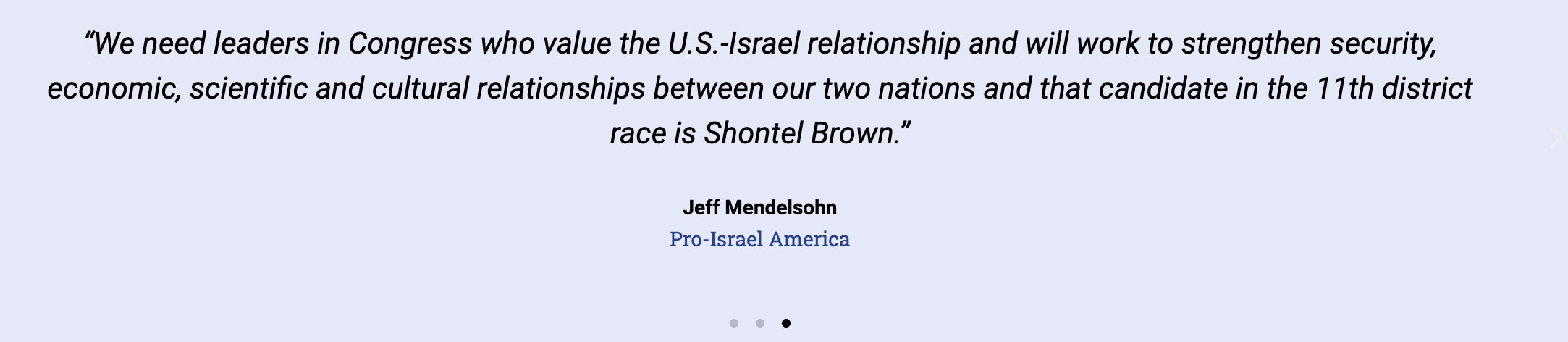
The oppo research that appears on Brown’s website has nothing to do with Turner’s stance on Israel; it doesn’t even mention Israel. The criticisms of Turner revolve around her insufficient loyalty to Democrats: citing her lukewarm support for Biden in the presidential election and her refusal to back Hillary Clinton against Donald Trump. The praise of Brown centers on her local record. Yet just underneath the red box are three rotating quotes validating Brown’s support for Israel. The first is from Mellman, and though he wears many hats — most prominently as head of the Mellman Group, a polling and consulting firm — the site labels him “DMFI PAC President.” DMFI endorsed Brown in February, but has not disclosed any outside spending on her behalf.
Brown for Congress
The second is from Michael Siegal, who previously chaired the Jewish Federations of North America and is a donor to Brown’s campaign.
Brown for Congress
The third is from Jeff Mendelsohn of Pro-Israel America, which was allied in 2020 with Americans for Tomorrow’s Future. Pro-Israel America, the Brown campaign, and DMFI did not respond to requests for comment.
Brown for Congress
That this type of coordinating-without-coordinating has grown so common undermines the core rationale of Citizens United, Lessig said. “The premise of Citizens United, or the whole line of cases that assume there’s such a thing as independent spending, is that there’s independence. Obviously there can be technical independence, but if both sides are building a strategy based on the same data they’re essentially coordinating,” said Lessig, who authored the book “They Don’t Represent Us: Reclaiming Our Democracy.” “In the context of antitrust we’d have no problem understanding it as coordination.”
And because the independence isn’t real, the debt politicians owe to super PACs is real. “What that means is there’s no real separation that would undermine the sense of obligation or sense of gratitude that a member would feel for the super PAC’s intervention,” said Lessig. “There’s no quid pro quo, but there’s a dependence on the super PAC.”
A IS FOR ANTI-ASIAN
A worried Korean American woman recently posted a screenshot of a classroom test her 12 year old sister had sat in school. Multiple choice Q3, reproduced in the image above, offers 3 answers to the question: Which one of these Chinese NORMS is TRUE?
The lesson here is not simply the description of violence designed to frighten children, it is in itself a form of violence.
AND A IS FOR ABSENCE AND BEING AFRAID
A US Department of Education survey published in late March 2021 revealed that 15% of Asian American students were attending school in person full-time in January. That is compared with 49% of white students, 33% of Latino students and 28% of Black students.
B IS FOR BATLEY AND FOR BOMBS
Meanwhile in Batley, UK, schoolchildren in a recent RE lesson on blasphemy were shown the Charlie Hebdo cartoon of the prophet Mohammed wearing a turban designed to look like a bomb. National media showed angry parents gathering outside the school to protest and reported that the teacher concerned was in hiding in fear of his life. Some papers reported the same cartoon had been shown by a different teacher the week before, without protests, and quoted other parents questioning why there was suddenly ‘a fuss’. No one suggested the second appearance of the cartoon in a classroom might feel to an anxious parent like normalization.
Robert Jenrick, the Tory communities secretary, said: “This is a country based on free speech and teachers should be able to tackle difficult and controversial issues in the classroom – and issues should not be censored.”
C IS FOR CRITICAL RACE THEORY
Women and Equalities Minister Kemi Badenoch, speaking in the House of Commons during Black History Month in October 2020 said there was no place in British classrooms for critical race theory, more often referred to in the UK as institutional racism, and that any teacher presenting white privilege as fact would be breaking the law.
It was voted the year’s best speech on the influential website ConservativeHome.
D IS FOR ‘DEFENSE’
Israel Defense Forces. | Screenshot:Twitter.
E IS FOR ENDORSEMENT
‘Schools should not under any circumstances use resources produced by organizations that take extreme political stances on matters. This is the case even if the material itself is not extreme, as the use of it could imply endorsement or support of the organization.’ UK Department for Education, September 2020
Examples cited by the Department include ‘a publicly stated desire to abolish or overthrow democracy, capitalism, or to end free and fair elections.’
F IS FOR THE FUTURE
‘Each generation has the responsibility to teach and train the next generation. You know if we win a few elections, we’re still going to be losing unless we win the hearts and minds of our children. This is the battle. Hitler was right on one thing. He said, “Whoever has the youth has the future”. Our children are being propagandized.’
Mary Miller, entering US Congress as a new Republican Congresswoman, January 2021
G IS FOR ‘GET INVOLVED’
‘The Left continues its relentless attack on America’s founding principles – but we can stop them. Run for your school board or city council. Join a local commission. Get involved in your communities. We ALL must do our part to protect and champion American values.’ Mike Pompeo on Twitter
H IS FOR HISTORICAL FACTS
Publisher Pearson has paused distribution of 2 GCSE textbooks on conflict in the Middle East following a report by 2 academics, which found that hundreds of changes to text, maps, photographs and timelines had been made to the 2020-21 edition, leading to the distortion of historical fact in favour of Israel. The changes were made following an intervention by the Board of Deputies of British Jews and the organization UK Lawyers for Israel.
I IS FOR INTIFADA IN ‘P IS FOR PALESTINE’
A few years ago in 2017, a New York bookshop stocking a popular children’s book ‘P is for Palestine’ was targeted by Zionists demanding removal of the book from its shelves. It removed the book and issued the following apology:
“We regret that we did not fully appreciate the political or communal ramifications of the children’s book ‘P is for Palestine’ by Dr Golbarg Bashi, nor did we anticipate the pain and distress it has caused in our community. We now understand these much better. We oppose terrorism or other forms of violence perpetrated against Israeli civilians during the intifada or thereafter. Any impression from the book to the contrary is not our view. We support Israel’s right to exist. We do not endorse the Boycott, Divestment and Sanctions movement (BDS).”
In 2014 3,800 Palestinian civilians were killed by Israeli strikes on Gaza.
Letter I is for Intifada, defined in the book by a father speaking to his daughter as ‘rising up for what is right’.
J IS FOR A JUST WAY
Debbie Reese, curriculum specialist, speaking to the US National School Boards Association about the teaching of American history: ‘I’d like to see more schools – and more states – mandating that Native curriculum be brought to their students. Montana’s ‘Indian Education for All’ is one example of a state that is educating students in a just way. There’s no excuse for anybody not knowing the names of the Native Nations, whose homeland they stand on, and where the peoples of those nations are today. If school boards asked their pre-k through 12th-grade teachers to begin every lesson on Native peoples with present tense verbs, it could make a difference for all students and people in the school community. Eventually, we won’t have to remind people that we’re here.’
Russian President Vladimir Putin has sent congratulations to fellow members of the Commonwealth of Independent States over their roles in the Allied victory over Nazi Germany in World War II, and called for “brotherly friendship and mutual assistance” to mold their future relations.
The message, delivered on May 8, came as Western Europe celebrated the 76th anniversary of the war and ahead of Moscow’s Victory Day parade scheduled for May 9.
German Chancellor Angela Merkel marked the anniversary with a Twitter message saying that “it remains our everlasting responsibility to keep alive the memory of the millions of people who lost their lives during the years of National Socialist tyranny.”
On May 7, German President Frank-Walter Steinmeier also addressed Nazi crimes, saying: “Confronting National Socialism and the memories of injustice and guilt do not weaken our democracy. On the contrary, it strengthens its resistance and resilience.”
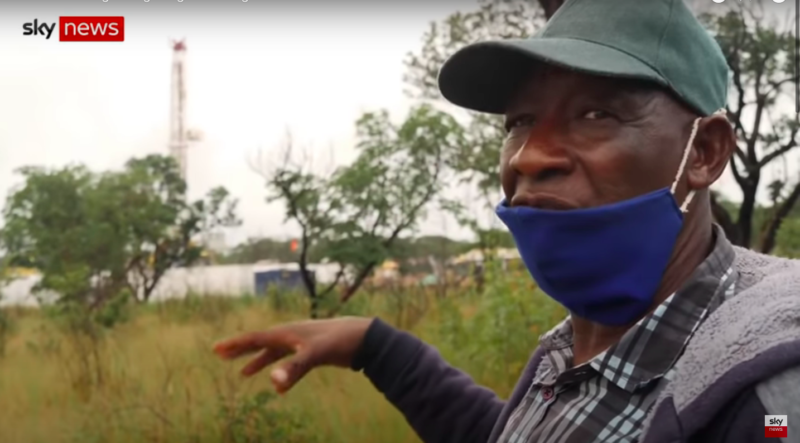
The first Andreas Mawano Limbundi and his family knew of oil exploration in their village in northeast Namibia was as they watched a drilling site being set up about 200 meters from their homestead late last year. Their village — 90 minutes along a potholed dirt road from the town of Rundu on the Namibia-Angola border — was peaceful, with the sounds of birdsong and the wind rustling the tree leaves. Since January 2021, however, that quiet has been shattered by 24-hour drilling. The family has no idea if they will have to leave their home and, if so, whether they will be compensated. They’re also angry that they were not consulted, and skeptical that they will benefit from permanent jobs despite having to live with the test well on their doorstep.
The rig belongs to ReconAfrica, an oil and gas company headquartered in Canada, currently drilling three test wells in the sedimentary Kavango Basin of Namibia. The company has a license for an area of 9,800 square miles, plus an adjacent area in neighboring Botswana — 13,250 square miles in total. According to a 2019 investor presentation obtained by National Geographic, the company’s goal is to drill hundreds of wells under a 25-year production license. Geochemist and ReconAfrica shareholder Daniel Jarvie estimated the basin has the potential to produce as much as 120 billion barrels of oil equivalent, which would make it one of the biggest global oil finds in recent years.
But ReconAfrica’s plans are touching off mounting questions and opposition. The regions of Kavango East and Kavango West are home to 200,000 people — including the indigenous San — making a living from farming, fishing, and tourism. A network of rigs, pipelines, and roads would sprawl across an environmentally sensitive, semi-arid region that is home to Africa’s largest remaining population of savanna elephants as well as numerous threatened or endangered wildlife species. In addition, the drilling — which may involve hydraulic fracturing, or fracking — also would encompass or border national parks and wildlife conservancies, and could threaten waterways that local communities rely on and that eventually flow into the renowned Okavango Delta, a UNESCO World Heritage Site.
Although many of the inhabitants of the region say they do not necessarily oppose oil drilling, they are concerned that they have largely been left in the dark and will not gain financially from the oil play. Despite the scale of the project, the development is shrouded in a cloak of ambiguity. Many Namibians, including environmentalists and even some in government, were surprised when ReconAfrica shipped an exploratory drilling rig to Namibia in late 2020. Though some local traditional leaders say they were consulted, that information often did not filter down to other community leaders or into many Kavango communities.
“They felt that they were not involved, they were hearing over the radio, over social media, in the media about development on their lands,” said Maxi Pia Louis, director of the Namibian Association of Community-Based Natural Resource Management Support Organizations (NACSO), which has been working with Kavango communities seeking guidance on how to ensure they will benefit from the proposed oil drilling. The Kavango is the poorest region of Namibia, with the unemployment rate reaching nearly 50 percent in Kavango East.
The Kavango Basin, which spans northeastern Namibia and northwestern Botswana, is part of the Kalahari Desert. In an otherwise dry environment, the Okavango River (known in Namibia as the Kavango) is a lifeline, flowing from the highlands of Angola, through northern Namibia, and emptying out into the Okavango Delta, in northwest Botswana. ReconAfrica’s license area is home to the Kavango people – five tribal groups who mostly make their living fishing, cattle herding, and farming pearl millet, maize, and sorghum. Alongside agriculture, tourism — including hunting — is one of the main industries, and locals are worried that extensive oil drilling could drive away wildlife — and visitors.
ReconAfrica’s license for oil development covers a 13,250-square-mile area in Namibia and Botswana. RECONAFRICA
The drilling area is also the homeland of the San — otherwise known as Bushmen — a group of many tribes who have historically been victims of genocide and who lost most of their land during the colonial era. Critics of the ReconAfrica development, including a group of Anglican bishops, have declared that the exploration “violates San rights under the UN Declaration on the Rights of Indigenous Peoples.”
“The process has not been an open one, with Namibians waking up to [an oil] venture that has already been signed and settled,” the Bishop of Namibia, Reverend Luke Pato, said in a statement. “There are many questions to be answered.”
South African San youth leader, Craige Q7 Beckett, is worried that San people in remote parts of Namibia and Botswana wouldn’t hear about the oil development until it is too late. With six other San leaders, Beckett walked more than 300 miles in February from the South African town of Knysna to Cape Town, to present the Namibian diplomatic mission with a petition opposing drilling in the Kavango Basin. He’ll soon begin the second stage of his walk, heading into Namibia and Botswana to speak with San communities and assess how the development might affect them.
Driving north from the Namibian capital of Windhoek to the Kavango East capital of Rundu, the scenery shifts from rolling hills — green with the heavy, much-needed recent rains in early 2021 — into dusty plains. Potholes appear along the edges of the tarmac. Donkey carts trundle down the side of the road, along with cows and goats driven by herders. Hawkers hold giant wild mushrooms — omajowa, a seasonal delicacy — aloft to passing vehicles.
Beyond short-term opportunities, the residents of Kavango worry about the state in which ReconAfrica will leave the region. The 2019 environmental impact assessment (EIA) commissioned by ReconAfrica was widely criticized for glossing over potential ecological problems. Experts cited, among other things, the lack of specialist reports pertaining to flora and fauna — for example, the impact of oil drilling on the plants that San communities use as medicine.
After the exploration stage, the development would likely involve building hundreds of wells, pipelines, and pumping stations, all linked by access roads. Such industrialization would inevitably result in habitat fragmentation, affecting creatures large and small that will face road mortality and disruption of hunting territories and migration routes. Critics say the EIA also did not sufficiently address the impact on the Okavango region’s 18,000 elephants; maintaining migration corridors for the elephants is crucial to both their safety and that of villagers. The Kavango region also is home to endangered wild dogs, which require large areas in which to hunt, and cheetahs, which are highly vulnerable to habitat loss and fragmentation.
“ReconAfrica refuses to talk about the bigger picture – what the landscape would look like in the event of an oil find,” Chris Brown, CEO of the Namibian Chamber of Environment — an industry-sponsored organization that works with environmental groups — said in an email. “They focus just on the immediate step. The public wants to know what the likely consequences would be of an oil find and the impacts to the Kavango regions and to the Okavango Basin. ReconAfrica refuses to discuss this.”
A key concern is the impact on the region’s water supplies. Indeed, one of the first test wells was drilled close to the Omatako River, which is linked to the Kavango River and is about 150 miles from the Okavango Delta. A major question is whether ReconAfrica plans to frack for oil and gas, which has a history in the United States — where it is most widely used — of contaminating water and causing health issues. Previously, ReconAfrica CEO Scot Evans and the company have discussed unconventional drilling opportunities — a term often used to refer to fracking — in the Kavango. But the Namibian government has said that no such license has been issued, and ReconAfrica has since scrubbed any “unconventional” mentions from its literature.
Given that water from the region flows into the Okavango delta, “any pollution would be harmful” to the Okavango Basin ecosystem as well as Kavango communities, says Brown.
ReconAfrica has compared the geological conditions in the Kavango to the Karoo Basin in South Africa — an area where fracking has begun for natural gas — and the company seems confident it has found a major petroleum play. Recon Africa has a 90 percent stake in the Kavango development, the first of its kind in Namibia, while the Namibian government holds 10 percent.
Andreas Mawano Limbundi shows Sky News how close ReconAfrica’s test oil well is to his homestead.
SCREENSHOT VIA YOUTUBE
“Who knows what’s going to happen to the Okavango Delta? Will it change the flow direction?” Arkert asks. “I certainly can’t answer that. But are we prepared to take that risk?”
Perhaps of most immediate concern to local communities is ReconAfrica’s opacity. Max Muyemburuko is the chairperson of the Kavango East and West Regional Conservancy and Community Forestry Association. Although ReconAfrica’s license area includes several wildlife conservancies, the first Muyemburuko heard of the development was last November. He said recent meetings have still not revealed anything about potential negative impacts and what ReconAfrica plans to do about them. (ReconAfrica did not responded to Yale Environment 360’s requests for comment, though a spokeswoman told National Geographic that “ReconAfrica will ensure that there is no environmental impact from these wells.”)
Hamweyi village headman Mangundu Reinhardt — who also said he was not consulted or informed about ReconAfrica’s plans — said that he’d heard few complaints because most people simply had no idea what was happening. But Muyemburuko said at least one community member he met was enthusiastic about jobs that might be created and the prospect of greater prosperity in the Kavango region. Some hope ReconAfrica may fix the long dirt road to Kawe, the site of a test drilling well. Currently, the drive is laborious, the road pocked with deep holes, with frequent sections of bone-shaking corrugated ridges. The company has also drilled water wells for the Kawe community.
The lack of job opportunities in the region is one of ReconAfrica’s key arguments for its project. The company said that as of late last year, 44 people were working on at the test drilling site near Kawe village, including 29 Namibians, seven of whom are from the village. Local residents say some women from the area have been hired to work in the kitchen and the other opportunities are one-week contracts for jobs such as digging a vegetable garden.
Civilians stage a silent protest against the drilling in the Kavango Basin in Cape Town, South Africa in March. Jaco Marais/Die Burger/Gallo Images via Getty Images
Some local residents say they are concerned that if full-fledged drilling moves forward, most jobs will be taken by foreigners or people from elsewhere in Namibia who have the necessary skills and experience. But in its publicity materials, ReconAfrica says the development will be an economic boon for the region, and quotes one resident born and raised in Kavango, Taye Reino, attacking environmental opponents as “prophets of doom.”
“Stop with the fear mongering,” Reino is quoted as saying. “This kind of stuff has failed to deliver development to this part of the country.”
Local leaders and residents have not been encouraged by the environmental assessment practitioner who wrote the EIA, Sindila Mwiya of Risk-Based Solutions. Numerous people have accused him of acting hostilely toward anyone questioning ReconAfrica’s activities. After Muyemburuko emailed Mwiya some questions in January, Mwiya — who is supposed to be unbiased in his role — responded by labeling one question about the removal of trees as “stupidity and nonsense of the highest level” and accusing Muyemburuko of “Eurocentric and colonial thinking” in denying people the chance for jobs and regional development.
Muyemburuko says, however, that he does not oppose ReconAfrica’s plans, per se.
“I’m not against the development,” he said. “But the people, the community closest to the area, they have to benefit from this project.”
A heavily armed police raid in the Jacarezinho favela of Rio de Janeiro, Brazil, on Thursday resulted in at least 28 deaths and many wounded. It was the deadliest police raid and the second deadliest massacre in Rio’s history. The police said they were executing arrest and search warrants against alleged drug traffickers. Residents washed away pools of blood after police officers, supported by armored personnel carriers and helicopters, used automatic weapons and explosives into the densely populated residential neighborhood.
Fogo Cruzado, a research institute that tracks armed violence in Rio de Janeiro, reported that 38 people have been killed in Jacarezinho during police raids since July 2016, constituting 83 percent of all gun homicides in the area. Last year, police in the state of Rio killed 1,239 people, an average of three per day, according to official data. Nearly 80 percent of Brazilians killed by Rio’s police are Black and brown, despite representing only about half of the population.
“Yesterday the Civil Police sent a message: The law doesn’t apply to them.”
The raid flouted a Supreme Court ruling last June ordering that police limit violent operations during the coronavirus pandemic, on account of the deaths of many innocent bystanders caught in crossfires. Among the victims Thursday were passengers in a public transit railcar passing nearby that was struck by stray bullets. “Yesterday the Civil Police sent a message: The law doesn’t apply to them,” said Maria Isabel Couto, a director at Fogo Cruzado. (My partner, Cecília Olliveira, is the founder of Fogo Cruzado, and I have done work for the organization.)
Witnesses told The Intercept that at least some of the deaths were the result of police “executions” of unarmed individuals. A police representative told the media on Thursday that one police officer had been killed and the other 24 dead were suspected drug traffickers. “To do an operation like this, there is a lot of planning, and we follow many protocols,” said Ronaldo Oliveira, the police chief responsible for the operation. “We follow certain techniques and police tactics to try hard to avoid confrontations and achieve our objectives. But that is not always the final result.”
On Friday afternoon, Cecília Olliveira reported for El País that, of the 21 suspects targeted by the raid, only three were arrested and three more were killed. The police have not revealed if any of the 13 identified victims who were not targets of the raid had criminal records.
In August 2017, The Intercept covered an intense seven-day police operation in Jacarezinho in response to the death of a police officer. At least five people were killed. Police opened fire from helicopters flying overhead and used snipers.
A similar dynamic may have played out this week, according to Pablo Nunes, a coordinator at Rio’s Center for Studies in Public Security and Citizenship. The police “made it very clear that this was a revenge operation. The 27 deaths occurred after the police officer was shot. This is what the police do, and it’s well documented,” said Nunes on Friday evening, adding that the raid was “repugnant” and “criminal.”
“Since at least 2018, we are living in a political climate of acceptance and even incentivization of this type of behavior,” he said. The election of President Jair Bolsonaro and his allies at the state and local levels, Nunes added, has promoted “a culture of impunity” for police violence.
Video translated by Elias Bresnick.
Assista ao vídeo do The Intercept Brasil aqui, em português.
In a recent tweet, BJP Yuva National Convenor Devang Dave claimed that the Anti-Terror Squad (ATS) arrested two people, including a man named Abu Tahir, for illegal possession of 7 kg of uranium in Nagpada, Mumbai. Devang is also the founder of the Facebook page ‘I Support Narendra Modi’.
BJP supporter and advocate Prashant Patel Umrao also tweeted that the ATS apprehended two individuals, both purportedly Muslims, for illegal possession of uranium. He identified the two accused as Abu Tahir Afzal Hussain and Mohammad Jigar.
News Nation Consulting Editor Deepak Chaurasia identified one accused as Abu Tahir Afzal Hussain and the other as Jigar. Arun Pudur also posted a similar tweet, though he mentioned that the other accused’s name is Jagir.
Twitter user @MeghUpdates wrote that there were two accused, but named only Abu Tahir.
This slideshow requires JavaScript.
The handle @PNRai1 quote-tweeted Chaurasia’s tweet, adding, “Uranium Jihad. Obviously, this wasn’t done out of good intentions. Good that these men were caught in Maharashtra, otherwise liberals and Congress supporters would have spun it as Hindus harassing Muslims.”
Facebook user Sunil Kumar Pandey claimed that three individuals were arrested in this case and all of them hailed from the Muslim community.
Misleading posts add a communal spin
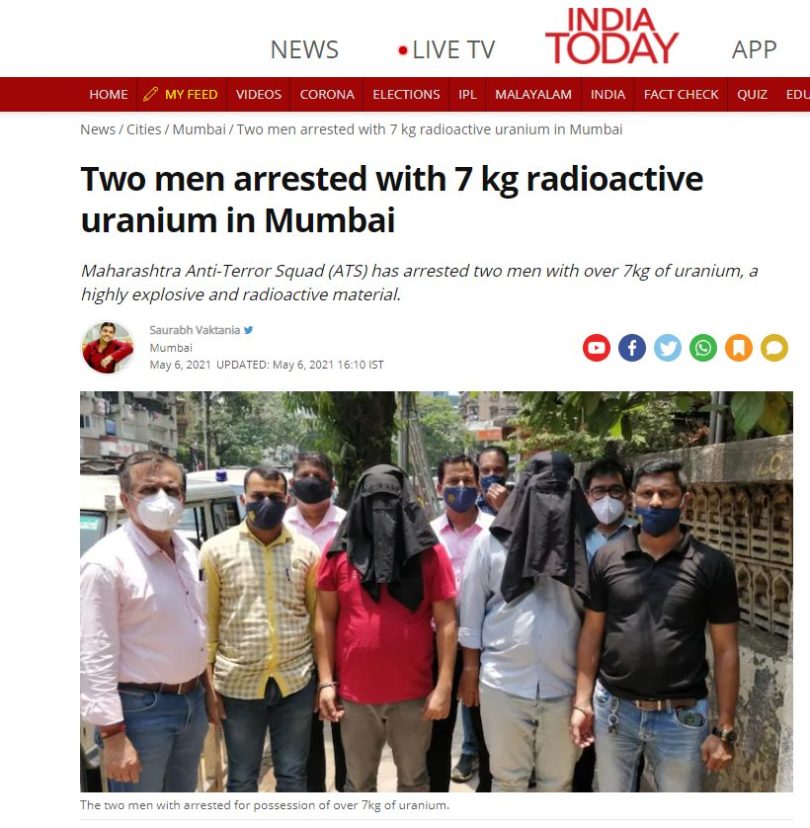
On May 6, ATS officials reported the arrest of two people for illegal possession of 7 kg of uranium worth over Rs. 21 crores in Maharashtra. Uranium is a highly radioactive substance that can prove to be fatal if handled without proper care. India Today reported that on February 14, officials received a tip about a man named Jigar Pandya who was trying to sell pieces of uranium. The police arrested him on the same day. It was found during their investigation that he had obtained the uranium from a Mankhurd resident named Abu Tahir. The police immediately raided Tahir’s home and arrested him as well.
The Wire identified the second accused Abu Tahir as Abu Tahir Afzal Hussain Chaudhary. Meanwhile, News18 reported that his full name was Abu Tahir Hussain Chaudhary.
This slideshow requires JavaScript.
This led to confusion. Since different media outlets reported different names of Abu Tahir, social media users began claiming that there were three accused and not two.
Furthermore, Twitter user @MeghUpdates did not mention Jigar Pandya’s name and Prashant Patel claimed his name was ‘Mohammed’ Jigar thus giving the incident an anti-Muslim spin.
Having a tattoo or an unmarried sister or an Instagram account — all of these things can count against women seeking custody of their children in Russia’s North Caucasus region, where local court decisions often reflect communities’ beliefs that children belong to the father’s side of the family.
In Muslim-majority Chechnya and Ingushetia, and to a lesser extent, Daghestan, deep-seated customs dictate that children go to the father’s side of family following a divorce. And while Russian federal law has demonstrated its preference for such children to stay with their mothers, city and district courts in the North Caucasus often go their own way in the name of tradition.
The issue is the subject of an extensive report by Current Time that tells the stories of several women struggling to wrest their children from a firmly established patriarchal system.
Nina Tseretilova’s efforts to be reunited with her three children have been thwarted for more than a year, despite the overturning of a local court’s decision to deny her custody because of her “lifestyle.”
Nina Tseretilova
In taking her kids away from her in July, Daghestan’s Kirovsky District Court was apparently swayed by testimony from Tseretilova’s ex-husband, Magomed Tseretilov, who argued that she had created an “unhealthy” moral and psychological environment for bringing up children.
As evidence, he presented photographs and videos from his ex-wife’s Instagram page in which she had conversations about “sex” and unconventional relations, and the court record noted that tattoos were visible on her body.
Tseretilova’s underage children, meanwhile, testified that she had hosted parties at which young people had smoked and consumed alcohol. The court was shown a music video by the Dagestani group Duet 11 in which Tseretilova plays a prominent role.
For her part, Tseretilova testified that she had married her ex-husband when she was 18 and that from the beginning he periodically beat her. She said she left him after he beat her while she was pregnant with their third child.
The court, taking into account the established traditions of Russia and of the Republic of Daghestan, determined that Tseretilova led a lifestyle “that does not correspond to the behavioral norms and rules of the majority,” and granted custody to her ex-husband.
Tseretilova, who tells Current Time that her ex-husband had “decided to punish” her after she pursued payment of alimony following their divorce in 2016, took the case to Daghestan’s Supreme Court.
But even though the high court ruled in her favor in March, her children have still not been handed over.
Zhanetta Tukhayeva has been working to get her eldest son back in an ordeal she says began seven years ago when her ex-husband, Ruslan Ibayev, kidnapped the boy for the first time, leaving their younger son with her only because she was still breastfeeding him.
Zhanetta Tukhayeva
In March 2020, the Leninsky District Court in the Chechen capital of Grozny ruled in favor of Ibayev, saying that both the couple’s sons should live with their father and that her parental rights be limited.
Ibayev’s argument in the case he initiated against Tukhayeva stressed the importance of “adats” — customary practices observed by Muslims in the North Caucasus — and cited her “divorced sisters” and “silicone lips” among reasons to deny her custody.
In its ruling, the court noted that Ibayev was an attentive father whose “social behavior was “completely based on the norms of Islam and Chechen traditions.”
It also backed Ibayev’s complaint about comments Tukhayeva made on Instagram in which she criticized the court proceedings as “laughable.” She wrote that her religious beliefs prevented her from getting any cosmetic procedures and accused her husband “of slinging mud and trying to intimidate her.”
The court, saying the post “shows what kind of person she is,” ordered her to delete her account.
The decisions were completely overturned just four months later by the Chechen Supreme Court, and Ibayev’s petition to appeal was denied. But Tukhayeva still has not been reunited with her eldest son and does not know where he lives.
Russian Islamic scholar Akhmet Yarlykapov explained that tradition- and religion-bound beliefs influence North Caucasus communities’ views on custody issues, particularly those involving women who married outside their clan.
“Following a divorce, the woman leaves for her father’s house, leaves for that clan. The children are considered to belong to the family of their father and, accordingly, remain in his family,” Yarlykapov told Current Time, the Russian-language network overseen by RFE/RL in cooperation with VOA. “With the grandmother, with an uncle, with anyone — but on the father’s side.”
In custody disputes, the influence of Shari’a law often leads the local court to side with the father’s family, according to Yarlykapov.
Olga Gnezdilova, a lawyer for the Legal Initiative project, which helps people file cases with the European Court of Human Rights (ECHR), said that in these cases it is common for local courts to scrutinize the “moral character” of the mother.
Gnezdilova says her organization has taken on many such cases from the North Caucasus. She highlighted multiple instances in which the fathers had died, yet local courts awarded custody to the deceased male’s families.
The lawyer added that Russian courts, referring to the 1959 UN Declaration on the Rights of the Child, have repeatedly enforced the declaration’s article stating that young children should not be separated from their mothers except in exceptional circumstances.
But while Russia does not officially recognize Shari’a law or adats, in practice Islamic law and tradition often compete against Russian secular law in the North Caucasus.
Gnezdilova said that while “regional judges have no legal basis to rely on in such decisions, they know that the Supreme Court of the Russian Federation does not like to review decisions about family disputes in the North Caucasus.”
She says that in some cases Russian judicial authorities have effectively upheld decisions by lower courts in the North Caucasus to deny the mother custody in favor of the father’s family.
In one example, Luiza Tapayeva’s four daughters were taken away by her husband’s family in Chechnya after his death in 2015. When she sued for custody, claiming that her four daughters had been kidnapped by their grandfather, the Urus-Martan city court decided the children should remain with the grandfather.
To the Legal Initiative’s surprise, Gnezdilova said, “the Supreme Court of Russia upheld this decision, even though the parents have a priority right in the upbringing of their children.”
The Russian government has been obligated in such cases to argue at the ECHR that the mothers’ rights had not been violated by the courts’ reliance on local customs.
“If the Russian authorities in an international court argue that the mother’s rights were not violated by deferring to tradition,” Gnezdilova asked, “then what can we expect from district judges?”
RFE/RL senior correspondent Michael Scollon contributed to this report
In the black and white TV schedule of the late 1950s and early 1960s, the Western drama series reigned supreme. One of the most popular was ‘Have Gun, Will Travel’, starring Richard Boone as a mercenary in the late 1800s. It helped to popularise the role of the lone gunman and boost the US gun rights culture. Indeed, the term, “have gun, will travel” entered the popular lexicon and has been often quoted since.
A recent example was in the latest issue of the US military monthly, ‘Air Force’, the magazine of the Air Force Association, with the title ‘Have Bombs, Will Travel’, which is grimly indicative of a specific trend in US military thinking after two decades of the failed ‘war on terror’.
It concerns a newly developed way of moving planes and bombs rapidly to sudden hot spots if the US Air Force doesn’t have sufficient bombs in place to do what is thought necessary. It is known as agile combat employment and uses what are normally very sophisticated and powerful aircraft in a secondary role as weapons transporters.
In a recent mission, six F-15E Strike Eagle aircraft of the 494th Expeditionary Fighter Squadron flew from the RAF base at Lakenheath in England to Al Dhafra, 30 kilometres south of Abu Dhabi in the UAE. Ferrying operations are pretty standard if a squadron is on the move but usually the planes would be unarmed, with the weapons sent out separately in large military transport aircrafts such as the C-17.
Loaded to the gills
However, on this occasion the six aircraft were not only armed but loaded to the gills with twice the amount of ‘smart’ bombs usually sent in such situations. This required extra crew skills and logistical support, not least with additional air-to-air refuelling, but it meant that the six planes could, between them, move 72 of the powerful, GPS-guided Joint Direct Attack Munitions in a single rapid operation.
This immediately raises the question, why go to that trouble and expense when the US Air Force already has access to bases from Europe to the Middle East, sub-Saharan Africa, Central Asia and the Western Pacific?
For the official answer, an article in the defence publication, ‘Defense News’, put it this way: “China and Russia can increasingly hold overseas US bases at risk. To adapt, the Air Force must evolve from its dependence on well-established airfields, or risk yielding an operational edge. Beijing’s asymmetric arsenal includes thousands of ballistic and cruise missiles capable of striking the first and second island chains of the Western Pacific. Moscow also boasts an immense quantity of ballistic and cruise missiles that easily range all of Europe.
“The Air Force is especially vulnerable to these threats because of its reliance on prepared airfields. While the service can overcome some disadvantages with long-range bombers, a war in which missiles knock out American air bases and prevent the ability to launch and recover short-range fighter jets is unlikely to end well.”
The reasoning above contextualises the development of the agile combat employment concept within the US’s long-standing rivalry with China and Russia, but that is too simple a reading. The US has plenty of more reasons to increase its weapon load in the Middle East, when you consider that its wars with Afghanistan, Iraq and Libya have all gone badly wrong, and it is withdrawing from Afghanistan as the Taliban sets its sights on taking over the country.