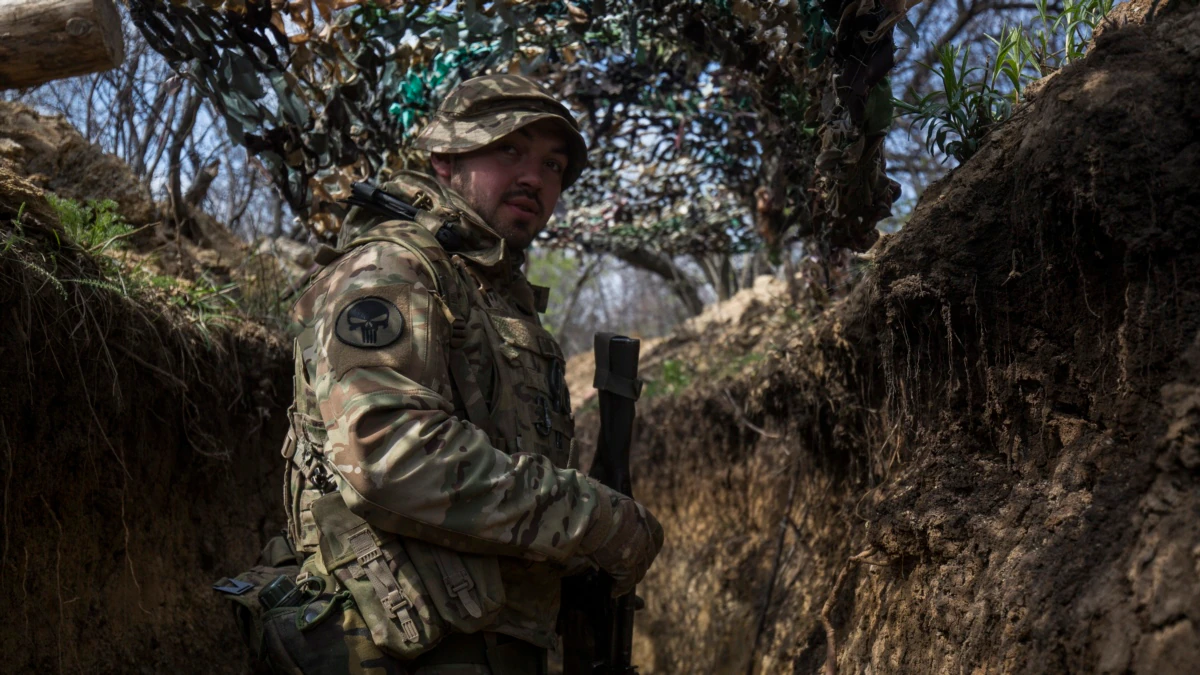
Russia’s Interior Ministry says that some 527,000 people in parts of eastern Ukraine where Moscow-backed separatist formations are waging a war against Kyiv have been granted Russian citizenship over the past two days.

The ministry’s press service made the announcement on May 2 to the state news agency TASS.

Earlier, Russia had issued 650,000 new passports in the region after President Vladimir Putin in 2019 issued an order for a simplified and expedited citizenship process for residents of those areas.

Moscow’s policy of handing out citizenship in Ukraine has come under intense international criticism as a bid to further destabilize the area, where more than 13,000 people have been killed since the fighting started in April 2014.

Ukraine has condemned the Russian naturalization of Ukrainian citizens as part of a hybrid-warfare campaign being waged by Moscow and a violation of Ukraine’s sovereignty.

Russia has provided military, economic, and political support to the separatists in parts of Ukraine’s Luhansk and Donetsk regions. Despite overwhelming evidence to the contrary, Moscow maintains it is not involved in Ukraine’s domestic affairs.

The developments come at a time of heightened tensions between Russia and Ukraine in recent weeks, when Russia launched a major military buildup along its border with Ukraine and in the Black Sea Ukrainian region of Crimea, which Moscow annexed in 2014.

On April 8, Putin’s deputy chief of staff, Dmitry Kozak, said Russia could “be forced to come to the defense” of Russian citizens in Ukraine, a statement that was repeated the following day by Kremlin spokesman Dmitry Peskov.

In November 2020, Peskov said, “Russia has always protected and will continue to protect the interests of Russians, regardless of where they live.”

Viktor Vodolatsky, deputy chairman of the Russian State Duma’s Committee on CIS Affairs and Eurasian Integration, told TASS on April 24 that Russia could issue up to 1 million new passports to Ukrainians by the end of the year.

On March 20, a Russian presidential decree came into force banning non-Russian citizens from owning land in most of Crimea.

“The European Union does not recognize the illegal annexation of the Crimean Peninsula by Russia, which is a clear violation of international law,” said an EU statement at the time.

“Therefore the European Union does not recognize this decree and considers its entry into force as yet another attempt to forcibly integrate the illegally annexed peninsula into Russia.”
With reporting by TASS, UNIAN, and The Atlantic

Turkmenistan has the fourth-largest reserves of natural gas in the world and many years ago was touted by its first president as being destined to become a second Kuwait.

Turkmenistan has now become a country where people stand in long lines for rations of bread, dig through garbage for scraps and things they might possibly be able to sell, while the government celebrates horses and dogs.

Turkmenistan’s economy has been in dire shape for more than half a decade now and the standard of living for the country’s people continues to drop.

And recently, current President Gurbanguly Berdymukhammedov has been guiding his son Serdar up the hierarchy of the government leading to speculation the presidency will be passed from father to son and the mismanagement that characterizes the Turkmen government will continue for another generation.

On this week’s Majlis Podcast, RFE/RL Media-Relations Manager Muhammad Tahir moderates a discussion that looks at the deterioration of Turkmenistan.

This week’s guests are: from the Netherlands, Ruslan Myatiev, the head of the Turkmen.news website; from Prague, Farruh Yusupov, the director of RFE/RL’s Turkmen Service, known locally as Azatlyk; and Bruce Pannier, the author of RFE/RL’s Qishloq Ovozi blog.

Listen to the podcast above or subscribe to the Majlis on iTunes or on Google Podcasts.

Turkmenistan has the fourth-largest reserves of natural gas in the world and many years ago was touted by its first president as being destined to become a second Kuwait.

Turkmenistan has now become a country where people stand in long lines for rations of bread, dig through garbage for scraps and things they might possibly be able to sell, while the government celebrates horses and dogs.

Turkmenistan’s economy has been in dire shape for more than half a decade now and the standard of living for the country’s people continues to drop.

And recently, current President Gurbanguly Berdymukhammedov has been guiding his son Serdar up the hierarchy of the government leading to speculation the presidency will be passed from father to son and the mismanagement that characterizes the Turkmen government will continue for another generation.

On this week’s Majlis Podcast, RFE/RL Media-Relations Manager Muhammad Tahir moderates a discussion that looks at the deterioration of Turkmenistan.

This week’s guests are: from the Netherlands, Ruslan Myatiev, the head of the Turkmen.news website; from Prague, Farruh Yusupov, the director of RFE/RL’s Turkmen Service, known locally as Azatlyk; and Bruce Pannier, the author of RFE/RL’s Qishloq Ovozi blog.

Listen to the podcast above or subscribe to the Majlis on iTunes or on Google Podcasts.

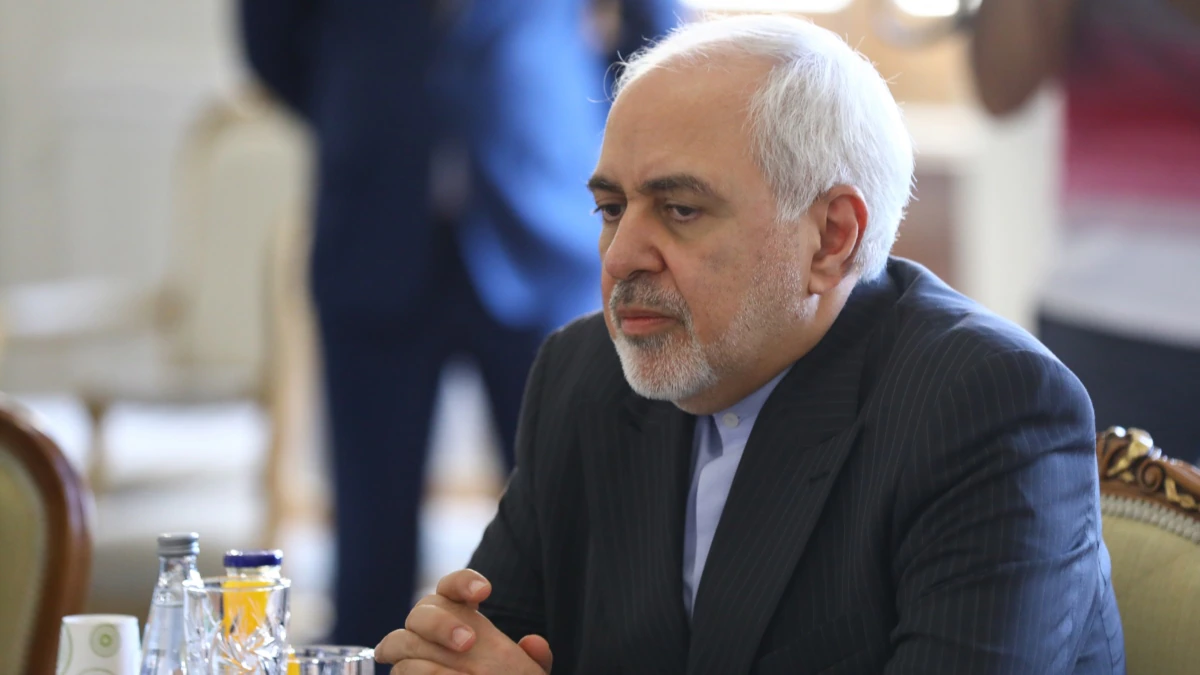
Embattled Iranian Foreign Minister Mohammad Javad Zarif has apologized for comments he made in a recording that was leaked last week in which he criticized the Islamic Revolutionary Guards Corps (IRGC) and the powerful late General Qasem Soleimani.

Zarif wrote on Instagram on May 2 that he hoped Soleimani’s family and the Iranian people would forgive him for the controversial comments.

The leaked recordings have touched off a firestorm in Iran less than two months ahead of a presidential election. On the recording, Zarif criticizes the IRGC’s involvement in diplomacy and charges that Soleimani maintained separate relations with Russia.

He also criticized his lack of influence within the country’s theocratic political system, saying that he was often left in the dark on important foreign-policy decisions.

Soleimani was killed by a U.S. drone strike near Baghdad in 2020 and, since then, has been lionized in Iran as a martyr. Prosecutors in Tehran have launched a criminal investigation into the leak, while hard-liners have accused Zarif of “betrayal” and the “defamation” of Soleimani.

The leaked audio was from an interview with Zarif that was recorded on February 24 as part of an “oral history” series, the interviewer, prominent economist Saeed Laylaz, said in an audio file that was posted online.

Zarif can be heard repeatedly saying his comments are not for publication.

After the disclosure, the Foreign Ministry said the most controversial excerpts were taken out of context from a seven-hour conversation.

Zarif has said he does not plan to participate in the June presidential election. In the past he has been often mentioned as a possible challenger to the hard-line faction.

Russia has long been one of Iran’s closest allies and has consistently supported Tehran at the United Nations. Moscow called the assassination of Soleimani a “reckless step” that threatened regional stability.

On April 28, Zarif posted on Instagram a video of himself visiting the memorial to his “longtime friend” Soleimani in Baghdad. He wrote that he favored a “smart adjustment” between the diplomatic and military spheres in Tehran.

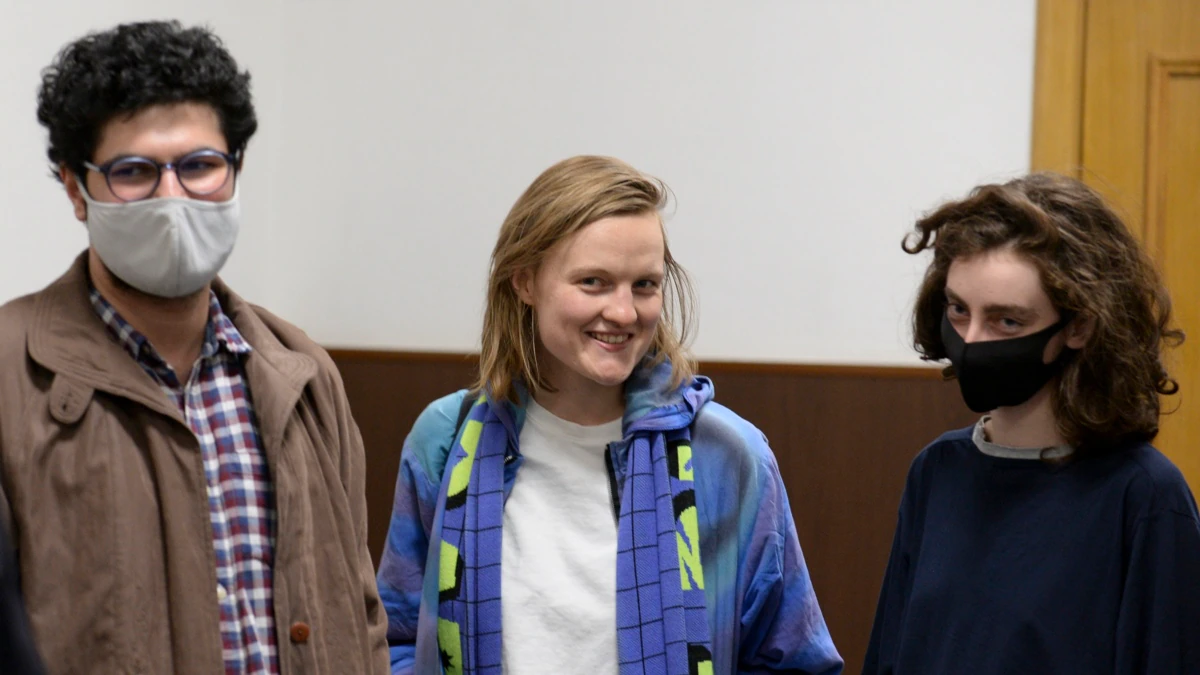
MOSCOW — A Moscow court has increased from one minute to two hours the time allowed outside each day for three of the four editors of the student magazine Doxa, who are accused of “engaging minors in actions that might be dangerous” over a video related to unsanctioned rallies protesting opposition politician Aleksei Navalny’s incarceration.

The Moscow City Court on April 26 upheld a lower court’s decision to impose pretrial restrictions for Armen Aramyan, Vladimir Metyolkin, and Natalya Tyshkevich, but mitigated the restrictions, ruling that the trio is allowed outside for two hours daily from 8 a.m. to 10 a.m.

A decision on the appeal of the fourth editor in the case, Alla Gutnikova, is expected to be made by the court on April 28.

On April 14, the Basmanny district court in the Russian capital ordered the four editors not to leave their homes between midnight and 11:59 p.m. for two months, giving them only one minute to be outside each day.

The four were detained for questioning at the Investigation Committee after their homes and the magazine’s offices were searched over the video, which the magazine posted online in January.

The video questioned teachers’ moves to warn students about possible repercussions they could face for participating in unsanctioned rallies on January 23 and January 31 in protest of Navalny’s arrest.

Doxa editors say the video was deleted from the magazine’s website following a demand from Russian media watchdog Roskomnadzor to remove it.

More than 10,000 supporters of Navalny were detained across Russia during and after the January rallies. Many of the detained men and women were either fined or handed several-day jail terms. At least 90 were charged with criminal offenses and several have been fired by their employers.

Human rights groups have called on Moscow repeatedly to stop targeting journalists because they are covering the protests or express solidarity with protesters since both are protected under the right to freedom of expression.

“Instead of targeting journalists, the authorities should hold accountable police who attack journalists and interfere with their work,” Human Rights Watch said in a statement on February 3.

Navalny was detained at a Moscow airport on January 17 upon his arrival from Germany, where he was recovering from a poisoning, which several European laboratories concluded was a military-grade chemical nerve agent, in Siberia in August 2020.

Navalny has insisted that his poisoning was ordered directly by President Vladimir Putin, which the Kremlin has denied.

In February, a Moscow court ruled that while in Germany, Navalny had violated the terms of parole from an old embezzlement case that is widely considered as being politically motivated. Navalny’s 3 1/2 year suspended sentence from the case was converted to a jail term, though the court said he will serve 2 1/2 years in prison given the amount of time he had been held in detention.

The state prosecutor spearheading a potentially devastating bid to brand Aleksei Navalny’s network of organizations “extremist” is no stranger to the Kremlin foe: In 2019, a report by Navalny’s Anti-Corruption Foundation (FBK) alleged that the lawman’s family controlled undeclared property worth millions of dollars.

The plaintiff in the case under which the FBK, the Citizens’ Rights Defense Foundation (FPZG), and Navalny’s offices nationwide could be declared extremist is the head of the Moscow city prosecutor’s office, Denis Popov.

Popov’s signature also stands at the bottom of an April 26 order freezing the activities of Navalny’s network of regional branches pending the outcome of the Moscow City Court’s closed-door hearings. His office has also asked the court to do the same with the FBK and the FPZG.

The “extremism” case is not the first time Popov and Navalny have clashed. Popov, 48, was named Moscow prosecutor by President Vladimir Putin in September 2019. Previously, he served as chief prosecutor in the Siberian region of Khakasia and the North Caucasus republic of Daghestan.

Popov was the lead prosecutor in the so-called “Moscow case” in 2019, in which several would-be candidates for Moscow district council seats and their supporters were prosecuted for participating in peaceful protests.

‘Lawful Lawlessness’

Popov “personally initiates cases against oppositionists at the behest of the National Guard,” the FBK report published in November 2019 stated. “The Moscow prosecutor plays a very important role in the listing of all sorts of ‘foreign agents.’ Any lawlessness that you run into in Moscow can be declared lawful by Prosecutor Popov.”

Weeks before the report was published, Popov had filed a suit against the FBK and its leadership, including Navalny, seeking reimbursement of nearly 5 million rubles ($67,000) for costs Moscow purportedly incurred during two unsanctioned protests earlier that year. In particular, Popov tried unsuccessfully to seize Navalny’s modest Moscow apartment.

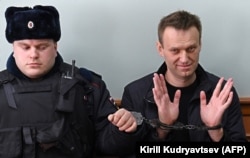
Kremlin critic Aleksei Navalny at one of his many court hearings in recent years. (file photo)


Kremlin critic Aleksei Navalny at one of his many court hearings in recent years. (file photo)

The FBK report, which featured video and text, provided evidence it said linked Popov and his family to undeclared property in Russia and abroad.

The report found that a Montenegrin company controlled by Popov’s ex-wife, Irina Popova, owned a lakeside apartment complex and other real estate worth, according to a financial document filed in Montenegro in 2018, more than 3 million euros.

‘Money From Who-Knows-Where’

The company was created in 2009 and owned all the property at least as early as 2011, when the Popovs were still married.

“All these Montenegrin investments were planned and made by the family of a working prosecutor, bureaucrat, and guardian of the law,” Navalny’s report stated. “With money that came from who-knows-where.”

According to asset declarations filed in Russia during this period, Popov was earning 58,000 rubles ($1,900) a month and his wife was “unemployed.”

Irina Popova also allegedly purchased an apartment in Spain in 2010 for 645,000 euros. And she purportedly owns a fishing resort in southern Russia’s Astrakhan region.

After searching through social media, Navalny’s investigators unearthed and published photographs of the Popovs and their children at all of the properties they identified.

Navalny’s investigators also found a lavish home in the elite stretch of Moscow suburbs known as Rublyovka registered in the name of Popov’s elderly mother, Lyudmila Popova.

After Navalny’s report was published, two Moscow city council deputies, Communist Yelena Shuvalyova and Yabloko party member Maksim Kruglov, appealed to Putin to investigate the allegations against Popov.

In apparent response, Kremlin spokesman Dmitry Peskov assured journalists that Popov’s declarations had been “subjected to serious scrutiny.” He added, however, that the presidential administration might take a second look if it was deemed necessary.

Like the rest of the FBK’s investigations into official corruption in Russia, no probe was launched into the findings about Popov.

In her 2014 book Putin’s Kleptocracy, the late American political scientist Karen Dawisha identified the perversion of the law enforcement system — and particularly the prosecutor’s office — as a key feature of Putin’s political model.

She found that “in the 10 years from 2002 to 2012, hundreds of thousands of businessmen were actually imprisoned, not just questioned or arrested, primarily as a result of rivals paying corrupt police, prosecutors, and judges to put away the competition.”

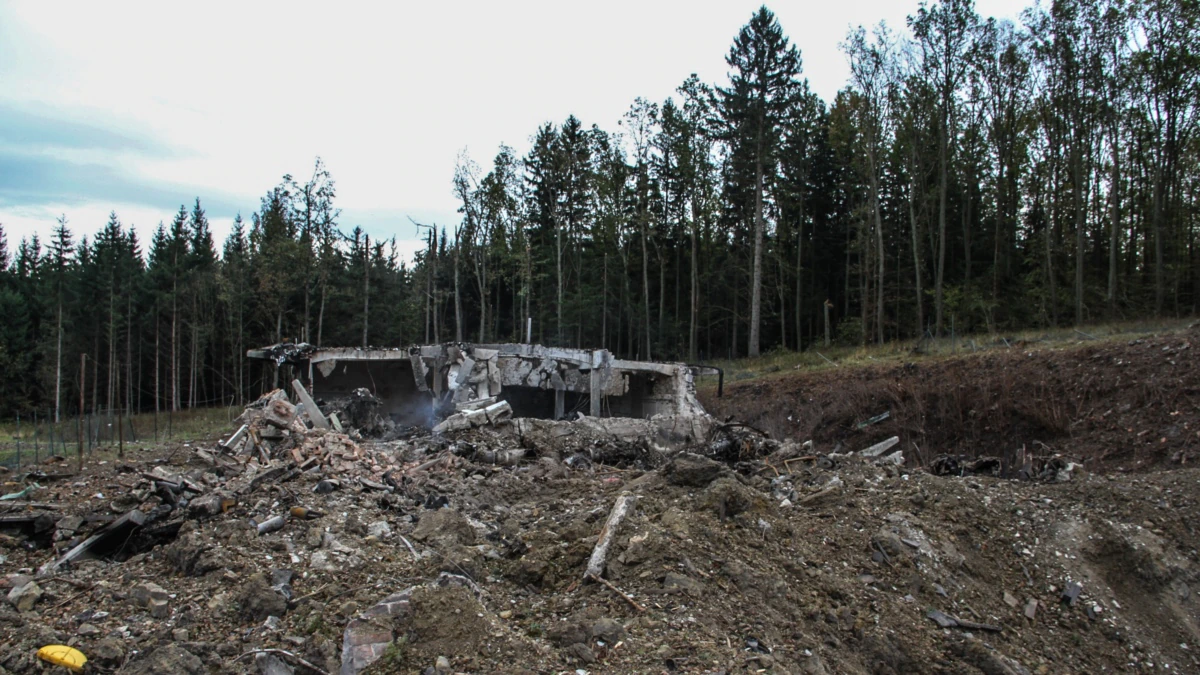
The Czech government on April 26 reiterated that evidence linking Russian GRU military intelligence to arms depot explosions in 2014 is “very convincing,” after President Milos Zeman cast doubt over allegations that have sparked a deep diplomatic rift with Russia.

Zeman, who is known for being sympathetic toward Moscow, said during a televised address to the nation on April 25 that there are two theories about what caused the explosion of a munitions depot near the eastern Czech town of Vrbetice in 2014.

He said that one version of events is that Russian intelligence was involved in the deadly explosion.

The other version, he said, was that the blast was caused by inexpert handling of ammunition.

“I take both lines [of investigation] seriously and I wish that they are thoroughly investigated,” Zeman said.

Prime Minister Andrej Babis on April 17 announced that investigators from the Czech intelligence and security services had provided “unequivocal evidence” that there was “reasonable suspicion regarding a role of members of Russian military intelligence GRU’s unit 29155 in the explosion of the munition depot in Vrbetice in 2014.”

In response, the Czech government announced the expulsion of 18 Russian diplomats it considered to be spies, setting off a string of tit-for-tat moves between Prague and Moscow.

GRU Involvement

Citing the report by the Czech Security Information Service, Zeman said that there was “neither proof nor evidence” that the two Russian GRU agents being sought regarding possible involvement in the explosion were at the arms depot.

“I hope that we will determine the truth and find out whether this suspicion [of Russian intelligence involvement] is justified,” Zeman said. “If that is the case — although I support fair relations with all important countries — the Russian Federation would have to pay the price of this presumed terrorist act.”

In response to Zeman’s comments, Deputy Prime Minister Jan Hamacek, who is also the interior minister, said information from intelligence, police, and investigators on the 2014 blasts was strong.

“As the Czech Republic we reacted very hard, so it is apparent the evidence was very convincing,” Hamacek said at a April 26 news conference.

“As far as I know, only one line of investigation exists on the Vrbetice case and that is the one connected with movements of those members of the [GRU] unit 29155,” Hamacek said.

“The president’s speech was such that everybody found something in it to please them including the Russian Federation, unfortunately,” he added.

Zeman, whose powers as president are largely ceremonial, has often expressed pro-Russian views and is seen as being friendly toward Moscow.

The explosion on October 16, 2014 in Vrbetice set off 50 tons of stored ammunition, killing two people. Two months later, another blast of 13 tons of ammunition occurred at the same site.

The Kremlin has denied any involvement in the incident, which has triggered anti-Russia protests in the Czech Republic.

More protests are planned for April 29 in Prague and other cities, this time also taking aim at Zeman for his position on Russia.

Czech media has reported that the ammunition and weaponry destroyed in the first Vrbetice blast was intended for Ukrainian forces fighting against Russia-backed separatist troops in eastern Ukraine.

The two Russian intelligence officers sought in relation to the explosion are the same GRU officers accused of a nerve-agent poisoning in England in 2018 that targeted former Russian double agent Sergei Skripal and his daughter.

With reporting by Reuters

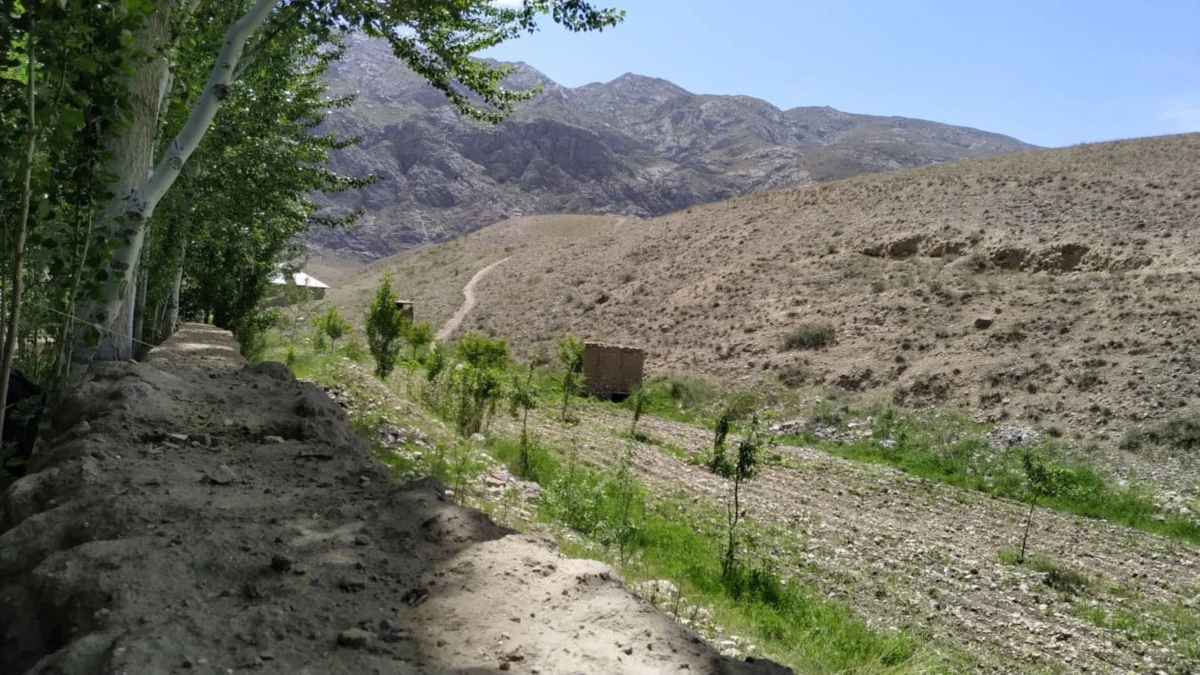
BISHKEK — Kyrgyzstan’s Foreign Ministry has summoned the Tajik ambassador and handed him a note protesting the detainment of two Kyrgyz men by Tajik authorities near a disputed segment of the border between the two countries.

The ministry said on April 26 that Deputy Foreign Minister Nurlan Niyazaliev met with Tajik Ambassador Nazirmad Alizoda to express his concerns over the detainment of the two residents of Kyrgyzstan’s southern Batken region.

“The Kyrgyz side has called upon the Tajik side to undertake immediate measures to find out all of the circumstances of the incident, hold all individuals responsible for the situation accountable, and inform the Kyrgyz side about the results,” the ministry said in a statement.

The statement added that Bishkek is ready to cooperate with Dushanbe in efforts to “form conditions in the areas close to the border to secure peace, safety, a friendly neighborhood, and stability.”

The two Kyrgyz nationals disappeared in the Batken region’s Leilek district on April 24 while constructing a house close to a disputed segment of border.

It later turned out that the missing men had been detained by Tajik law enforcement.

On April 25, the men were released and handed to Kyrgyzstan.

Earlier in April, Tajik President Emomali Rahmon said during his visit to Tajikistan’s Vorukh exclave within Kyrgyzstan that agreements on almost half of the Tajik-Kyrgyz border have been reached during more than 100 rounds of negotiations between Dushanbe and Bishkek since work on border delimitation started in 2002.

Many border areas in Central Asia’s former Soviet republics have been disputed since the collapse of the Soviet Union in 1991.

The situation is particularly complicated near the numerous exclaves in the volatile Ferghana Valley, where the borders of Kyrgyzstan, Tajikistan, and Uzbekistan meet.

In recent years there have been numerous incidents along the border which in some cases involved deadly gunfire.

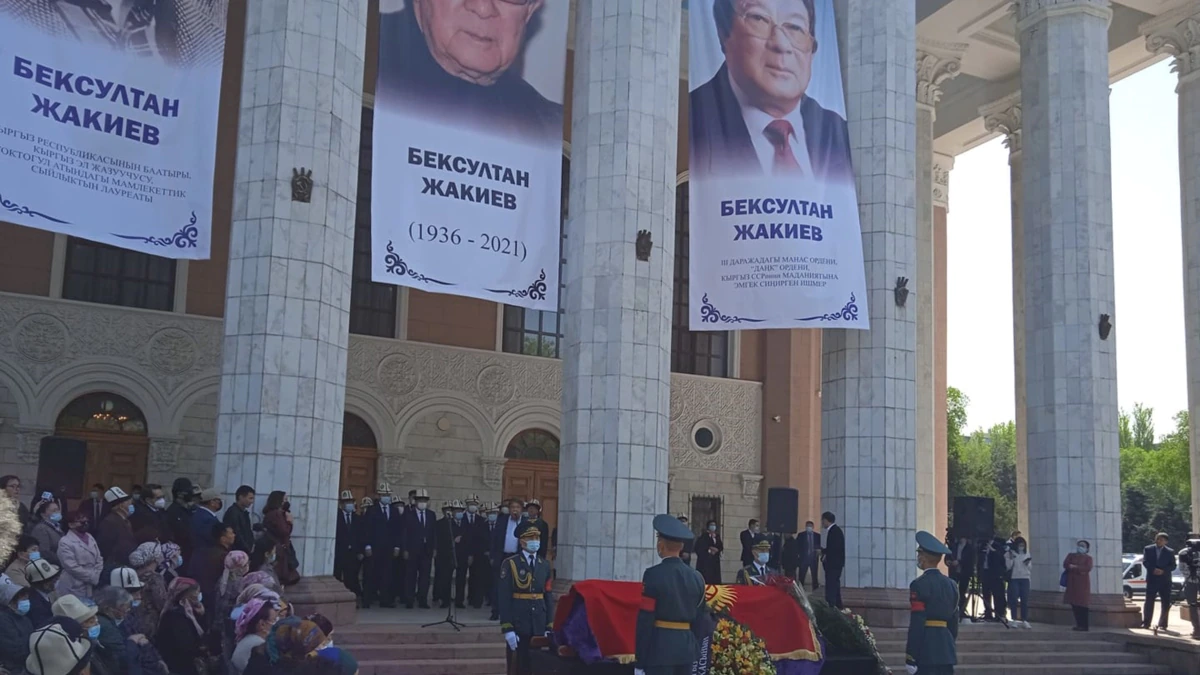
BISHKEK — Thousands of people have paid their last respects to to Kyrgyz writer and journalist Beksultan Jakiev, who died at the age of 85 after a long unspecified illness on April 25.

Prime Minister Ulukbek Maripov, Parliament Speaker Talant Mamytov, former President Sooronbai Jeenbekov, and other officials attended the farewell ceremony on April 26 at Bishkek’s Opera and Ballet Theater.

President Sadyr Japarov’s letter of condolence to the late writer’s relatives, friends, and colleagues was read aloud at the ceremony.

Jakiev was known for his books and articles about Kyrgyz culture and history as well as about modern Kyrgyzstan and Central Asia.

One of his most popular books was about the history of RFE/RL’s Kyrgyz Service, known locally as Radio Azattyk, and its long-time Cold War-era director Azamat Altay.

Jakiev was the recipient of numerous national awards and titles, including Hero of Kyrgyzstan, for his contribution to the former Soviet republic’s literature, culture, and journalism.

A journalist from Siberia who had to leave her native city of Kiselyovsk in the Siberian region of Kemerovo earlier this year after she was attacked says she has fled Russia fearing for her safety.

Natalya Zubkova, the chief editor of the News of Kiselyovsk website, told RFE/RL on April 26 that she moved to an unspecified country a week ago after police and an investigator from Kiselyovsk visited her at her new residence in the Urals city of Yekaterinburg to question her as “a witness” in a criminal case.

Zubkova said she refused to answer any questions and called her lawyer. According to her, the case might be an another move in ongoing attempts by Kiselyovsk authorities to take her daughter from her in retaliation for her articles criticizing authorities in the Kemerovo region for the “illegal widening of coal-mining territories” in the region.

In late February, Zubkova said an unknown attacker pushed her down with her face in snow as she was walking her dog. The man threatened the journalist and her daughters with further violence if “you open your mouth again.”

Several days after the attack, Zubkova fled Kiselyovsk for Yekaterinburg, hoping that authorities in her native region will leave her alone.

Russia’s Investigative Committee said on April 6 that it had sent an investigator to Yekaterinburg to question Zubkova in the case.

Zubkova told RFE/RL on April 26 that she will continue her journalistic activities, writing about the rights of Siberia’s indigenous ethnic groups, environmental damage from mining activities in the region, and corruption among officials in Kiselyovsk.

Last August, lawyer Anton Reutov physically attacked her in a courtroom during a hearing based on Zubkova’s report about alleged fraud involving Reutov that led to an elderly woman losing her apartment.

Zubkova said that following that incident she received several death threats.

In August 2019, Mayor Shkarabeinikov accused Zubkova of inciting social discord for interviewing Kiselyovsk residents who had asked Canadian Prime Minister Justin Trudeau and the UN Secretary-General Antonio Guterres to provide them with asylum after local authorities were unable to solve environmental problems they faced.