This story was originally published by Yale Environment 360 and is reproduced here as part of the Climate Desk collaboration.

The first Andreas Mawano Limbundi and his family knew of oil exploration in their village in northeast Namibia was as they watched a drilling site being set up about 200 meters from their homestead late last year. Their village — 90 minutes along a potholed dirt road from the town of Rundu on the Namibia-Angola border — was peaceful, with the sounds of birdsong and the wind rustling the tree leaves. Since January 2021, however, that quiet has been shattered by 24-hour drilling. The family has no idea if they will have to leave their home and, if so, whether they will be compensated. They’re also angry that they were not consulted, and skeptical that they will benefit from permanent jobs despite having to live with the test well on their doorstep.

The rig belongs to ReconAfrica, an oil and gas company headquartered in Canada, currently drilling three test wells in the sedimentary Kavango Basin of Namibia. The company has a license for an area of 9,800 square miles, plus an adjacent area in neighboring Botswana — 13,250 square miles in total. According to a 2019 investor presentation obtained by National Geographic, the company’s goal is to drill hundreds of wells under a 25-year production license. Geochemist and ReconAfrica shareholder Daniel Jarvie estimated the basin has the potential to produce as much as 120 billion barrels of oil equivalent, which would make it one of the biggest global oil finds in recent years.

But ReconAfrica’s plans are touching off mounting questions and opposition. The regions of Kavango East and Kavango West are home to 200,000 people — including the indigenous San — making a living from farming, fishing, and tourism. A network of rigs, pipelines, and roads would sprawl across an environmentally sensitive, semi-arid region that is home to Africa’s largest remaining population of savanna elephants as well as numerous threatened or endangered wildlife species. In addition, the drilling — which may involve hydraulic fracturing, or fracking — also would encompass or border national parks and wildlife conservancies, and could threaten waterways that local communities rely on and that eventually flow into the renowned Okavango Delta, a UNESCO World Heritage Site.

Although many of the inhabitants of the region say they do not necessarily oppose oil drilling, they are concerned that they have largely been left in the dark and will not gain financially from the oil play. Despite the scale of the project, the development is shrouded in a cloak of ambiguity. Many Namibians, including environmentalists and even some in government, were surprised when ReconAfrica shipped an exploratory drilling rig to Namibia in late 2020. Though some local traditional leaders say they were consulted, that information often did not filter down to other community leaders or into many Kavango communities.

“They felt that they were not involved, they were hearing over the radio, over social media, in the media about development on their lands,” said Maxi Pia Louis, director of the Namibian Association of Community-Based Natural Resource Management Support Organizations (NACSO), which has been working with Kavango communities seeking guidance on how to ensure they will benefit from the proposed oil drilling. The Kavango is the poorest region of Namibia, with the unemployment rate reaching nearly 50 percent in Kavango East.

The Kavango Basin, which spans northeastern Namibia and northwestern Botswana, is part of the Kalahari Desert. In an otherwise dry environment, the Okavango River (known in Namibia as the Kavango) is a lifeline, flowing from the highlands of Angola, through northern Namibia, and emptying out into the Okavango Delta, in northwest Botswana. ReconAfrica’s license area is home to the Kavango people – five tribal groups who mostly make their living fishing, cattle herding, and farming pearl millet, maize, and sorghum. Alongside agriculture, tourism — including hunting — is one of the main industries, and locals are worried that extensive oil drilling could drive away wildlife — and visitors.

ReconAfrica’s license for oil development covers a 13,250-square-mile area in Namibia and Botswana. RECONAFRICA

The drilling area is also the homeland of the San — otherwise known as Bushmen — a group of many tribes who have historically been victims of genocide and who lost most of their land during the colonial era. Critics of the ReconAfrica development, including a group of Anglican bishops, have declared that the exploration “violates San rights under the UN Declaration on the Rights of Indigenous Peoples.”

“The process has not been an open one, with Namibians waking up to [an oil] venture that has already been signed and settled,” the Bishop of Namibia, Reverend Luke Pato, said in a statement. “There are many questions to be answered.”

South African San youth leader, Craige Q7 Beckett, is worried that San people in remote parts of Namibia and Botswana wouldn’t hear about the oil development until it is too late. With six other San leaders, Beckett walked more than 300 miles in February from the South African town of Knysna to Cape Town, to present the Namibian diplomatic mission with a petition opposing drilling in the Kavango Basin. He’ll soon begin the second stage of his walk, heading into Namibia and Botswana to speak with San communities and assess how the development might affect them.

Driving north from the Namibian capital of Windhoek to the Kavango East capital of Rundu, the scenery shifts from rolling hills — green with the heavy, much-needed recent rains in early 2021 — into dusty plains. Potholes appear along the edges of the tarmac. Donkey carts trundle down the side of the road, along with cows and goats driven by herders. Hawkers hold giant wild mushrooms — omajowa, a seasonal delicacy — aloft to passing vehicles.

Beyond short-term opportunities, the residents of Kavango worry about the state in which ReconAfrica will leave the region. The 2019 environmental impact assessment (EIA) commissioned by ReconAfrica was widely criticized for glossing over potential ecological problems. Experts cited, among other things, the lack of specialist reports pertaining to flora and fauna — for example, the impact of oil drilling on the plants that San communities use as medicine.

After the exploration stage, the development would likely involve building hundreds of wells, pipelines, and pumping stations, all linked by access roads. Such industrialization would inevitably result in habitat fragmentation, affecting creatures large and small that will face road mortality and disruption of hunting territories and migration routes. Critics say the EIA also did not sufficiently address the impact on the Okavango region’s 18,000 elephants; maintaining migration corridors for the elephants is crucial to both their safety and that of villagers. The Kavango region also is home to endangered wild dogs, which require large areas in which to hunt, and cheetahs, which are highly vulnerable to habitat loss and fragmentation.

“ReconAfrica refuses to talk about the bigger picture – what the landscape would look like in the event of an oil find,” Chris Brown, CEO of the Namibian Chamber of Environment — an industry-sponsored organization that works with environmental groups — said in an email. “They focus just on the immediate step. The public wants to know what the likely consequences would be of an oil find and the impacts to the Kavango regions and to the Okavango Basin. ReconAfrica refuses to discuss this.”

A key concern is the impact on the region’s water supplies. Indeed, one of the first test wells was drilled close to the Omatako River, which is linked to the Kavango River and is about 150 miles from the Okavango Delta. A major question is whether ReconAfrica plans to frack for oil and gas, which has a history in the United States — where it is most widely used — of contaminating water and causing health issues. Previously, ReconAfrica CEO Scot Evans and the company have discussed unconventional drilling opportunities — a term often used to refer to fracking — in the Kavango. But the Namibian government has said that no such license has been issued, and ReconAfrica has since scrubbed any “unconventional” mentions from its literature.

Given that water from the region flows into the Okavango delta, “any pollution would be harmful” to the Okavango Basin ecosystem as well as Kavango communities, says Brown.

ReconAfrica has compared the geological conditions in the Kavango to the Karoo Basin in South Africa — an area where fracking has begun for natural gas — and the company seems confident it has found a major petroleum play. Recon Africa has a 90 percent stake in the Kavango development, the first of its kind in Namibia, while the Namibian government holds 10 percent.
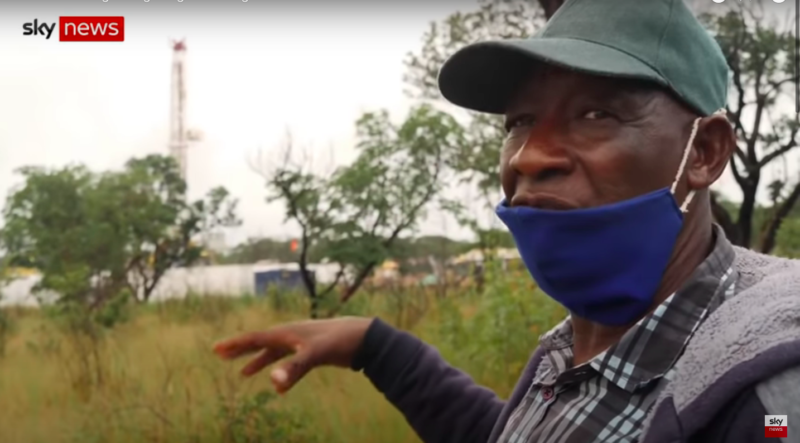
Andreas Mawano Limbundi shows Sky News how close ReconAfrica’s test oil well is to his homestead.
SCREENSHOT VIA YOUTUBE

“Who knows what’s going to happen to the Okavango Delta? Will it change the flow direction?” Arkert asks. “I certainly can’t answer that. But are we prepared to take that risk?”

Perhaps of most immediate concern to local communities is ReconAfrica’s opacity. Max Muyemburuko is the chairperson of the Kavango East and West Regional Conservancy and Community Forestry Association. Although ReconAfrica’s license area includes several wildlife conservancies, the first Muyemburuko heard of the development was last November. He said recent meetings have still not revealed anything about potential negative impacts and what ReconAfrica plans to do about them. (ReconAfrica did not responded to Yale Environment 360’s requests for comment, though a spokeswoman told National Geographic that “ReconAfrica will ensure that there is no environmental impact from these wells.”)

Hamweyi village headman Mangundu Reinhardt — who also said he was not consulted or informed about ReconAfrica’s plans — said that he’d heard few complaints because most people simply had no idea what was happening. But Muyemburuko said at least one community member he met was enthusiastic about jobs that might be created and the prospect of greater prosperity in the Kavango region. Some hope ReconAfrica may fix the long dirt road to Kawe, the site of a test drilling well. Currently, the drive is laborious, the road pocked with deep holes, with frequent sections of bone-shaking corrugated ridges. The company has also drilled water wells for the Kawe community.

The lack of job opportunities in the region is one of ReconAfrica’s key arguments for its project. The company said that as of late last year, 44 people were working on at the test drilling site near Kawe village, including 29 Namibians, seven of whom are from the village. Local residents say some women from the area have been hired to work in the kitchen and the other opportunities are one-week contracts for jobs such as digging a vegetable garden.
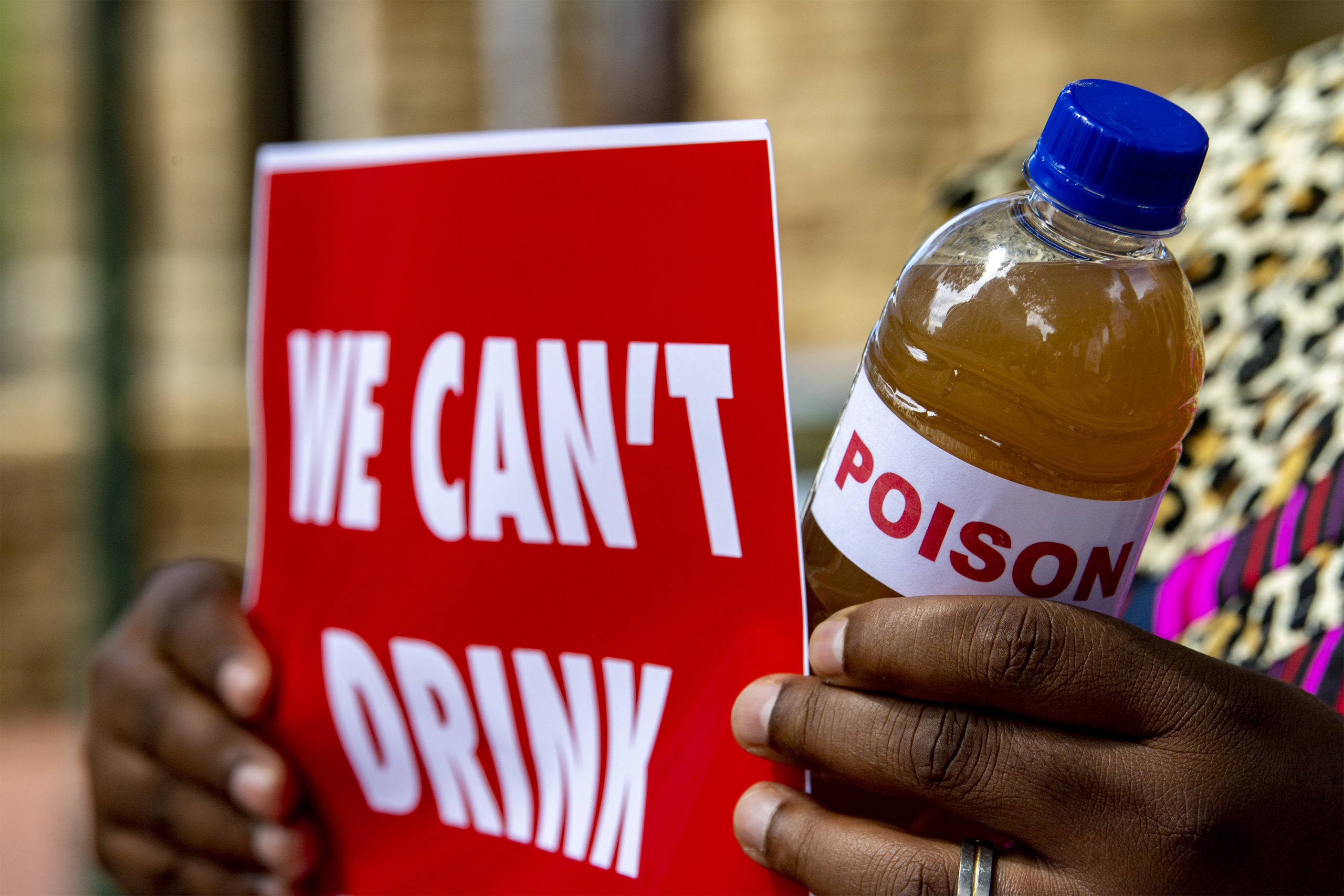
A picture of a sign that reads "WE CAN'T DRINK" and a bottle of dirty water with a "poison" label on it held by a person at a silent protest against the drilling in the Kavango Basin on the steps of St. George's Cathedral.
Civilians stage a silent protest against the drilling in the Kavango Basin in Cape Town, South Africa in March. Jaco Marais/Die Burger/Gallo Images via Getty Images

Some local residents say they are concerned that if full-fledged drilling moves forward, most jobs will be taken by foreigners or people from elsewhere in Namibia who have the necessary skills and experience. But in its publicity materials, ReconAfrica says the development will be an economic boon for the region, and quotes one resident born and raised in Kavango, Taye Reino, attacking environmental opponents as “prophets of doom.”

“Stop with the fear mongering,” Reino is quoted as saying. “This kind of stuff has failed to deliver development to this part of the country.”

Local leaders and residents have not been encouraged by the environmental assessment practitioner who wrote the EIA, Sindila Mwiya of Risk-Based Solutions. Numerous people have accused him of acting hostilely toward anyone questioning ReconAfrica’s activities. After Muyemburuko emailed Mwiya some questions in January, Mwiya — who is supposed to be unbiased in his role — responded by labeling one question about the removal of trees as “stupidity and nonsense of the highest level” and accusing Muyemburuko of “Eurocentric and colonial thinking” in denying people the chance for jobs and regional development.

Muyemburuko says, however, that he does not oppose ReconAfrica’s plans, per se.

“I’m not against the development,” he said. “But the people, the community closest to the area, they have to benefit from this project.”


How does accountability for police officers really work? Join reporters for a live digital event on what they learned from inside the insular world of policing — and what it means for you.

This event is sponsored by McKinsey & Company.

Sign up for ProPublica’s weekly newsletter: http://propub.li/2oyN8DY
Follow ProPublica on Twitter: http://propub.li/1fFfkwy
Follow ProPublica on Facebook: http://propub.ca/1EIvjjF

A heavily armed police raid in the Jacarezinho favela of Rio de Janeiro, Brazil, on Thursday resulted in at least 28 deaths and many wounded. It was the deadliest police raid and the second deadliest massacre in Rio’s history. The police said they were executing arrest and search warrants against alleged drug traffickers. Residents washed away pools of blood after police officers, supported by armored personnel carriers and helicopters, used automatic weapons and explosives into the densely populated residential neighborhood.

Fogo Cruzado, a research institute that tracks armed violence in Rio de Janeiro, reported that 38 people have been killed in Jacarezinho during police raids since July 2016, constituting 83 percent of all gun homicides in the area. Last year, police in the state of Rio killed 1,239 people, an average of three per day, according to official data. Nearly 80 percent of Brazilians killed by Rio’s police are Black and brown, despite representing only about half of the population.

“Yesterday the Civil Police sent a message: The law doesn’t apply to them.”

The raid flouted a Supreme Court ruling last June ordering that police limit violent operations during the coronavirus pandemic, on account of the deaths of many innocent bystanders caught in crossfires. Among the victims Thursday were passengers in a public transit railcar passing nearby that was struck by stray bullets. “Yesterday the Civil Police sent a message: The law doesn’t apply to them,” said Maria Isabel Couto, a director at Fogo Cruzado. (My partner, Cecília Olliveira, is the founder of Fogo Cruzado, and I have done work for the organization.)

Witnesses told The Intercept that at least some of the deaths were the result of police “executions” of unarmed individuals. A police representative told the media on Thursday that one police officer had been killed and the other 24 dead were suspected drug traffickers. “To do an operation like this, there is a lot of planning, and we follow many protocols,” said Ronaldo Oliveira, the police chief responsible for the operation. “We follow certain techniques and police tactics to try hard to avoid confrontations and achieve our objectives. But that is not always the final result.”

On Friday afternoon, Cecília Olliveira reported for El País that, of the 21 suspects targeted by the raid, only three were arrested and three more were killed. The police have not revealed if any of the 13 identified victims who were not targets of the raid had criminal records.

In August 2017, The Intercept covered an intense seven-day police operation in Jacarezinho in response to the death of a police officer. At least five people were killed. Police opened fire from helicopters flying overhead and used snipers.

A similar dynamic may have played out this week, according to Pablo Nunes, a coordinator at Rio’s Center for Studies in Public Security and Citizenship. The police “made it very clear that this was a revenge operation. The 27 deaths occurred after the police officer was shot. This is what the police do, and it’s well documented,” said Nunes on Friday evening, adding that the raid was “repugnant” and “criminal.”

“Since at least 2018, we are living in a political climate of acceptance and even incentivization of this type of behavior,” he said. The election of President Jair Bolsonaro and his allies at the state and local levels, Nunes added, has promoted “a culture of impunity” for police violence.

Video translated by Elias Bresnick.

Assista ao vídeo do The Intercept Brasil aqui, em português.

In a recent tweet, BJP Yuva National Convenor Devang Dave claimed that the Anti-Terror Squad (ATS) arrested two people, including a man named Abu Tahir, for illegal possession of 7 kg of uranium in Nagpada, Mumbai. Devang is also the founder of the Facebook page ‘I Support Narendra Modi’.

BJP supporter and advocate Prashant Patel Umrao also tweeted that the ATS apprehended two individuals, both purportedly Muslims, for illegal possession of uranium. He identified the two accused as Abu Tahir Afzal Hussain and Mohammad Jigar.

News Nation Consulting Editor Deepak Chaurasia identified one accused as Abu Tahir Afzal Hussain and the other as Jigar. Arun Pudur also posted a similar tweet, though he mentioned that the other accused’s name is Jagir.

Twitter user @MeghUpdates wrote that there were two accused, but named only Abu Tahir.

This slideshow requires JavaScript.

The handle @PNRai1 quote-tweeted Chaurasia’s tweet, adding, “Uranium Jihad. Obviously, this wasn’t done out of good intentions. Good that these men were caught in Maharashtra, otherwise liberals and Congress supporters would have spun it as Hindus harassing Muslims.”

Facebook user Sunil Kumar Pandey claimed that three individuals were arrested in this case and all of them hailed from the Muslim community.

Misleading posts add a communal spin

On May 6, ATS officials reported the arrest of two people for illegal possession of 7 kg of uranium worth over Rs. 21 crores in Maharashtra. Uranium is a highly radioactive substance that can prove to be fatal if handled without proper care. India Today reported that on February 14, officials received a tip about a man named Jigar Pandya who was trying to sell pieces of uranium. The police arrested him on the same day. It was found during their investigation that he had obtained the uranium from a Mankhurd resident named Abu Tahir. The police immediately raided Tahir’s home and arrested him as well.

The Wire identified the second accused Abu Tahir as Abu Tahir Afzal Hussain Chaudhary. Meanwhile, News18 reported that his full name was Abu Tahir Hussain Chaudhary.

This slideshow requires JavaScript.

This led to confusion. Since different media outlets reported different names of Abu Tahir, social media users began claiming that there were three accused and not two.

Furthermore, Twitter user @MeghUpdates did not mention Jigar Pandya’s name and Prashant Patel claimed his name was ‘Mohammed’ Jigar thus giving the incident an anti-Muslim spin.

Having a tattoo or an unmarried sister or an Instagram account — all of these things can count against women seeking custody of their children in Russia’s North Caucasus region, where local court decisions often reflect communities’ beliefs that children belong to the father’s side of the family.

In Muslim-majority Chechnya and Ingushetia, and to a lesser extent, Daghestan, deep-seated customs dictate that children go to the father’s side of family following a divorce. And while Russian federal law has demonstrated its preference for such children to stay with their mothers, city and district courts in the North Caucasus often go their own way in the name of tradition.

The issue is the subject of an extensive report by Current Time that tells the stories of several women struggling to wrest their children from a firmly established patriarchal system.

Nina Tseretilova’s efforts to be reunited with her three children have been thwarted for more than a year, despite the overturning of a local court’s decision to deny her custody because of her “lifestyle.”

Nina Tseretilova


Nina Tseretilova

In taking her kids away from her in July, Daghestan’s Kirovsky District Court was apparently swayed by testimony from Tseretilova’s ex-husband, Magomed Tseretilov, who argued that she had created an “unhealthy” moral and psychological environment for bringing up children.

As evidence, he presented photographs and videos from his ex-wife’s Instagram page in which she had conversations about “sex” and unconventional relations, and the court record noted that tattoos were visible on her body.

Tseretilova’s underage children, meanwhile, testified that she had hosted parties at which young people had smoked and consumed alcohol. The court was shown a music video by the Dagestani group Duet 11 in which Tseretilova plays a prominent role.

For her part, Tseretilova testified that she had married her ex-husband when she was 18 and that from the beginning he periodically beat her. She said she left him after he beat her while she was pregnant with their third child.

The court, taking into account the established traditions of Russia and of the Republic of Daghestan, determined that Tseretilova led a lifestyle “that does not correspond to the behavioral norms and rules of the majority,” and granted custody to her ex-husband.

Tseretilova, who tells Current Time that her ex-husband had “decided to punish” her after she pursued payment of alimony following their divorce in 2016, took the case to Daghestan’s Supreme Court.

But even though the high court ruled in her favor in March, her children have still not been handed over.

Zhanetta Tukhayeva has been working to get her eldest son back in an ordeal she says began seven years ago when her ex-husband, Ruslan Ibayev, kidnapped the boy for the first time, leaving their younger son with her only because she was still breastfeeding him.

Zhanetta Tukhayeva


Zhanetta Tukhayeva

In March 2020, the Leninsky District Court in the Chechen capital of Grozny ruled in favor of Ibayev, saying that both the couple’s sons should live with their father and that her parental rights be limited.

Ibayev’s argument in the case he initiated against Tukhayeva stressed the importance of “adats” — customary practices observed by Muslims in the North Caucasus — and cited her “divorced sisters” and “silicone lips” among reasons to deny her custody.

In its ruling, the court noted that Ibayev was an attentive father whose “social behavior was “completely based on the norms of Islam and Chechen traditions.”

It also backed Ibayev’s complaint about comments Tukhayeva made on Instagram in which she criticized the court proceedings as “laughable.” She wrote that her religious beliefs prevented her from getting any cosmetic procedures and accused her husband “of slinging mud and trying to intimidate her.”

The court, saying the post “shows what kind of person she is,” ordered her to delete her account.

The decisions were completely overturned just four months later by the Chechen Supreme Court, and Ibayev’s petition to appeal was denied. But Tukhayeva still has not been reunited with her eldest son and does not know where he lives.

Russian Islamic scholar Akhmet Yarlykapov explained that tradition- and religion-bound beliefs influence North Caucasus communities’ views on custody issues, particularly those involving women who married outside their clan.

“Following a divorce, the woman leaves for her father’s house, leaves for that clan. The children are considered to belong to the family of their father and, accordingly, remain in his family,” Yarlykapov told Current Time, the Russian-language network overseen by RFE/RL in cooperation with VOA. “With the grandmother, with an uncle, with anyone — but on the father’s side.”


In custody disputes, the influence of Shari’a law often leads the local court to side with the father’s family, according to Yarlykapov.

Olga Gnezdilova, a lawyer for the Legal Initiative project, which helps people file cases with the European Court of Human Rights (ECHR), said that in these cases it is common for local courts to scrutinize the “moral character” of the mother.

Gnezdilova says her organization has taken on many such cases from the North Caucasus. She highlighted multiple instances in which the fathers had died, yet local courts awarded custody to the deceased male’s families.

The lawyer added that Russian courts, referring to the 1959 UN Declaration on the Rights of the Child, have repeatedly enforced the declaration’s article stating that young children should not be separated from their mothers except in exceptional circumstances.

But while Russia does not officially recognize Shari’a law or adats, in practice Islamic law and tradition often compete against Russian secular law in the North Caucasus.

Gnezdilova said that while “regional judges have no legal basis to rely on in such decisions, they know that the Supreme Court of the Russian Federation does not like to review decisions about family disputes in the North Caucasus.”

She says that in some cases Russian judicial authorities have effectively upheld decisions by lower courts in the North Caucasus to deny the mother custody in favor of the father’s family.

In one example, Luiza Tapayeva’s four daughters were taken away by her husband’s family in Chechnya after his death in 2015. When she sued for custody, claiming that her four daughters had been kidnapped by their grandfather, the Urus-Martan city court decided the children should remain with the grandfather.

To the Legal Initiative’s surprise, Gnezdilova said, “the Supreme Court of Russia upheld this decision, even though the parents have a priority right in the upbringing of their children.”

The Russian government has been obligated in such cases to argue at the ECHR that the mothers’ rights had not been violated by the courts’ reliance on local customs.

“If the Russian authorities in an international court argue that the mother’s rights were not violated by deferring to tradition,” Gnezdilova asked, “then what can we expect from district judges?”

RFE/RL senior correspondent Michael Scollon contributed to this report

In the black and white TV schedule of the late 1950s and early 1960s, the Western drama series reigned supreme. One of the most popular was ‘Have Gun, Will Travel’, starring Richard Boone as a mercenary in the late 1800s. It helped to popularise the role of the lone gunman and boost the US gun rights culture. Indeed, the term, “have gun, will travel” entered the popular lexicon and has been often quoted since.

A recent example was in the latest issue of the US military monthly, ‘Air Force’, the magazine of the Air Force Association, with the title ‘Have Bombs, Will Travel’, which is grimly indicative of a specific trend in US military thinking after two decades of the failed ‘war on terror’.

It concerns a newly developed way of moving planes and bombs rapidly to sudden hot spots if the US Air Force doesn’t have sufficient bombs in place to do what is thought necessary. It is known as agile combat employment and uses what are normally very sophisticated and powerful aircraft in a secondary role as weapons transporters.

In a recent mission, six F-15E Strike Eagle aircraft of the 494th Expeditionary Fighter Squadron flew from the RAF base at Lakenheath in England to Al Dhafra, 30 kilometres south of Abu Dhabi in the UAE. Ferrying operations are pretty standard if a squadron is on the move but usually the planes would be unarmed, with the weapons sent out separately in large military transport aircrafts such as the C-17.

Loaded to the gills

However, on this occasion the six aircraft were not only armed but loaded to the gills with twice the amount of ‘smart’ bombs usually sent in such situations. This required extra crew skills and logistical support, not least with additional air-to-air refuelling, but it meant that the six planes could, between them, move 72 of the powerful, GPS-guided Joint Direct Attack Munitions in a single rapid operation.

This immediately raises the question, why go to that trouble and expense when the US Air Force already has access to bases from Europe to the Middle East, sub-Saharan Africa, Central Asia and the Western Pacific?

For the official answer, an article in the defence publication, ‘Defense News’, put it this way: “China and Russia can increasingly hold overseas US bases at risk. To adapt, the Air Force must evolve from its dependence on well-established airfields, or risk yielding an operational edge. Beijing’s asymmetric arsenal includes thousands of ballistic and cruise missiles capable of striking the first and second island chains of the Western Pacific. Moscow also boasts an immense quantity of ballistic and cruise missiles that easily range all of Europe.

“The Air Force is especially vulnerable to these threats because of its reliance on prepared airfields. While the service can overcome some disadvantages with long-range bombers, a war in which missiles knock out American air bases and prevent the ability to launch and recover short-range fighter jets is unlikely to end well.”

The reasoning above contextualises the development of the agile combat employment concept within the US’s long-standing rivalry with China and Russia, but that is too simple a reading. The US has plenty of more reasons to increase its weapon load in the Middle East, when you consider that its wars with Afghanistan, Iraq and Libya have all gone badly wrong, and it is withdrawing from Afghanistan as the Taliban sets its sights on taking over the country.

Two Russian nationals are among four men who have pleaded guilty to cybercrimes that targeted banks and companies across the United States, resulting in millions of dollars of losses, the Justice Department said on May 7.

The four men — Aleksandr Grichishkin, 34, and Andrei Skvortsov, 34, of Russia; Aleksandr Skorodumov, 33, of Lithuania; and Pavel Stassi, 30, of Estonia — provided so-called “bulletproof hosting” services to a network of cybercriminals, according to court documents.

The bulletproof hosting operation rented Internet Protocol (IP) addresses, servers, and domains to cybercriminal clients who in turn used the technical infrastructure to disseminate malware that could gain access to victims’ computers and steal banking credentials, the Justice Department said in a news release.

“Over the course of many years, the defendants facilitated the transnational criminal activity of a vast network of cybercriminals throughout the world by providing them a safe-haven to anonymize their criminal activity,” said Special Agent in Charge Timothy Waters of the FBI’s Detroit Field Office.

The malware hosted by the organization attacked U.S. companies and financial institutions between 2009 and 2015, the Justice Department said.

Acting Assistant Attorney General Nicholas L. McQuaid said organizations that aid cybercriminals in deploying malware are “no less responsible for the harms these malware campaigns cause, and we are committed to holding them accountable.”

According to court filings and statements made by the defendants, Grichishkin and Skvortsov were founding members of the operation and its proprietors.

All four pleaded guilty to one count of conspiring to engage in a Racketeer Influenced Corrupt Organization (RICO) in U.S. District Court in Michigan. Each defendant faces a maximum penalty of 20 years in prison at their sentencing hearing later this year.

Law enforcement partners in Germany, Estonia, and the United Kingdom assisted the FBI in its investigation.

U.S. prosecutors said they were seeking a 17-year prison sentence for a former U.S. Army Green Beret who pleaded guilty last year to years of providing classified information to a Russian military intelligence agent.

The filing on May 7 in U.S. federal court in Virginia follows Peter Debbins’s guilty plea last November to a federal Espionage Act charge.

According to the court filing, Debbins, 46, had a 15-year relationship with Russian intelligence dating back to 1996 when he was an exchange student from the University of Minnesota and on a visit to Russia for an independent study program gave an alleged Russian handler the names of four Roman Catholic nuns he had visited in Russia.

Two years prior, according to U.S. prosecutors, Debbins, whose mother was born in the Soviet Union, traveled to Russia for the first time and met his current wife in the central city of Chelyabinsk. Debbins’s father-in-law was a colonel in the Russian air force.

Debbins told Russian intelligence he considered himself a “son of Russia,” and “thought that the United States was too dominant in the world and needed to be cut down to size,” according to the indictment filed last year.

Court filings show that Debbins joined the U.S. Army as an active duty officer in 1998 and served through 2005, the last two years as a Special Forces officer.

While on assignment in Azerbaijan, he was discharged and lost his security clearance after violating protocols. That included bringing his wife with him to Azerbaijan and allowing her to use a government-issued cell phone, according to the court filing.

After being discharged from the military, he worked as a civilian for U.S. military contractors, in some cases in counterintelligence, including work as a Russian linguist.

The original charging indictment alleged that he provided information and names of his fellow Special Forces members while he was on assignment in Azerbaijan and Georgia.

According to his guilty plea, Debbins admitted that the Russian agents used the information he provided to evaluate whether other Special Forces officers could be persuaded to cooperate with Russia.

It wasn’t immediately clear when Debbins will be sentenced.

Reporters at major newspapers and magazines are hard to reach by telephone. Today it is increasingly hard to converse with them about timely scoops, leads, gaps in coverage, and corrections to published articles.

We started an online webpage: Reporter’s Alert. From time to time, we will use Reporter’s Alert to present suggestions for important reporting on topics that are either not covered or not covered thoroughly. Reporting that just nibbles on the periphery won’t attract much public attention or be noticed by decision-makers. Here is the fifth installment of suggestions:

1. Jamie Dimon, the CEO of JP Morgan Chase, has just reported staggering quarterly earnings. This achievement, no doubt assisted by policies of the Federal Reserve, makes the following statement by him on January 21, 2021, a wonderful opportunity for reportorial follow up:

“I’ve been to a lot of meetings with presidents and prime ministers and senators and congressmen, and the selfishness and parochialism with the business folks is just absolutely outrageous.”

What did Mr. Dimon mean by such a judgment of his peers in the business world? He is known to be outspoken. There might be a provocative story should he choose to elaborate. But first, he has to be asked.

2. The scrutiny of Internet advertising is much less than the attention formally given to print advertising before the Internet. The major trade journal, Advertising Age, led by the legendary columnist, Stanley Cohen, was often very critical of the advertising industry. The Federal Trade Commission (FTC) even required, at one time, specific advertising claims to have substantiation filed with the agency. Today, the giant’s Google, Facebook, and other masters of the Internet rely heavily on ad revenues, their Achilles Heel. How effective are these ads? Is their fine-tuned targeting based on privacy invasions? What is Google et al. doing in their backrooms?

3. Speaking of corruption, what safeguards are being placed over the trillions of dollars streaming into all corners of the country from Washington legislation? In the $31 billion proposed for the reservations of the First Nations, there is also $5 million allocated to oversee disbursements. What is being done to catch and punish any waste, fraud, and abuse on what is spent inside and outside the US? Wherever there are government contracts, grants, and loans, there must be consistent media digging and reporting.

4. Billions of dollars of imported foods are coming to the United States labeled as “organic.” How is this claim being verified? What does the U.S.D.A. do to assure its labels are truthful? Any inspectors? What evasions have been uncovered? The temptation to sell the organic label but not the real organic fruits, vegetables, and other foodstuffs are everywhere. Are any of the major environmental or consumer groups (Greenpeace, NRDC, Friends of the Earth, Consumer Reports) monitoring this situation? Is the Customs Bureau doing anything?

5. It is increasingly difficult, especially in an Internet Age, to quit your vendor. Some of these obstacles are due to complexities in the relationship. For example, compare banks today with banks in the 1960s. But much of this lock-in is deliberate – sometimes with penalties for leaving – requiring consumers to go through hoops. Try getting out of your Amazon Prime “Membership.” See how leaving Amazon compares to your one-click purchases from Mr. Jeff Bezos. Moving from brokerage and credit card firms is needlessly bureaucratic – after one spends hours trying to get through to the right persons (forget about one-stop quitting in an era of much-touted one-stop shopping).

Then there are the “dark moments,” where corporate coercion sells you stuff you didn’t ask for or know about. There are also vendor tricks for upgrading your sales category. This is a controlling mechanism by vendors which also dilutes the effects of competition – a kind of barrier to the mobile choice of vendors. There is much to investigate here that is sometimes rooted in the pits of the omnipresent fine print contracts.

6. Just who are those state legislators in the GOP brazenly harassing certain categories of voters? How dare they do such a thing in plain sight – after their right-wing corporate attorneys do the devious drafting of the bills? Creating crazy hurdles to block voters (such as difficult IDs, requiring notarized signatures, and many more obstacles reported often in the media) is over-regulating, harassing, intimidating, and purging voters. So too are bills in Florida and Texas criminalizing or entrapping free speech street protests.

Profile these incinerators of democracy, these closeted bigots, and venomous beasts of prey who target the most vulnerable and discriminated against wannabe voters. Do specific state laws provide criminal penalties for officials implementing these shredders of voting rights? If not, why not? Are private remedies too onerous or non-existent? These abuses should get at least as much opprobrium, censorship, and demands for resignation as “no-touch” sexual harassment receives.

7. During meetings or telephone conversations with newspaper editors, I urge them to do random surveys of how difficult it is for ordinary citizens to simply get through to their government agencies at the local, state, and federal levels. Editors immediately praise the suggestion and then do nothing.

Many zillions of hours are wasted waiting on the phone for government officials (e.g., the budget-strapped IRS). But apart from any budget excuses, for many agencies, avoiding calls or not responding to callers has become part of the culture at many government departments. Some agencies simply leave their phones off the hook for hours at a time. This occurred before the Covid-19 pandemic. Reporters may not experience this distress because they can get through more often, though they may not like the nature of the response non-response. Media surveys should be conducted by “ordinary people” with ordinary questions, for starters.

Getting through to corporations and their so-called “customer service” departments can offer similar hurdles. Telephone, insurance, and utility companies, for instance, all avoid talking to their customers. Emails are also easily dismissed and, anyhow, emails are not like two-way telephone conversations.

Hope all the above and the prior four Reporter’s Alert lists help stimulate some reporting on these important topics.

India — gripped by the second wave of the COVID-19 pandemic — has been endlessly witnessing desperate scrambles for hospital beds, the dire need for oxygen and mass cremation. Amid all this, the stock market is booming. In fact, Mumbai Sensex has signaled that bullish trends have been on the rise. Over the year ending April 1, 2021, while benchmark composite indices rose by 19% in the Philippines, 35% in Indonesia and 48% in Thailand, the rise was a staggering 77% in India, which experienced one of the sharpest real economy contractions in economic activity over that period. Moreover, India — unlike other Southeast Asian countries — has witnessed increased speculative investments at the expense of portfolio investments in bonds.

RBI’s Support for the Super-rich

Thriving stock market amid a general slowdown is a direct result of the Reserve Bank of India’s (RBI) over-friendly attitude. During the years, investors have been assured that if any kind of instability visits upon them, the authorities will immediately arrive to offer moratoriums, state-guaranteed loans and other liquidity-enhancing measures to make up for disappearing cash flows. Their expectations are entirely accurate. On May 5, 2021, RBI announced repayment relief, as well as $6.8 billion in three-year funding at its policy rate of 4% for banks. These liquidity infusion measures gave Indian equities a booster shot, lifting the benchmark indices 0.88% higher on the same day.

RBI’s supportive stance toward the stock market has proven to be extremely beneficial for the ruling class. When the stock market was entering a bear phase in 2020 — with crony capitalists like Mukesh Ambani and Gautam Adani suffering losses — the central bank instantaneously began its policy of regular credit injections and quantitative easing. Refilled coffers directly aided the concentration and centralization of capital, allowing businesses to begin a new round of speculation with less competition and higher profit margins.

When stock prices were falling in February-March 2020, powerful investors — rather than offloading their stocks — used the state’s money to buy up stocks from smaller owners who were busy panic-selling. Therefore, when stock prices increased after April, they got enormous capital gains. In spite of occasional ups-and-downs, the stock market scaled new heights in 2020, leading to an astronomic increase in wealth appropriation by the speculative super-rich class. The ranks of Indian dollar billionaires swelled from 102 to 140 in 12 months, their combined wealth doubling to $596 billion in 2020, when the oppressed masses of India were bearing the entire burden of the first wave of the pandemic. These 140 billionaires now eat up 22.7% of India’s GDP of $2.62 trillion.

Global Conditions

The situation of India’s financial sector is a part of the wider global conditions which have evolved since the 1990s. With low profit rates in the productive sectors of the economy, endemic overproduction and weak demand, investments decreased. Corporations turned to the financial sector and the stock exchange. The vast sums of capital that could not be profitably invested in the real economy produced a growing market for high-risk, high-reward investments. In other words, the expansion of the financial system, of the whole debt and credit apparatus, has been a way of utilizing the economic surplus which is not utilized in productive investment.  It is instead poured into speculation, and that creates a wealth effect that has a secondary stimulus to the underlying economy, because as people who benefit from asset price increases get wealthier, they spend more on consumption, and that stimulates the economy. Finance also provides some jobs, although not as much as other sectors of the economy.

While stock values represent future expected streams of earnings arising primarily from production, finance has become increasingly autonomous from production or the real economy, relying on financial bubbles and unsustainable explosions of credit/debt. This means that the speculative process depends for its very continuation on the piling up of greater and greater amounts of debt, and in order to do this, it needs to have constant cash infusions from the real economy to provide additional capital that can be leveraged. But as the underlying system remains stagnant, the bubble eventually bursts — typically after a speculative mania in which the rapid rise in quantity of debt leads to a marked decline in its quality.

At this point of time — when the liquidity has dried up — the monetary authorities intervene to keep the whole house of cards from collapsing. This serves to reduce the risk to speculators, thereby keeping the value of stocks and other financial assets rising on a long-term basis, along with the overall wealth/income ratio. In these circumstances, asset accumulation by speculative means has replaced actual accumulation or productive investment as a route to the increase of wealth, generating a condition which Costas Lapavistas calls “profits without production.” The recent actions of India’s central bank are structurally situated in this new global regime of profiteering which is geared toward irrational profit-making for the few.