Britain has accused Iranian authorities of abuse that “amounts to torture” of a dual national held by Iran for five years, while the United States has rejected an unsourced report that a prisoner swap had been agreed for Westerners held in Iran.
The renewed focus on Westerners held in Iran emerged a day after the parties to a 2015 nuclear agreement with Iran wrapped up a third round of tense talks on May 1 focused on bringing the United States and Iran back into full compliance with the deal.
British Foreign Secretary Dominic Raab on May 2 said that dual British-Iranian national Nazanin Zaghari-Ratcliffe, who has been held in Iran since 2016, is being held “unlawfully” and “being treated in the most abusive” way.
“I think it amounts to torture the way she’s being treated, and there is a very clear, unequivocal obligation on the Iranians to release her,” Raab told BBC television on May 2.
Raab spoke by telephone with former charity worker Zaghari-Ratcliffe on April 28, days after her lawyer announced that she had been sentenced to another year in prison in Iran for spreading “propaganda against the system.”
Zaghari-Ratcliffe was already serving a five-year sentence for plotting the overthrow of Iran’s government, a charge that she, her supporters, and rights groups deny.
Her husband, Richard Ratcliffe, has accused Tehran of holding Zaghari-Ratcliffe as a diplomatic ploy.
Iranian state TV on May 2 quoted an anonymous source as saying a deal had been agreed for the United Kingdom to pay hundreds of millions of pounds for the release of Zaghari-Ratcliffe.
The claims of a prisoner swap came in the hours before a nationally broadcast speech by Iranian Supreme Leader Ayatollah Ali Khamenei in which he made no mention of such a deal.
The U.S. State Department denied Iranian reports suggesting a deal including a prisoner swap had been made between Washington and Tehran.
“Reports that a prisoner swap deal has been reached are not true,” U.S. State Department spokesman Ned Price said. “As we have said, we always raise the cases of Americans detained or missing in Iran. We will not stop until we are able to reunite them with their families.”
The unsourced reports said four Iranians and “four American spies who have served part of their sentences” would be traded and $7 billion in frozen Iranian funds released.
Iran is known to be holding at least four Americans: father and son Baquer and Siamak Namazi, environmentalist Morad Tahbaz, and entrepreneur Emad Shargi.
Hawks in Iran and the West have opposed U.S. President Joe Biden’s stated aim of rejoining the so-called Joint Comprehensive Plan of Action, the nuclear deal his predecessor Donald Trump abandoned in 2018 to reimpose sanctions on Iran.
With reporting by AP and AFP
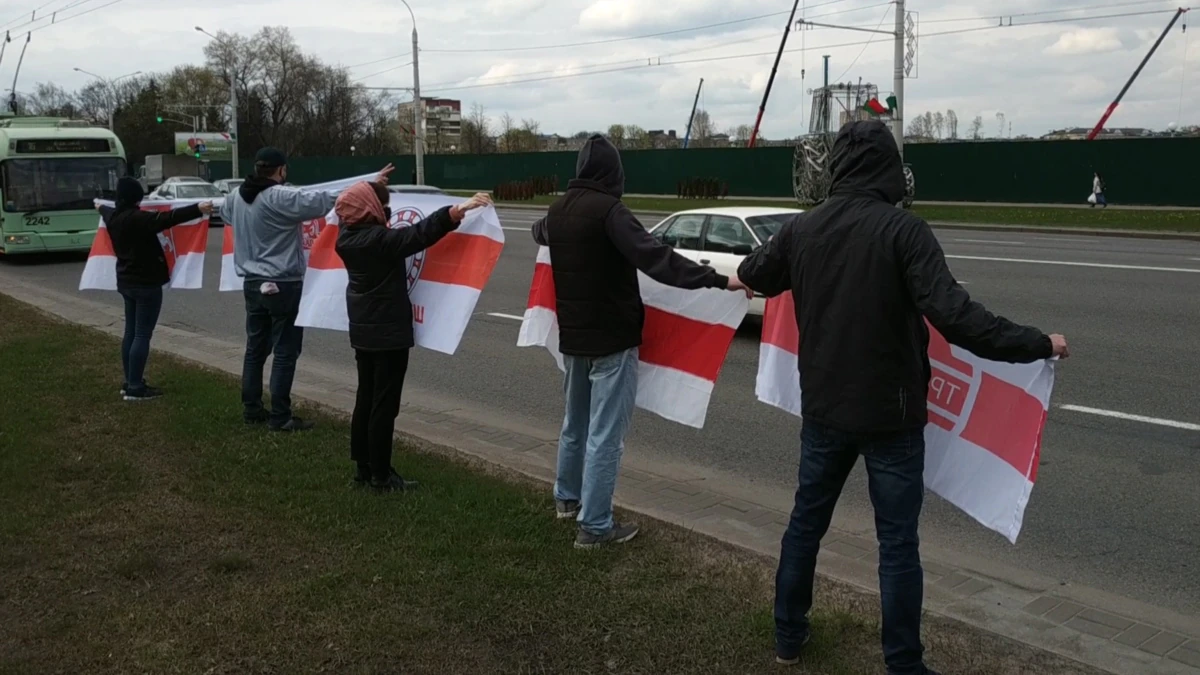
Protesters displayed banned white-and-red national flags in several areas of the suburbs of the Belarusian capital, Minsk, on May 1, including a park, by the roadside, and in residential areas. The protesters were continuing to press their demand for the resignation of Alyaksandr Lukashenka.
President Joe Biden faced a fresh call to fully end “forever wars” after his administration released former President Donald Trump’s secret rules regarding the use of lethal strikes outside of designated war zones.
The Biden administration released the partly-redacted 11-page document, “Principles, Standards, and Procedures for U.S. Direct Action Against Terrorist Targets,” late Friday to the ACLU and New York Times, which had both filed transparency lawsuits to see the guidelines.
Biden suspended the rules once he took office, the Timesreported, and began a review of them in March. That move prompted Hina Shamsi, director of the ACLU’s national security project, to urge not a “review” but an end to the program. “Tinkering with the bureaucracy of this extrajudicial killing program will only entrench American abuses,” she said at the time.
According to the Times: “The review, officials said, discovered that Trump-era principles to govern strikes in certain countries often made an exception to the requirement of ‘near certainty’ that there would be no civilian casualties. While it kept that rule for women and children, it permitted a lower standard of merely ‘reasonable certainty’ when it came to civilian adult men.”
Author and director of the Center on National Security at Fordham Law Karen J. Greenberg summed up the background recently, writing:
In his second term, [former President Barack] Obama did try to put some limits and restrictions on lethal strikes by [remotely piloted aircraft], establishing procedures and criteria for them and limiting the grounds for their use. President Trump promptly watered down those stricter guidelines, while expanding the number of drone strikes launched from Afghanistan to Somalia, soon dwarfing Obama’s numbers. According to the British-based Bureau for Investigative Journalism, Obama carried out a total of 1,878 drone strikes in his eight years in office. In his first two years as president, Trump launched 2,243 drone strikes.
The document’s release follows a fall court order saying the Trump administration could no longer keep the rules secret or deny their existence.
“The United states will continue to take extraordinary measures to ensure with near certainty that noncombatants will not be injured or killed in the course of operations, using all reasonably available information and means of verification,” the Trump-era document states. However, it adds, “Variations to the provision… may be made where necessary.”
Brett Max Kaufman, senior staff attorney for the ACLU, said in a statement, “We appreciate this release, which confirms our fear that President Trump stripped down even the minimal safeguards President Obama established in his rules for lethal strikes outside recognized conflicts.”
“Over four administrations,” Kaufman continued, “the U.S. government’s unlawful lethal strikes program has exacted an appalling toll on Muslim, Brown, and Black civilians in multiple parts of the world. Secretive and unaccountable use of lethal force is unacceptable in a rights-respecting democracy, and this program is a cornerstone of the ‘forever wars’ President Biden has pledged to end. He needs to do so.”
Letta Tayler, associate director and counterterrorism lead with Human Rights Watch’s Crisis and Conflict Division, shared the Times reporting on Saturday with a tweet saying the deadly force rules document was “Not surprising but no less repugnant: Trump stripped down already minimal safeguards from U.S. targeted killings.”
Saturday also marked the 18th anniversary of former President Geroge W. Bush’s “Mission Accomplished” speech—a date noted by Rep. Barbara Lee (D-Calif.), who cast the sole vote against the 2001 Authorization for the Use of Military Force (AUMF) in the wake of the September 11th attacks.
“Eighteen years ago, George W. Bush stood in front of a ‘mission accomplished’ banner backdrop and told the nation that ‘major combat operations in Iraq have ended,'” Lee tweeted. “After the loss of thousands of lives and trillions of dollars, it’s time to finally put an end to our forever wars.”
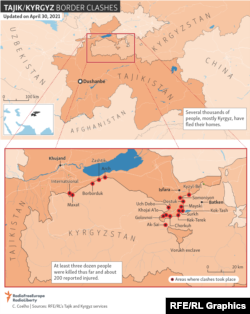
Both sides have reported calm on the Kyrgyz-Tajik border as a day-old cease-fire appeared to be holding and more than 40 people were being mourned from some of the worst clashes in decades on their disputed frontier.
A joint Kyrgyz-Tajik military commission reported finding an unexploded rocket embedded in a residence in the area as the group inspected the scene of 24 hours of intense violence on April 28-29.
Kyrgyzstan is observing two days of official mourning for 34 people who died in Batken Province. One hundred and seventy-eight more were reported injured on the Kyrgyz side, seven of them still in grave condition.
Some 30,000 Kyrgyz villagers were reportedly evacuated from their homes.
Fifteen people were thought to have been killed on the Tajik side and 90 more injured, according to RFE/RL’s Tajik Service, although Tajik authorities did not disclose casualty figures.
The Kyrgyz Interior Ministry said in a statement on May 2 that “the situation in all districts and villages of Batken Province on the Kyrgyz-Tajik border is stable and calm.”
The violence followed a dispute over the installation of surveillance cameras at a water-distribution point near Tajikistan’s Vorukh exclave, drawing in security forces from both countries.
Kyrgyz security officials at one point accused Tajik forces of using MI-24 helicopter gunships to shoot at Kyrgyz villages.
Kyrgyz reports say about 100 structures, including dozens of homes, three border checkpoints, a medical center, a police station, and two schools, were damaged.
The heads of national security for the post-Soviet, Central Asian neighbors agreed to the pullback during a crisis meeting on May 1.
The meeting of the Tajik and Kyrgyz delegations followed a telephone conversation between Kyrgyz President Sadyr Japarov and his Tajik counterpart, Emomali Rahmon.
The European Union, the Organization for Security and Cooperation in Europe (OSCE), and Russia have all urged both sides to respect the cease-fire agreement.
Kyrgyzstan and Tajikistan both host Russian military bases.
Human Rights Watch has urged an immediate investigation to hold either side responsible for laws-of-war violations against civilians.
Like many other border areas in Central Asia, almost half of the 970-kilometer-long Kyrgyz-Tajik border has not been demarcated, leading to tensions for the past 30 years.
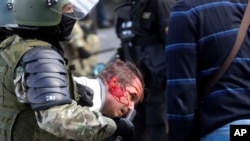
Anger spilled onto the streets of Minsk and across Belarus on August 9, 2020, shortly after polls closed and a state-run exit survey pointed to a big victory for Alyaksandr Lukashenka. Protesters marched through the streets of the capital, many facing off against armed riot police who dealt with them brutally.
No election in Belarus under Lukashenka, in power since 1994, had been deemed free or fair by the West, and this one was no different, although the strongman was suddenly more vulnerable than he had been going into past votes. He was under fire for refusing to institute lockdown measures to cope with the COVID-19 pandemic, which he dismissed as “mass hysteria.”
Crisis In Belarus
Read our coverage as Belarusians continue to demand the resignation of Alyaksandr Lukashenka amid a brutal crackdown on protesters. The West refuses to recognize him as the country’s legitimate leader after an August 9 election considered fraudulent.
He was also facing a strong challenge from Svyatlana Tsikhanouskaya, a political novice and last-minute fill-in candidate for her jailed husband, Syarhey Tsikhanouski. Her huge campaign rallies had fueled hopes, quickly dashed, that Lukashenka’s decades-long authoritarian rule was nearing an end.
Maryna Zolatava, editor in chief of the country’s most popular news website, the independent outlet Tut.by, was working the editorial desk that day when reports came in of unrest on the streets of Minsk after the polls closed.
“The recollections from August 9 are seared into my mind,” Zolatava told RFE/RL’s Belarus Service in a recent interview, describing the scene “when our reporters in the field began calling in to the editorial office to tell us what was happening in the city.”
“Explosions, gunfire…. I couldn’t believe the things the reporters were telling me,” she said. It was all remarkable, but we didn’t have time to reflect on what was happening.”
The protests, with crowds swelling to as many as 200,000 people in Minsk, have continued ever since, albeit with dwindling numbers. That has been put down to fatigue and the fear instilled by the Lukashenka government’s brutal crackdown. More than 30,000 Belarusians have been detained, and hundreds beaten on the streets and in custody.
Rights groups have documented some 1,000 cases of suspected torture. At least five people have been killed. Tsikhanouskaya was forced to flee to Lithuania after the vote amid threats to her and her family.
For the crackdown and alleged vote rigging, Lukashenka and his inner circle have been hit with sanctions by the United States, the European Union, and others, including Canada.
Lukashenka faces international isolation and is ever more reliant on support from larger, more powerful neighbor Russia, which commentators say is exploiting his weakness to squeeze out more concessions on a union treaty deal that critics say further erode what sovereignty it still possesses.
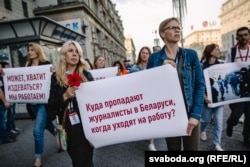
The practice of independent journalism, long dangerous work in tightly controlled Belarus, has become substantially riskier over the past year. And even journalists at state-run media weren’t safe: Dozens who voiced support for the opposition were thrown out of work and replaced by state TV journalists from Russia.
According to the Belarusian Association of Journalists, 481 journalists were detained in 2020, twice as many than the previous six years combined.
Fear And Courage
Belarus slipped five places, to 158th, in Reporters Without Borders’ (RSF) 2021 World Press Freedom Index. Three journalists were given hard prison time, including two facing two-year prison sentences.
“The authorities are trying to suppress all independent voices and to strike fear into the hearts of journalists,” said Jeanne Cavelier, the head of RSF’s Eastern Europe and Central Asia desk. “RSF hails the courage of those who continue to report on the crackdown in Belarus and calls on international organizations to take action to prevent such harassment and to secure the release of journalists jailed for doing their job.”
During the early days of postelection protests, journalists were not widely targeted by police, Zolatava said — but that changed quickly, and soon police were harassing even those with vests clearing identifying them as “press.”
“At the time I thought, ‘This can’t be!’ But it is, and it should not be so. The administrative arrests had started. It all seemed impossible — the fact that all this was happening was surreal.”
The risk of her reporters being beaten or snatched off the street by police began to weigh on Zolatava. “It wasn’t like that before. Now you’re under constant stress as you try to maintain a state of normality within your team. And you constantly think about how you can guarantee the safety of your people,” she said. “It has greatly changed the job. It doesn’t impact you physically, it’s more like constant psychological pressure. You really have to be prepared for it.”
Long targeted by the authorities for its hard-hitting reporting, Tut.by has found itself under even greater scrutiny over the past year. The Ministry of Information warned the news site over four articles before withholding its accreditation for three months starting on October 1.
Tut.by only registered as a media outlet in January 2019. Before that, it had operated without media credentials since the site’s founding in 2000.
Behind Bars
Despite the growing pressures, Zolatava said her reporting team remains largely intact. “Have people left due to security issues or political problems? Nothing like that has happened. In August, our work underwent huge changes. Everything that happened before and after that has hugely impacted all of our lives,” she said, adding that her reporters were detained 38 times by police in 2020.
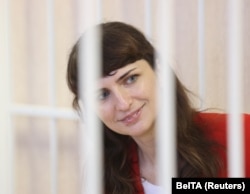
One of them was Katsyaryna Barysevich. She was arrested on November 19 after writing an article about Raman Bandarenka, who died several days earlier following a beating by a group of masked assailants. Barysevich disputed the official claim that Bandarenka was drunk, citing medical findings that no alcohol had been detected in his blood.
The doctor who provided the lab results, Artsyom Sarokin, was arrested, tried, and convicted along with Barysevich, ultimately receiving a suspended two-year prison sentence and fine of 1,450 Belarusian rubles ($560) for disclosing medical information. Barysevich was handed a six-month prison term and fined 2,900 rubles ($1,130) for disclosing medical information and instigating a crime by pressuring a first responder to share information.
Katsyaryna Barysevich is seen inside a defendants’ cage during a court hearing in Minsk in February.
“Katsyaryna is in good spirits. Barysevich is someone deserving of admiration. Katya is the best,” Zolatava said. “It is definitely very distressing that she is in there [prison]. And it’s awful that we can’t change that.”
“We are doing our best. We are writing appeals, trying to draw the attention of the international community to the situation of Katsyaryna,” she said, thanking the Belarusian Association of Journalists and human rights activists for their efforts. “But almost five months have passed since November 19, and Katya is still behind bars. And it’s just awful. How can this be happening?”
Barysevich’s arrest and sentencing served as wake-up calls to editors at Tut.by, Zolatava aid. “After Katya’s arrest, we began to discuss our future more often and consult with lawyers. Although, in principle, her arrest did not affect the editorial policy; self-censorship did not increase. Katya did nothing illegal. She did her job, did it as it should be done,” she said.
On April 20, the Minsk City Court upheld Barysevich’s conviction and sentence. She is now scheduled to be released from prison on May 19.
‘Nightmarish Events’
While Barysevich’s was one the harshest sentences, two other Belarusians suffered an even worse fate. Katsyaryna Andreyeva and Darya Chultsova, reporters for Belsat, a Poland-based satellite TV station, were arrested on November 15 while covering a rally in Minsk to commemorate Bandarenka.
A court in Minsk on February 18 found Andreyeva and Chultsova guilty and sentenced them to two years in prison each, sparking international condemnation, with EU foreign affairs spokesman Peter Stano denouncing it as a “shameful crackdown on media.”
Despite the dangers, more people than ever are turning to Tut.by for credible news coverage, although numbers are slipping as weariness creeps in, Zolatava said.
Visits to the site peaked in August, September, and October. By December, they began to dip and the downward trend continues, although there was a blip around March 25 and 27, when Tsikhanouskaya had called for a huge turnout coinciding with the anniversary of the founding in 1918 of the first free Belarusian republic.
“I think there is a fatigue factor with readers. A year ago, the coronavirus appeared, and the situation then was not completely normal. I think people were looking for something a bit lighter. The whole world is now stressed,” Zolatava said.
Maryna takes part in a march of solidarity of journalists in Minsk in September 2020.
Meanwhile, Lukashenka’s government is pushing ahead with more media restrictions. Changes to the country’s mass media law — passed by the rubber-stamp parliament earlier this month — would make it illegal for journalists to “discredit” the state, or livestream mass unauthorized gatherings, among other draconian measures. According to Human Rights Watch, at least seven reporters face trial.
Despite the bleak prospects and pangs of doubt, Zolatava says she is determined to continue her work at Tut.by. “There have been so many nightmarish events, so much that is unfair, that I’ve wondered whether it’s possible to continue the work. The injustice, the fact that so much is horribly illegal, and yet we are still working,” she said.
“On the other hand, what else can we do?” she continued. “We have to continue working so that all that has happened is not forgotten and remains a chapter of our history. So that people will know everything that happened.”
Written by Tony Wesolowsky based on reporting by RFE/RL’s Belarus Service
Hope — it seems to be everywhere these days. Humans routinely hope for all sorts of stuff — easy-to-assemble IKEA furniture, vaccines against COVID-19, economically painless solutions to global warming. Some believe we’re born with an “innate” sense of hope, and according to positive psychologist Barbara Frederickson, hope is one of the “top ten positive emotions.” It’s even been said that “when hope dies in a person, physical death is not far off.”
Among conservation workers, activists and anyone concerned with the climate crisis, hope is called upon to do particularly heavy lifting. A recent Google search on the phrase “hope and conservation” returned a whopping 779,000 results. In the top result, conservation journalist Jeremy Hance asks “Has hope become the most endangered species in conservation?”
There’s a common narrative shared by Hance and other like-minded commentators. Hope, according to this line of thinking, is a bulwark against the despair that would be an all-too-natural reaction to torrents of environmental bad news. Ecologist Steve Morton calls it “the elixir of (environmental) action,” whereas, to feel hopeless, according to numerous sources, is to be numbered and paralyzed into inaction. Gregory Balmford and Nancy Knowlton, architects of the Earth Optimism movement, even argue that hopelessness among conservationists could become “a driver of extinction.”
I’m an ecologist, not a psychologist, but I’ve long been struck by the centrality of hope in professional conservation discourse. Commentaries in the conservation literature extoll and debate the virtues of having “hope in hard times.” But are we, I asked myself, expecting hope to do too much?
To investigate this question, I teamed up with psychology Ph.D. candidate Elizabeth Williams and sustainability expert Melanie Zurba to investigate the many dimensions of hope and to ask whether hope’s really a necessary prerequisite for people to engage in environmental action. Our resulting review, published last year in the journal Biological Conservation, reached back to the earliest definitions and psychological theories of hope and found that it has both benefits and pitfalls for people working on conservation and environmental issues.
Hope Status? It’s Complicated.
Strong claims for the power of hope in modern human affairs follow a long history in which hope was seen in a negative light. Ancient Greek writers, for example, often perceived hope as a refuge for wishful thinkers, the gullible and those who underestimated the gravity of their situations.
It was left to thinkers from the Enlightenment and later to reframe hope as a positive attribute with goals that can be actively pursued.
That brings us to contemporary positive psychology, which defines hope as “a positive motivational state” (not an emotion) that enables people to exercise agency (goal-directed energy) in the pursuit of objectives that are possible but not 100% certain.
This type of “active” or “authentic” hope is what conservation biologist David Orr had in mind when he described hope as “a verb with its sleeves rolled up.” Orr’s folksy definition capture the idea of hope as having pragmatic, achievable goals that demand conservationists take the actions needed to realize them. You may not know how to save the world, but you can hope to conserve a watershed.
However, don’t confuse hope — especially active hope — with four related but different states that have less positive implications.
First, there’s optimism. Unlike active hope, optimism’s objectives may be vague or even absent. Optimism is best thought of as a sunny expectation that “everything will turn out for the best.”
Then there’s passive hope, in which individuals hope for favorable but fuzzily defined outcomes such as “a solution” to climate change. Passive hope may actually be demotivational. For example, those who feel hopeful because they only expose themselves to positive visions of the future may fail to follow through on those feelings to make them real.
There’s also absolute hope, the refusal to despair in the face of an inevitably bad future, like a terminal illness. A patient may be terminal, but absolute hope allows them to maintain their sense of self and resist dwelling on the diagnosis.
Finally, at the extreme end of making the best out of bad times, there’s radical hope, which helps to makes unsatisfactory or disastrous present circumstances tolerable by maintaining hope for future deliverance. You can have radical hope without knowing what future deliverance looks like or when it will arrive. One individual often held up as an archetype of radical hope is Plenty Coups, last principal chief of the Crow Nation, who led his people through a period in which Crow traditions of hunting and warriorship were destroyed.
Though it may seem noble, radical hope can be a slippery slope to “positive reappraisal,” where negative outcomes are re-evaluated as opportunities or even as beneficial. Naturalist and blogger Phil Barnett appeared to be practicing positive reappraisal when he wrote: “…if only for the sake of our mental health, we can accept the reality of a globe, everywhere sullied by man’s footprints and perhaps even learn to love it.” In a real-world conservation example, I’d posit that both radical hope and positive reappraisal lie behind the “Hail Mary” plan to clone the functionally extinct northern white rhinoceros, now down to two individuals, both of them female.
To Hope or to Hope Not?
Not everyone buys into the hope agenda. Environmental writers Paul Kingsnorth and Derrick Jensen accuse environmentalists of buying into false hope. Echoing the ancient Greeks, they say that false hope leads to unattainable goals, illusory expectations, and inept action strategies. To Kingsnorth, “False hope is worse than no hope.” Jensen seems to be thinking about both false hope and radical hope when he says hope is a “longing for a future condition over which you have no agency; it means you are essentially powerless.”
Furthermore, absence of hope doesn’t stop some people from acting in pro-environmental ways. Greta Thunberg doesn’t always come across as a fount of positivity, yet she continues to fight for the world she wants. Neither Kingsnorth nor Jensen feels hopeful, yet each continues to act in the world, albeit from outside mainstream environmentalism. To Jensen, removing false hope is a precondition for action: “When we stop hoping the situation will somehow not get worse, then we are finally free — truly free — to honestly start working to resolve it.”
So, to hope or not to hope? Should we embrace and encourage hope because it is the “elixir of conservation”? Or should we avoid investing too much emotional and professional capital in hope? Because, let’s face it, while conservationists may try to save as many endangered species and populations as possible, disappointments are inevitable.
Right now, it seems as though most conservation-oriented literature is solidly on hope’s side. A sparse but growing body of psychological research supports a role for active hope in helping conservationists “stay in the game.” During the past six months two intellectual heavy hitters, political scientist Thomas Homer-Dixon and science communicator Elin Kelsey, brought out books extolling the virtues of hope. Their titles: Commanding Hope (Homer-Dixon) and Hope Matters (Kelsey) leave little doubt as to where their authors stand on the importance of hope.
Personality, Leadership and Organizational Strengths Matter
At the end of our review, we concluded that active hope can be a powerful ingredient in conservation success, provided the complexities of hope as a motivational state are acknowledged.
We found that passive hope, radical hope and positive reappraisal seem to be unlikely motivators of success in most environmental battles. And optimism certainly won’t cut it, since optimists don’t typically feel obligated to act in the world to make their expectations real.
It’s active hope, we argue, that’s the gold standard. Only active hope provides the inspiration, agency and pathways to success that are needed for environmental action to succeed. Research in fields as diverse as athletic performance and psychotherapy has associated active hope with successful outcomes. Furthermore, active hope may provide environmental workers with a buffer of resilience against the repeated pain of environmental loss.
But hope on its own, we also found, is not particularly useful.
By themselves, expressions of hope are imperfect predictors of engagement in pro-conservation action. Nor is the direction of causation between hope and action always clear. Pro-environmental behavior may sometimes be a prelude to having hope rather than the other way round. And hope isn’t the only determinant of future action. Life goals, personality traits, cognitive biases, cultural values, childhood experience, age, gender, religion and cultural identity also influence pro-conservation attitudes and actions.
An important take-home message that emerged from our review is that conservation organizations must work to foster personal qualities and behaviors that turn active hope into action. Having a sense of personal agency, engaging in goal-directed projects, and developing clear roadmaps to the future enable conservation workers to be effective.
Leadership is also important. Strong conservation leaders inspire their troops with clear, long-term visions allied to pragmatic road maps of how to make those visons real.
And yet, as important as vision may be, it is often neglected. In a 2018 report based on interviews with 116 Canadian environmental leaders, Graham Saul, the executive director of Nature Canada, concluded that many environmental organizations lack a unifying vision around which forward-looking hopes could coalesce.
The bottom line is that having active hope helps to make conservation visions reality. But don’t expect hope to achieve good things unaided. Inspirational leadership and solid organizational scaffolding are needed to help hopeful conservation workers succeed. In the present environmental moment, conservation organizations may also need to cultivate resilience among workers and volunteers against the times when even active hope fails to pan out.
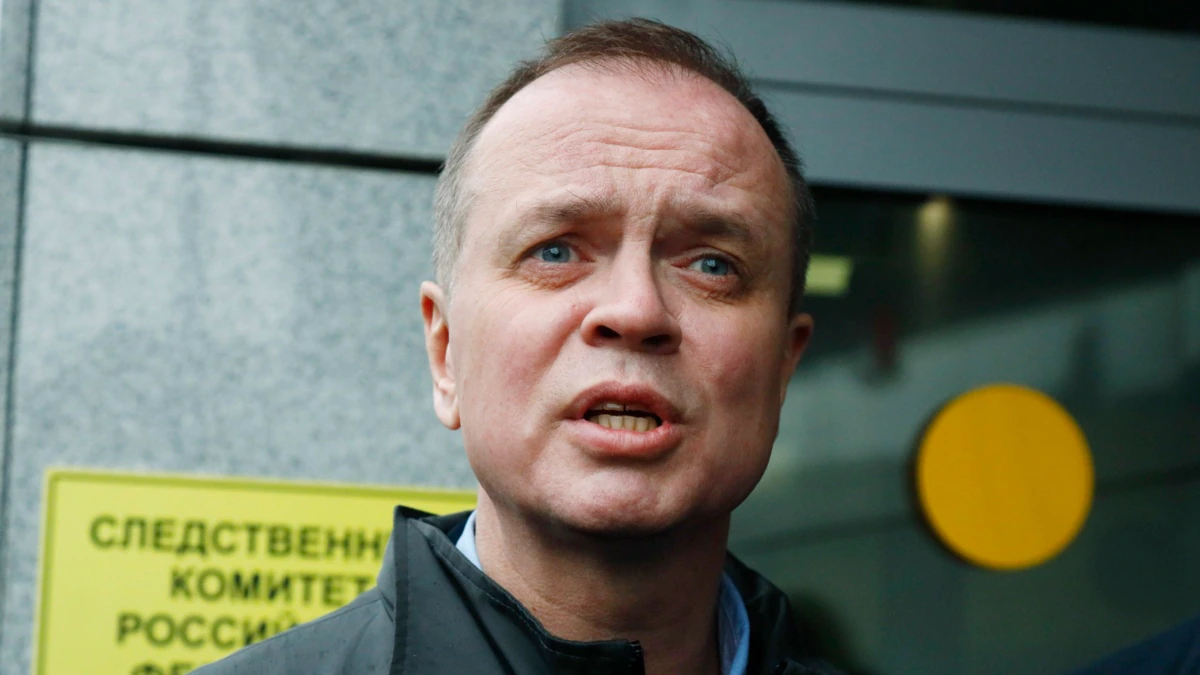
More than 80 Russian journalists, writers, historians, and translators have issued an open letter in support of prominent defense attorney Ivan Pavlov, who was detained in Moscow on April 30 and accused of disclosing classified information about the ongoing investigation of former journalist Ivan Safronov.
“The persecution of Ivan Pavlov and the seizure of confidential case files is an act of terror directed not only at Pavlov but at the entire law community and an attempt to drive Pavlov out of the Ivan Safronov case,” the open letter published on May 2 said.
The signatories of the letter represent the Moscow PEN Club and the Free Speech Association.
Pavlov, 50, is one of Russia’s leading human rights lawyers and the head of the legal-aid foundation Team 29. Law enforcement officers searched the Team 29 office in St. Petersburg, the home of the group’s IT specialist, and the apartment of Pavlov’s wife.
Safronov is accused of treason and has been in pretrial detention since July 2020. Authorities say he gave classified information about Russian arms sales in the Middle East to the Czech Republic, an accusation that Safronov denies.
Pavlov has also been representing the Anti-Corruption Foundation (FBK), which was created by imprisoned opposition politician Aleksei Navalny and which Russian authorities are pushing to have declared an “extremist” organization.
In a statement on April 30, Amnesty International described Pavlov as “one of the country’s most courageous lawyers” and said his detention was “a travesty of justice.”
Pavlov also defended physicist Viktor Kudryavtsev, who was also charged with treason. Kudryavtsev died of cancer on April 29 as his trial was pending.
Pavlov told journalists that the 14 months Kudryavtsev spent in pretrial detention had “completely damaged his health.” The case was “an example of how the secret services are literally killing Russian science in general,” he added.
MYTH #1: We’re all getting the COVID vaccine…
No. Not all of us. Many developing countries don’t have any supply at all yet. Nothing. At best, many will only be able to vaccinate one person in 10 this year. Unless something changes, vaccinating everyone across the entire world will take years. But if you’re lucky enough to live in a rich developed country then you’ve either already had a jab or are very likely to get one soon. Rich countries are vaccinating at a rate of one person-per-second—which is fantastic!—but for most people in the world the future is an uncertain and unprotected one.
MYTH #2: … and we’re beating the pandemic.
Well, there’s hope if you live in a rich country, sure. But poor countries all over the globe just don’t have enough vaccines. They don’t have enough oxygen or medical supplies either. We’re simply not making enough vaccines because big pharmaceutical corporations have a monopoly on them and rich countries cornered the vaccine market long ago. As a result, vaccine inequality is going to make COVID both more deadly and more costly. Vaccine inequality could cost the world as much as $9 trillion. And then there’s mutations: the longer we let the virus spread, the more it will evolve and today’s vaccines won’t work, sooner than we think. Which means we’re not beating COVID until we beat it everywhere.
MYTH #3 The UN is getting enough vaccines to poor countries.
It’s trying to—but the UN alone can’t do it. The World Health Organisation’s “COVAX” facility aims to get 20% of people living in poor countries vaccinated by 2021. This is welcome—but would you be happy if only one person in five was vaccinated in your neighbourhood? There’s another UN initiative called the “COVID Technology Access Pool” (C-TAP) where Big Pharma corporations were invited to volunteer their vaccine technology and know-how so that more producers around the world could make them. This is a super-important initiative. But not one Big Pharma corporation has signed up so far—zero! Meanwhile, some rich countries say they’ll donate some of their surplus vaccines to poor countries which is helpful too, but we’re not going to vaccinate everyone by donation.
MYTH #4: ‘Intellectual property’ isn’t the problem here…
It really is a big part of it. Everything needed to make the vaccine—the know-how and technology—is held under the lock-and-key of the pharmaceutical corporations’ “intellectual property”. And there is a huge fight over it: 101 developing countries led by South Africa and India are calling for World Trade Organisation members to waive intellectual property rights over the COVID vaccines and a powerful minority of rich nations led by the US, UK, EU and Japan are fiercely opposing them (although the Biden Administration is said to be reconsidering its position—which is encouraging news). Intellectual property goes to the heart of vaccine inequality. In the 1980s Big Pharma led an idea (that inventors be given sole control in order to profit from their “intellectual property”) that became one of the key rules governing global trade today. They argued for these deliberate monopolies as the best way to guarantee innovation and maximise the benefits for humanity. It also happened to be heavily in their own financial interests. Today this approach is actually locking away the benefits of publicly funded science for billions of people on the planet.
MYTH #5: …. it just allows Big Pharma to protect its discoveries…
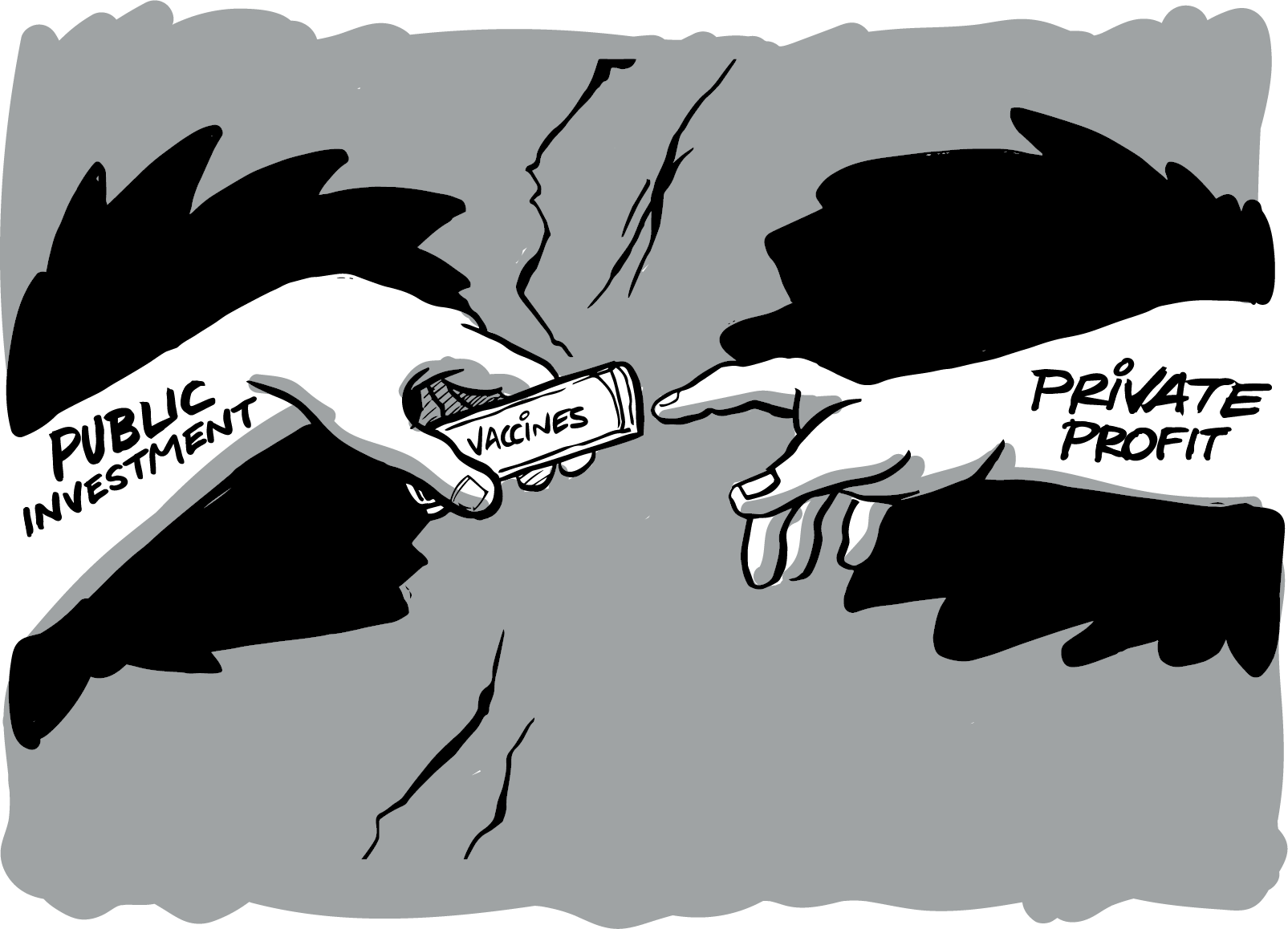
No—the discovery and production of these vaccines was funded by more than $100 billion in tax-payers’ money. Vaccines have effectively been privatised and handed over to big Pharma. So the likes of Pfizer and BioNTech, Moderna, AstraZeneca, Novavax and Johnson & Johnson have significant control over all the technology, know-how and science—and along with that, all the decisions about how many vaccines get made, their cost, and who gets it and when. They’re protecting huge revenue: Pfizer’s vaccine will be one of its best-sellers at around $15 billion in revenue this year alone. It has sold almost all its doses to rich nations and isn’t interested in producing them outside the US and Europe for years.
MYTH #6: … and it gives them an incentive to keep discovering.
This excuse is designed to really play upon our worst fears (“they won’t help us in the next pandemic if they don’t make billions out of this one“). It doesn’t hold water. Governments will always incentivize private corporations to help protect public health (remember that $100bn of public money that sparked today’s COVID vaccines?). Nor is anyone suggesting the Big Pharma corporations do it for free. There are times, certainly, when respecting private property can drive greater efficiency and productivity. But these rights aren’t sacrosanct. Sometimes they simply don’t guarantee the best social or economic outcome. This is one of those times where to do so is causing greater inequality and will lead to many more deaths and economic ruin.
MYTH #7: The real problem is the lack of manufacturing capacity.
Nope. Right now, there is more manufacturing capacity all around the world that isn’t being used, and is could be. There are vaccine producers from Bangladesh to Denmark saying they’re ready to go. You might expect, during a deadly pandemic, that once a vaccine was discovered factories everywhere would swing into action. Not so. In large part because Big Pharma corporations—backed by rich countries—are not willing to share their technology and know-how. If they did, we’d see generic competition being able to produce more global supply at lower prices.
MYTH #8: We can’t risk sub-standard vaccines coming onto market.
Really!? Pharmaceutical manufacturers over the world are already making hundreds of thousands of medicines and vaccines that we all use and have done for years. They are qualified and capable of making a COVID vaccine in accordance with strict WHO quality standards—if only they were allowed. AstraZeneca itself has licensed production to companies around the world, including in India and in Argentina, so it is already comfortable that its vaccine can be produced in countries that are able to test, control and regulate quality standards. Suggesting they can’t ‘keep up standards’ smacks of arrogance and excuse. It is a long-used tactic of the most powerful pharmaceutical corporations to protect their profits. Protecting standards is vital and can be achieved
MYTH #9: There are legal ways around intellectual property.
Yes—in theory, for public health emergencies like this—but rich countries make these exceptions nearly impossible for others to use. For example, “compulsory licenses” should allow countries to access certain technologies. But to make a COVID vaccine, there are hundreds of different things for which they would have to obtain a license. For many countries, compulsory licenses are like being offered a toothpick to break down the steel fence of Big Pharma’s intellectual property control.
MTYH #10: Anyway… there’s nothing you can do about it.
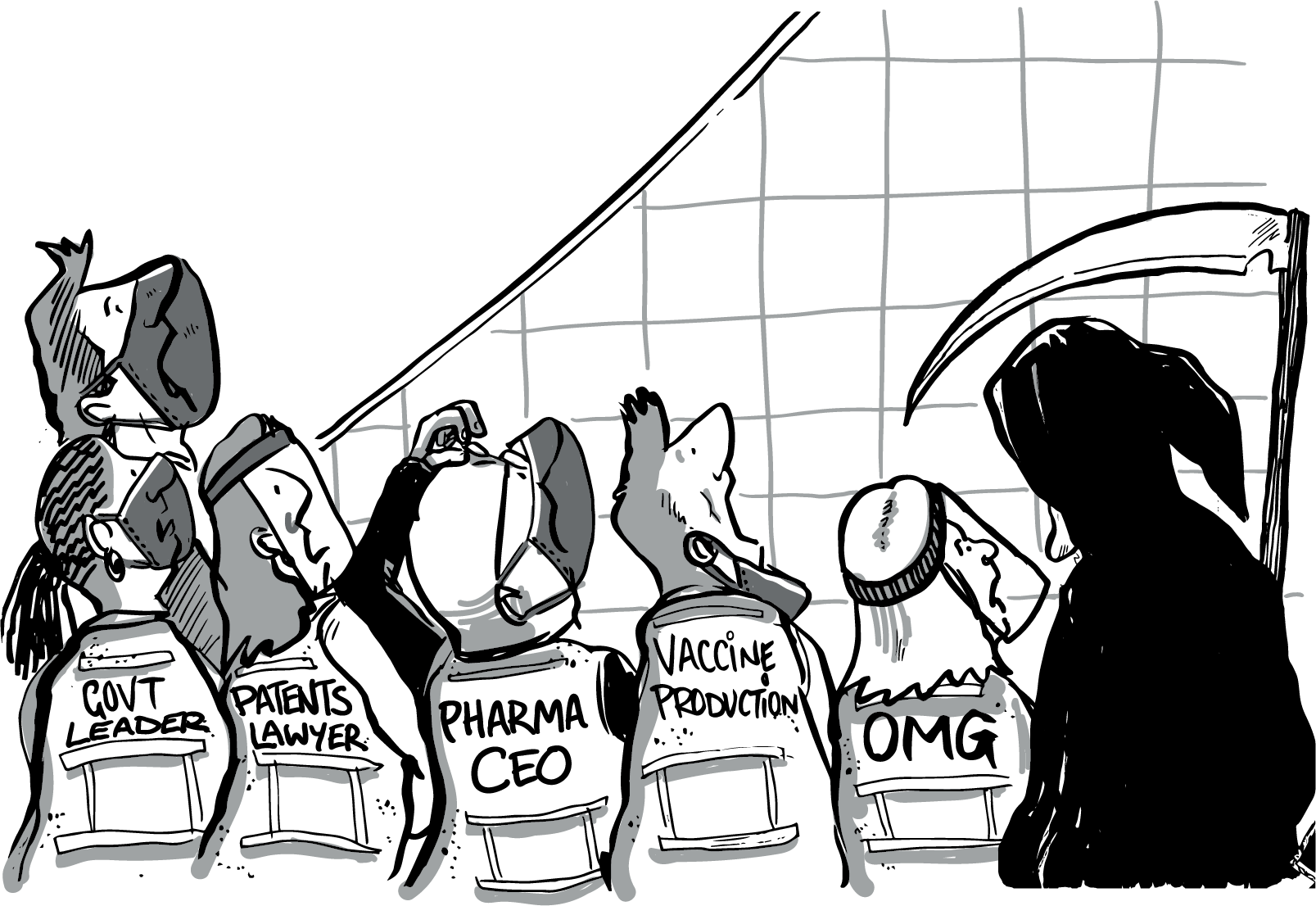
OMG … but you can! Join the People’s Vaccine campaign. Support the majority of people who believe that vaccine monopolies are at odds with our universal right to health. The only way these big pharmaceutical corporations and rich governments will move is by being shamed into it. As they have been before. In the 2000s Oxfam joined a global campaign that pressured many of these same corporations from their shameless monopoly profiteering from HIV/AIDS drugs.
Thursday, Propel teachers and other staff voted 236-82 to join the Pennsylvania State Education Association (PSEA).
The drive took 9 months to achieve. Propel enrolls about 4,000 students at 13 schools in Braddock Hills, Hazelwood, Homestead, McKeesport, Pitcairn, Turtle Creek, Munhall, McKees Rocks and the North Side.
They don’t have to be run by elected school boards. They don’t have to manage their business at public meetings. They don’t have to open their budgets to public review. Heck! They don’t even have to spend all the money they get from taxes on their students.
Nor do they have to accept every student in their coverage area. They can cherry pick whichever students they figure are cheapest to educate and those who they predict will have the highest test scores. And they can hide this discrimination behind a lottery or whatever other smoke screen they want because – Hey! The rules don’t apply to them!
Now you have to pay a living wage. You can’t demand people work evenings and weekends without paying them overtime. You have to provide safe working conditions for students and staff. And if you want to cut student services and pocket the difference, the staff is going to have something to say about that – AND YOU HAVE TO LISTEN!
How much will union power beat back charter bosses?
And how much it does so may depend to a large degree on the individuals working at the school and the degree of solidarity they can exercise against their bosses.
Will the worst financial gamblers abandon school privatization because unions make it too difficult to make handfuls of cash? One can hope.
If it happened, the only charters left standing would be those created without profit as their guiding principle. The goal would really have to be doing the best thing for children, not making shadowy figures in the background a truckload of money.
Do such charter schools even exist? Maybe. With staff continuing to unionize, maybe there will be even more of them.
However, even if all of them become altruistic, there still remains a problem.
Most of the people who work at charter schools are dedicated to their students and want them to succeed. They deserve every opportunity to thrive in a profession centered around children, not profit.
But can a system created to enrich the few ever be fully rehabilitated into one that puts children first?