Long persecuted by Iran’s Islamic regime, followers of the Baha’i faith in Tehran have now been told they must bury their dead upon the mass graves of political prisoners.

The Baha’i community in the Iranian capital has for years buried its dead in a special section of Tehran’s Khavaran cemetery, near the resting place for hundreds or even thousands of political prisoners who were victims of mass executions in the late 1980s.

Cemetery officials have in recent days reportedly told Baha’is that they are no longer allowed to bury their dead in that section of the cemetery.

Instead, they have been given two choices: they can bury their dead in the narrow space between existing Baha’i graves or use the area where the mass graves are located, says Simin Fahandej, the Baha’i International Community representative to the United Nations in Geneva.

Baha’is find the order unacceptable and want to be able to bury their dead with dignity and according to their religious rules. “With the destruction of many Baha’i cemeteries in the past four decades, Baha’is have experienced the pain caused by disrespect to the deceased and they don’t want others to experience the same pain,” Fahandej said in an interview with RFE/RL’s Radio Farda.

He added that this new pressure from the authorities is part of more than 40 years of state repression and discrimination that Baha’is have faced in Iran since the creation of the Islamic republic.
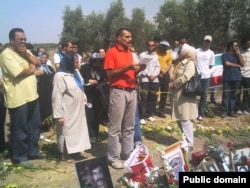
Victims' families attend a remembrance ceremony in Khavaran cemetery in Tehran.


Victims’ families attend a remembrance ceremony in Khavaran cemetery in Tehran.

History Of Persecution

Baha’is — who number some 300,000 in Iran and have an estimated 5 million followers worldwide — have faced systematic persecution in Iran, where their faith is not officially recognized in the country’s constitution.

Since the Islamic Republic of Iran was established in 1979, hundreds of Baha’is have been arrested and jailed for their beliefs. At least 200 have been executed or were arrested and never heard from again — that includes all the members of three National Spiritual Assemblies from 1980 to 1984.

Thousands more have been banned from higher education or had their property confiscated. The community has long had its cemeteries desecrated and its loved ones’ gravestones destroyed.

The latest restriction put on Baha’i burials in Tehran, where most of Iran’s Baha’is live, has also upset the families of the executed political prisoners. They even wrote in an open letter dated April 25 complaining that several new graves had appeared near the site of the mass burials at Khavaran.

“On Friday April 23, while visiting the nameless land of our loved ones, we saw something that was shocking to believe: graves were dug in the mass graves’ site of our loved ones and two Baha’is were also buried in those graves,” said the letter, which was signed by 79 family members of the executed political prisoners.

“It is our right to know the exact burial place of our loved ones,” the letter said, adding that “after being deprived of this right for 40 years, we demand that there won’t be any changes and invasion at this cemetery.”

They also urged the Iranian authorities to refrain from forcing Baha’is to bury their loved ones on the area where the mass graves are located. “Don’t rub salt in our old wounds,” said the letter, addressed to Iranian President Hassan Rohani and Tehran Mayor Piruz Hanachi.

‘Salt In Our Wounds’

In a separate statement, some of the children of the executed prisoners said they opposed “any changes” at Khavaran, calling on the Baha’is not to submit to the order telling them where to bury their dead. “This is not the first time that the Islamic republic has attempted to cover up the remains of its crimes,” the statement said.

Several photos of the purported new graves at Khavaran, including two that had signs and flowers laid on them, have been posted online. The images appeared also to show white lines drawn in the dirt apparently as marks for new graves. RFE/RL cannot verify the authenticity of the images. Reports suggest about 10 new graves have appeared recently at Khavaran’s mass graves’ section.

Amnesty International said in a statement on April 29 that the Iranian authorities had attempted for years to destroy the mass-grave sites of the victims of the 1988 prison executions “in a bid to eliminate crucial evidence of crimes against humanity, denying truth, justice, and reparations to the families of those forcibly disappeared and extrajudicially executed in secret.”

“As well as causing further pain and anguish to the already persecuted Baha’i minority by depriving them of their rights to give their loves ones a dignified burial in line with their religious beliefs, Iran’s authorities are willfully destroying a crime scene,” said Diana Eltahawy, Amnesty International’s deputy director for the Middle East and North Africa.

The executions of political prisoners were carried out in the last days of the 1980-88 Iran-Iraq War, after the founder of the Islamic republic, Ayatollah Ruhollah Khomeini, declared that apostates and those who had taken up arms against the Islamic republic were “waging war against God” and should be sentenced to death.

The prisoners were sent to their deaths following very brief interrogations by a small group of state officials, dubbed by prisoners as “death commissions.”

The Iranian establishment has rarely acknowledged the executions while also enforcing a news blackout on the issue. They have also repeatedly harassed family members of the victims who seek answers about their loved ones.

The Baha’i faith is a monotheistic religion whose central figure is Sayyed Ali Muhammad Shirazi, better known as Bab, who was executed in Tabriz by the Persian authorities in 1850. Based on the teachings of Persian religious leader Bahaullah, it considers the founders of various faiths — including Buddha, Jesus Christ, and the Prophet Muhammad — as expressions of God.

The central tenet of Baha’is is to promote a “oneness of humankind” that treats people of different nationalities, races, and classes equally.

Elahe Ravanshad of RFE/RL’s Radio Farda contributed to this story

Asia Pacific Report newsdesk

Journalists are fearful that increased harassment, abuse and violence directed towards them during the covid-19 pandemic could become the new normal, says the union for Australian media workers.

Releasing its 2021 report into the state of press freedom in Australia, Unsafe at Work – Assaults on Journalists, the Media, Entertainment & Arts Alliance says attacks on journalists increased both globally and and in Australia throughout 2020.

MEAA has been cataloguing the decline of press freedom in Australia now for 20 years.

MEAA says political polarisation caused by the pandemic was behind much of the rising animosity towards journalists, particularly through social media.

But the union also warns that law enforcement agencies have become more heavy-handed in their treatment of journalists.

According to MEAA’s 2021 press freedom survey – the fourth year it has been conducted – Australian journalists are fearful of an increasingly hostile working environment where physical assaults, online abuse and harassment by law enforcement agencies are becoming common.

Although most working journalists who completed the survey said they had not been physically attacked or harassed themselves, 88.8 percent said they were fearful that threats, harassment and intimidation was on the rise.

Assaults on journalists
A quarter of all journalists surveyed said they had been assaulted at least once during their career, and one-in-five said they had been harassed by police while reporting over the past 12 months.

A larger number – 35 percent – have been subjected to threats to their safety online and 70 percent said they did not believe their employer provided sufficient training or support in situations where they faced threats or assaults.

MEAA chief executive Paul Murphy said an MEAA media release that the survey results were unsettling.

“Journalists know that their work will always be under scrutiny and expect it to be criticised, but they are entitled to a safe workplace like all other workers,” he said.

“But in recent years, and encouraged by politicians, journalists are being exposed to much more than an acceptable critique of their work.

“They are threatened and sometimes assaulted at public events, while social media has now evolved into a vehicle for abuse, harassment and threats against journalists. Sometimes these attacks are one-offs but increasingly they are part of a torrent of abuse, which is a weapon to hurt and to harm.

“The polarisation of politics is a key feature in much of this abuse.

Urgent action needed
“Urgent action is needed to ensure journalists can carry on their duties to our communities free from abuse, harassment, arrests and violence.”

Overall, MEAA says that there has been little improvement in press freedom in Australia over the past 12 months, although the union welcomed the decision by the Australian Federal Police not to prosecute three journalists on national security grounds following raids in 2019.

MEAA is hopeful that reform is slowly approaching towards a national uniform defamation regime, and there are positive signs that the Queensland government will finally adopt journalist shield laws, bringing it into line with all other jurisdictions.

MEAA will release its 2021 report into the state of press freedom in Australia, Unsafe at Work – Assaults on Journalists, on UNESCO World Press Freedom Day today – Monday, May 3.

The annual report catalogues MEAA’s press freedom concerns in Australia, and the region.

Print Friendly, PDF & Email

Asia Pacific Report newsdesk

Journalists are fearful that increased harassment, abuse and violence directed towards them during the covid-19 pandemic could become the new normal, says the union for Australian media workers.

Releasing its 2021 report into the state of press freedom in Australia, Unsafe at Work – Assaults on Journalists, the Media, Entertainment & Arts Alliance says attacks on journalists increased both globally and and in Australia throughout 2020.

MEAA has been cataloguing the decline of press freedom in Australia now for 20 years.

MEAA says political polarisation caused by the pandemic was behind much of the rising animosity towards journalists, particularly through social media.

But the union also warns that law enforcement agencies have become more heavy-handed in their treatment of journalists.

According to MEAA’s 2021 press freedom survey – the fourth year it has been conducted – Australian journalists are fearful of an increasingly hostile working environment where physical assaults, online abuse and harassment by law enforcement agencies are becoming common.

Although most working journalists who completed the survey said they had not been physically attacked or harassed themselves, 88.8 percent said they were fearful that threats, harassment and intimidation was on the rise.

Assaults on journalists
A quarter of all journalists surveyed said they had been assaulted at least once during their career, and one-in-five said they had been harassed by police while reporting over the past 12 months.

A larger number – 35 percent – have been subjected to threats to their safety online and 70 percent said they did not believe their employer provided sufficient training or support in situations where they faced threats or assaults.

MEAA chief executive Paul Murphy said an MEAA media release that the survey results were unsettling.

“Journalists know that their work will always be under scrutiny and expect it to be criticised, but they are entitled to a safe workplace like all other workers,” he said.

“But in recent years, and encouraged by politicians, journalists are being exposed to much more than an acceptable critique of their work.

“They are threatened and sometimes assaulted at public events, while social media has now evolved into a vehicle for abuse, harassment and threats against journalists. Sometimes these attacks are one-offs but increasingly they are part of a torrent of abuse, which is a weapon to hurt and to harm.

“The polarisation of politics is a key feature in much of this abuse.

Urgent action needed
“Urgent action is needed to ensure journalists can carry on their duties to our communities free from abuse, harassment, arrests and violence.”

Overall, MEAA says that there has been little improvement in press freedom in Australia over the past 12 months, although the union welcomed the decision by the Australian Federal Police not to prosecute three journalists on national security grounds following raids in 2019.

MEAA is hopeful that reform is slowly approaching towards a national uniform defamation regime, and there are positive signs that the Queensland government will finally adopt journalist shield laws, bringing it into line with all other jurisdictions.

MEAA will release its 2021 report into the state of press freedom in Australia, Unsafe at Work – Assaults on Journalists, on UNESCO World Press Freedom Day today – Monday, May 3.

The annual report catalogues MEAA’s press freedom concerns in Australia, and the region.

Print Friendly, PDF & Email

Russia’s Interior Ministry says that some 527,000 people in parts of eastern Ukraine where Moscow-backed separatist formations are waging a war against Kyiv have been granted Russian citizenship over the past two days.

The ministry’s press service made the announcement on May 2 to the state news agency TASS.

Earlier, Russia had issued 650,000 new passports in the region after President Vladimir Putin in 2019 issued an order for a simplified and expedited citizenship process for residents of those areas.

Moscow’s policy of handing out citizenship in Ukraine has come under intense international criticism as a bid to further destabilize the area, where more than 13,000 people have been killed since the fighting started in April 2014.

Ukraine has condemned the Russian naturalization of Ukrainian citizens as part of a hybrid-warfare campaign being waged by Moscow and a violation of Ukraine’s sovereignty.

Russia has provided military, economic, and political support to the separatists in parts of Ukraine’s Luhansk and Donetsk regions. Despite overwhelming evidence to the contrary, Moscow maintains it is not involved in Ukraine’s domestic affairs.

The developments come at a time of heightened tensions between Russia and Ukraine in recent weeks, when Russia launched a major military buildup along its border with Ukraine and in the Black Sea Ukrainian region of Crimea, which Moscow annexed in 2014.

On April 8, Putin’s deputy chief of staff, Dmitry Kozak, said Russia could “be forced to come to the defense” of Russian citizens in Ukraine, a statement that was repeated the following day by Kremlin spokesman Dmitry Peskov.

In November 2020, Peskov said, “Russia has always protected and will continue to protect the interests of Russians, regardless of where they live.”

Viktor Vodolatsky, deputy chairman of the Russian State Duma’s Committee on CIS Affairs and Eurasian Integration, told TASS on April 24 that Russia could issue up to 1 million new passports to Ukrainians by the end of the year.

On March 20, a Russian presidential decree came into force banning non-Russian citizens from owning land in most of Crimea.

“The European Union does not recognize the illegal annexation of the Crimean Peninsula by Russia, which is a clear violation of international law,” said an EU statement at the time.

“Therefore the European Union does not recognize this decree and considers its entry into force as yet another attempt to forcibly integrate the illegally annexed peninsula into Russia.”

With reporting by TASS, UNIAN, and The Atlantic

Russia’s Interior Ministry says that more than 527,000 people in parts of eastern Ukraine where Moscow-backed separatist formations are waging a war against Kyiv have been granted Russian citizenship over the past two years.*

The ministry’s press service made the announcement on May 2 to the state news agency TASS.

It said around 40 percent of applications had been rejected, citing expulsions or restrictions on entry to Russia.

Russian President Vladimir Putin in April 2019 issued an order for a simplified and expedited citizenship process for residents of those areas.

Moscow’s policy of handing out citizenship in Ukraine has come under intense international criticism as a bid to further destabilize the area, where more than 13,000 people have been killed since the fighting started in April 2014.

Ukraine has condemned the Russian naturalization of Ukrainian citizens as part of a hybrid-warfare campaign being waged by Moscow and a violation of Ukraine’s sovereignty.

Russia has provided military, economic, and political support to the separatists in parts of Ukraine’s Luhansk and Donetsk regions. Despite overwhelming evidence to the contrary, Moscow maintains it is not involved in Ukraine’s domestic affairs.

The developments come at a time of heightened tensions between Russia and Ukraine in recent weeks, when Russia launched a major military buildup along its border with Ukraine and in the Black Sea Ukrainian region of Crimea, which Moscow annexed in 2014.

On April 8, Putin’s deputy chief of staff, Dmitry Kozak, said Russia could “be forced to come to the defense” of Russian citizens in Ukraine, a statement that was repeated the following day by Kremlin spokesman Dmitry Peskov.

In November 2020, Peskov said, “Russia has always protected and will continue to protect the interests of Russians, regardless of where they live.”

Viktor Vodolatsky, deputy chairman of the Russian State Duma’s Committee on CIS Affairs and Eurasian Integration, told TASS on April 24 that Russia could issue up to 1 million new passports to Ukrainians by the end of the year.

On March 20, a Russian presidential decree came into force banning non-Russian citizens from owning land in most of Crimea.

“The European Union does not recognize the illegal annexation of the Crimean Peninsula by Russia, which is a clear violation of international law,” said an EU statement at the time.

“Therefore the European Union does not recognize this decree and considers its entry into force as yet another attempt to forcibly integrate the illegally annexed peninsula into Russia.”

With reporting by TASS, UNIAN, and The Atlantic
*CORRECTION: A previous version of this story gave an incorrect time frame for the issuing of Russian passports to residents of eastern Ukraine.

In the final episode of Raoul Peck’s HBO documentary, “Exterminate All the Brutes,” Peck says in a voice-over, “The very existence of this film is a miracle.”

That is 100 percent true. Before this moment in history, it would have been impossible to imagine that one of the world’s largest corporations — AT&T, owner of HBO, with a current market cap of $220 billion — would have funded and broadcast a film like this. The fact that it somehow squeezed through the cracks and onto our TVs and laptop screens demonstrates that something profound about the world is changing. Decades, centuries of people fighting and dying were required both to widen the cracks and mold someone like Peck, the right human at the right time, to step through.

“Exterminate All the Brutes” is a sprawling disquisition — four episodes, each an hour long — into the invention and consequences of 500 years of “white” supremacy, presented via a high-gloss pastiche of old footage, newly filmed dramatizations, and clips from Hollywood movies. “White” needs scare quotes because the film makes clear that whiteness is not something that exists in reality — like, say, the moon — that is right there whether we believe in it or not. Instead, it’s something imaginary that we’ve somehow all agreed on, like pieces of paper having value.

These two made-up concepts meet in the $100 bill via the man on its face, Benjamin Franklin. In 1751, Franklin wrote an essay that makes clear that anyone can be classified as “white” or read out of the white race, depending on the needs of the moment.

Franklin was desperate to keep the British colonies “white,” but by white, he didn’t mean European. For Franklin, only the English and Saxons counted. Germans, Swedes, Russians, and the French were hilariously “swarthy,” and thus “will never adopt our Language or Customs, any more than they can acquire our Complexion.”

At the same time, as the miniseries illustrates, the English were colonizing Ireland and demoting its nearly translucent inhabitants to nonwhite. A famous British clergyman named Charles Kingsley, extremely liberal by the standards of the day, wrote home from a trip to Sligo that the people somehow had skin “as white as ours” but nevertheless were subhuman “chimpanzees.” In the U.S., the Irish were the standard by which nonwhiteness was measured, to the extent that African Americans were sometimes referred to as “smoked Irish.”

Of course, America eventually promoted the Irish to white, on the condition that they would be team players. Across the world in South Africa, the apartheid regime decided that Japanese immigrants were loyal enough to be “honorary whites.” The sorting process can even be seen in real time in a 1949 Atlantic article by a friend of Franklin D. Roosevelt about his trip to the newly born Israel. The country, he explained, could be useful as “the best guarantee” for Western interests in the area. Jewish people, who had previously been “moth-eaten” and “grease-spotted,” now possessed “physical beauty, healthy vitality, politeness, good nature” and were comparable to Thomas Jefferson. Arab people were in the way but “about as dangerous as so many North American Indians,” and therefore nonwhite and “foul, diseased, smelling, rotting, and pullulating with vermin.”

Director Raoul Peck and actor Eddie Arnold.

Photo: Velvet Film/David Koskas/Courtesy HBO

Peck may be only the filmmaker who would want to take on this gigantic subject and then manage to present it as is, simultaneously terrifying and preposterous. Born in Haiti — i.e., the western half of Hispaniola, the island where Columbus landed in the “New” World — Peck has lived all over the planet and has a humanistic sympathy for all people, both at their best and their absolute worst. He’s made several dozen films, many documentaries, and was nominated for an Oscar in 2017 for “I Am Not Your Negro,” about James Baldwin.

At the outset, Peck says, “This is a story, not a contribution to historical research,” and he knows what he’s doing as a storyteller. Every minute of the miniseries has startling moments that examine the story of Europe’s colonization of the world from the other end of the gun — or, by this point, the other end of a Predator drone’s AN/AAS-52 Multi-Spectral Targeting System. Manifest Destiny, the White Man’s Burden, France’s Mission civilisatrice, Spain’s Misión civilizadora, Portugal’s Missão civilizadora — all are reframed so they can be seen as the code words they were.

Peck also does a masterful job excavating how this idea was birthed. It wasn’t that Europeans decided that they were superior to the rest of the world’s people and therefore had to conquer them. It was the other way around: The rest of the world had the land and gold that Europe coveted, and so, over hundreds of years, Europeans developed a jerry-rigged justification for how stealing it all was okay and indeed praiseworthy.

“Exterminate All the Brutes” borrows its title from a famous line in “Heart of Darkness,” the 1899 novel by Joseph Conrad about the colonizing of Congo. (Moviegoers may be more familiar with “Apocalypse Now,” an adaptation of the book with the location switched to Vietnam.) At one point, the narrator, Marlow, explains why there had to be some kind of reason for the rapine and plunder:

It was just robbery with violence, aggravated murder on a great scale … the conquest of the earth, which mostly means the taking it away from those who have a different complexion or slightly flatter noses than ourselves, is not a pretty thing when you look into it too much. What redeems it is the idea only. An idea at the back of it; not a sentimental pretense but an idea; and an unselfish belief in the idea — something you can set up, and bow down before, and offer a sacrifice to …

A report by the upriver colonial agent and mass murderer Mr. Kurtz makes clear what this means in practice. Kurtz begins by declaring, “By the simple exercise of our will we can exert a power for good practically unbounded,” and quickly degenerates into an exhortation to “exterminate all the brutes!”

This was not some oversimplification written to make a tendentious point but instead an exact depiction of reality, then and now. Trent Lott, the Senate minority leader at the start of the Iraq War in 2003, initially asked for prayers for the U.S. military “as they engage in an intense but noble battle … We went in there to free those people.” Six months later he mused, “If we have to, we just mow the whole place down, see what happens.”

The series jumps around in time to examine a seemingly endless number of genocides — some that may be hazily remembered today, many that are totally forgotten. But Peck’s purpose is not just to make a list of atrocities. Rather, he is arguing a case that culminates in the film’s exceedingly disturbing last 20 minutes.

The Holocaust, Peck shows, was not an inexplicable outburst of madness, unconnected to the rest of history. It was instead the logical culmination of the ideology of European colonialism and white supremacy. “When what had been done in the heart of darkness was repeated in the heart of Europe, no one wished to recognize what everyone knew,” he says. “Auschwitz is the modern industrial application of established extermination methods.”

That’s where “Exterminate All the Brutes” leaves us. It does not offer any solutions or false hope. In fact, after watching it, it’s hard not to consider that whiteness is a demonic whirlwind that may end by destroying everyone — starting with its traditional victims but eventually engulfing people who thought that their whiteness would protect them and are in for a big surprise.

On the other hand, there is the miracle of the documentary’s existence. That by itself means that deep tectonic plates are shifting in the world’s consciousness. It’s not impossible that this film will someday be considered a key part of a long, complex, messy reckoning that will see whiteness relegated to humanity’s Museum of Terrible Ideas. If people have a future, it will be one in which tourists come and gape in horror that anyone ever thought this awful concept made sense.

By Yogi Ernes in Jakarta

Indonesian police have seized 15 Papuan students among scores arrested at a May Day rally in central Jakarta on the ground that they did not have a permit to demonstrate.

“Yes, 15 people were secured and taken to the Metro Jaya regional police [headquarters]. They wanted to protest without a permit,” said Metro Jaya regional police spokesperson Senior Commissioner Yusri Yunus.

The students were arrested yesterday as they marched past the US Embassy on Jl Medan Merdeka Selatan in central Jakarta. They were taken to the Metro Jaya headquarters.

According to Yunus, when they were questioned by officers at the location, the Papuan students were unable to produce a permit for the action.

Yunus said that the 15 students were not carrying any suspicious objects and because of this they had now been sent home.

“We’ve now sent them home. Earlier we just collected data on them,” said Yunus.

The rallies in Jakarta were centred on the Horse Statue area.

Thousands took to streets
Thousands of workers from various different trade unions took to the streets to convey their aspirations.

The workers took up a number of demands, one of which was cancelling the Job Creation Law which they say harms workers.

CNN Indonesia reports that up to 300 people were arrested in rallies near the Horse Statue and the International Labour Organisation (ILO) offices in central Jakarta.

The figures on the arrests were obtained by summarising statements made by police up until the May Day actions ended at 5.05 pm.

The first arrests were the 15 Papuan students.

Following this, police arrested 12 anarchists.

Senior Commissioner Yunus said that the group was arrested as they wanted to join protesting workers in front of the ILO office.

“12 young anarchists were arrested,” said Yunus.

Yunus said they were arrested because it was suspected that they wanted to “create a riot” during the labour protests.

“As is usual with them there were suspicions they wanted to create a riot, so we secured them, we questioned them”, said Yunus.

Thirty students from the Indonesian Association of Catholic Students (PMKRI) were also arrested.

Central Jakarta District police deputy chief Assistant Superintendant Setyo Koes Hariyanto said the students were arrested as they tried to incite chaos by setting fire to tyres.

Women protesters arrested
In Medan, North Sumatra, CNN Indonesia reports that Medan metropolitan district police (Polrestabes) arrested 14 protesters seven women and seven men – the from the People’s Resistance Alliance for the Destruction of Tyranny.

Medan Legal Aid Foundation (LBH) labour and urban poor division head Maswan Tambak said there were no grounds for the repressive action by police against the peaceful protest.

In addition, the protesters did not violate covid-19 health protocols.

Protesters from the Medan People and Workers Accumulation of Anger Alliance (AKBR) acused rogue police officers of intimidating and sexually harassing them.

“There were police who recorded demonstrators by sticking their mobile phones in the face of women protesters. It really wasn’t ethical, and we consider that threatening,” said the founder of Women Today (PHI), Lusty Ro Manna Malau.

“The actions of these rogue police cannot be allowed to become normalised.”

Translated by James Balowski for Indoleft News. The original title of the article was “Polisi Amankan 15 Mahasiswa Papua di Demo Hari Buruh di Jakarta”.

Print Friendly, PDF & Email

Turkmenistan has the fourth-largest reserves of natural gas in the world and many years ago was touted by its first president as being destined to become a second Kuwait.

Turkmenistan has now become a country where people stand in long lines for rations of bread, dig through garbage for scraps and things they might possibly be able to sell, while the government celebrates horses and dogs.

Turkmenistan’s economy has been in dire shape for more than half a decade now and the standard of living for the country’s people continues to drop.

And recently, current President Gurbanguly Berdymukhammedov has been guiding his son Serdar up the hierarchy of the government leading to speculation the presidency will be passed from father to son and the mismanagement that characterizes the Turkmen government will continue for another generation.

On this week’s Majlis Podcast, RFE/RL Media-Relations Manager Muhammad Tahir moderates a discussion that looks at the deterioration of Turkmenistan.

This week’s guests are: from the Netherlands, Ruslan Myatiev, the head of the Turkmen.news website; from Prague, Farruh Yusupov, the director of RFE/RL’s Turkmen Service, known locally as Azatlyk; and Bruce Pannier, the author of RFE/RL’s Qishloq Ovozi blog.

Listen to the podcast above or subscribe to the Majlis on iTunes or on Google Podcasts.

Turkmenistan has the fourth-largest reserves of natural gas in the world and many years ago was touted by its first president as being destined to become a second Kuwait.

Turkmenistan has now become a country where people stand in long lines for rations of bread, dig through garbage for scraps and things they might possibly be able to sell, while the government celebrates horses and dogs.

Turkmenistan’s economy has been in dire shape for more than half a decade now and the standard of living for the country’s people continues to drop.

And recently, current President Gurbanguly Berdymukhammedov has been guiding his son Serdar up the hierarchy of the government leading to speculation the presidency will be passed from father to son and the mismanagement that characterizes the Turkmen government will continue for another generation.

On this week’s Majlis Podcast, RFE/RL Media-Relations Manager Muhammad Tahir moderates a discussion that looks at the deterioration of Turkmenistan.

This week’s guests are: from the Netherlands, Ruslan Myatiev, the head of the Turkmen.news website; from Prague, Farruh Yusupov, the director of RFE/RL’s Turkmen Service, known locally as Azatlyk; and Bruce Pannier, the author of RFE/RL’s Qishloq Ovozi blog.

Listen to the podcast above or subscribe to the Majlis on iTunes or on Google Podcasts.