National security police in Hong Kong have apparently blocked the website of a church on the democratic island of Taiwan and hacked into its database after it raised funds to aid people fleeing arrest in connection with the 2019 protest movement, organizers told RFA on Monday.

Church member Hwang Chun-sheng said the site has been blocked for a week, and its database hacked.

“It’s pretty pointless just shutting down our public website; it’s just tedious, and really it’s all about scoring a big propaganda point with the domestic audience [in mainland China],” Hwang said.

“But it is also an indicator of the mainlandization of Hong Kong … maybe Hong Kong will be next [to be put behind the Great Firewall],” he said.

According to the Wei Wei Po newspaper, which is controlled by the ruling Chinese Communist Party (CCP), the Presbyterian Church had launched a fund-raising campaign to help people fleeing in the wake of the movement.

“The Taiwan Presbyterian Church expressed support for rioters during the turmoil in Hong Kong over the [extradition] law, and was also implicated in investigations by the national security division of the Hong Kong Police Force into radio talk show host Giggs,” the paper said.

Wan Siu-yin, who is known by his nickname Giggs, was arrested on suspicion of “seditious intent,” over comments he made during online radio shows he hosted from August to October 2020.

‘Seditious intent’

Wan, 52, has been charged with “acting with seditious intent” in online programs that he hosted between August and October last year, after he publicized the fund-raising campaign on  his show.

“In the event of a crime that endangers national security, the service provider may be required to remove [content or access to content] with the approval of the secretary for security,” the Wen Wei Po reported, citing the national security law imposed on Hong Kong from July 1, 2020, which outlaws public criticism of, or peaceful opposition to, the authorities.

The crowdfunding campaign raised more than H.K.$10 million (US$1.29 million), H.K.$4 million of which was transferred to the Taiwan church’s bank account.

The paper said the church was “an advocate of independence for Taiwan,” a phrase used by the CCP to describe anyone who opposes its claim on the country, which has never formed part of the People’s Republic of China, nor been controlled by the CCP.

Hwang said the church is now communicating with activists in Hong Kong using VPNs and encryption, with regular email and Facebook Messenger too compromised.

He said the church has been involved in ongoing fundraising for Hongkongers who fled to Taiwan to pursue college degrees as a way of avoiding repercussions for their role in the 2019 protests, but who have since run out of money and can’t go home.

“We try not to let them drop out after a year, and find ways to keep them in their study programs,” Hwang said. “We find jobs for some of the students.”

CCP sends fake protesters

Taiwan has meanwhile announced it will tighten the rules around applications from Hong Kong residents for its permanent residence card, requiring them to remain there for two years before applying.

Media reports said the move was an apparent bid to prevent ‘fake’ Hong Kong protesters working for the CCP from infiltrating the island.

In January, Hong Kong police blocked HKChronicles, a website dedicated to publishing first-hand accounts of the Hong Kong pro-democracy movement.

The block was the first indication that China may be exporting its Great Firewall to the city since the national security law took effect. Police have declined to confirm publicly that they took action, but responded by citing the relevant section of the law.

Attempts to connect to the Presbyterian Church of Taiwan’s website at www.pct.org.tw from the United Kingdom on Monday resulted in a browser warning that the connection was “not private.”

“Attackers might be trying to steal your information from www.pct.org.tw (for example, passwords, messages, or credit cards),” it said. “This may be caused by a misconfiguration or an attacker intercepting your connection.”

Social media users said the website of Taiwan’s ruling Democratic Progressive Party (DPP) was also failing to load from around the world, suggesting it had been hacked.

The site failed to load, leaving a timed-out connection, when browsed from the U.K. on Monday.

Reported by Hwang Chun-mei for RFA’s Mandarin Service, and by Chung Kuang-cheng for the Cantonese Service. Translated and edited by Luisetta Mudie.

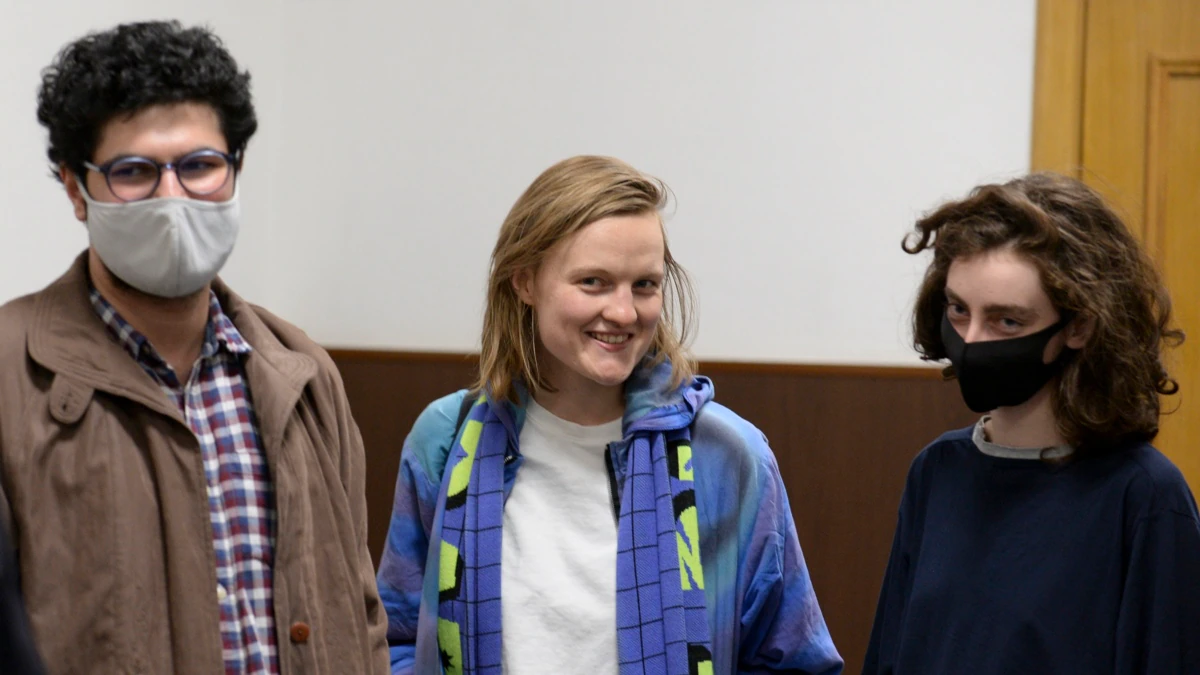
MOSCOW — A Moscow court has increased from one minute to two hours the time allowed outside each day for three of the four editors of the student magazine Doxa, who are accused of “engaging minors in actions that might be dangerous” over a video related to unsanctioned rallies protesting opposition politician Aleksei Navalny’s incarceration.

The Moscow City Court on April 26 upheld a lower court’s decision to impose pretrial restrictions for Armen Aramyan, Vladimir Metyolkin, and Natalya Tyshkevich, but mitigated the restrictions, ruling that the trio is allowed outside for two hours daily from 8 a.m. to 10 a.m.

A decision on the appeal of the fourth editor in the case, Alla Gutnikova, is expected to be made by the court on April 28.

On April 14, the Basmanny district court in the Russian capital ordered the four editors not to leave their homes between midnight and 11:59 p.m. for two months, giving them only one minute to be outside each day.

The four were detained for questioning at the Investigation Committee after their homes and the magazine’s offices were searched over the video, which the magazine posted online in January.

The video questioned teachers’ moves to warn students about possible repercussions they could face for participating in unsanctioned rallies on January 23 and January 31 in protest of Navalny’s arrest.

Doxa editors say the video was deleted from the magazine’s website following a demand from Russian media watchdog Roskomnadzor to remove it.

More than 10,000 supporters of Navalny were detained across Russia during and after the January rallies. Many of the detained men and women were either fined or handed several-day jail terms. At least 90 were charged with criminal offenses and several have been fired by their employers.

Human rights groups have called on Moscow repeatedly to stop targeting journalists because they are covering the protests or express solidarity with protesters since both are protected under the right to freedom of expression.

“Instead of targeting journalists, the authorities should hold accountable police who attack journalists and interfere with their work,” Human Rights Watch said in a statement on February 3.

Navalny was detained at a Moscow airport on January 17 upon his arrival from Germany, where he was recovering from a poisoning, which several European laboratories concluded was a military-grade chemical nerve agent, in Siberia in August 2020.

Navalny has insisted that his poisoning was ordered directly by President Vladimir Putin, which the Kremlin has denied.

In February, a Moscow court ruled that while in Germany, Navalny had violated the terms of parole from an old embezzlement case that is widely considered as being politically motivated. Navalny’s 3 1/2 year suspended sentence from the case was converted to a jail term, though the court said he will serve 2 1/2 years in prison given the amount of time he had been held in detention.

A new book by Michael Ratner offers a glimpse of the activist’s modest life.

Environmentalists and Florida residents voiced concern and outrage Monday as state government officials and the biotechnology giant Oxitec announced plans to move ahead this week with a pilot project that involves releasing up to a billion genetically engineered mosquitoes in Monroe County over a two-year period.

 “EPA has set the lowest possible bar for approving genetically engineered insects and has opened Pandora’s Box for future experiments that will slide through with little investigation.”
—Barry Wray, Florida Keys Environmental Coalition

Presented by local authorities as an effort to control the population of Aedes aegypti—a mosquito species that can carry both the dengue and yellow fever virus—critics warn that the effort’s supposed benefits and its potential negative consequences have not been sufficiently studied.

Responding to news that the first boxes of GE mosquitos are set to be placed in six locations in Monroe County this week, Friends of the Earth noted in a press release that “scientists have raised concerns that GE mosquitoes could create hybrid wild mosquitoes which could worsen the spread of mosquito-borne diseases and could be more resistant to insecticides than the original wild mosquitoes.”

Dana Perls, food and technology program manager at Friends of the Earth, called on the Environmental Protection Agency (EPA)—which approved the project last May—to “halt this live experiment immediately.”

“This is a dark moment in history,” said Perls. “The release of genetically engineered mosquitoes puts Floridians, the environment, and endangered species at risk in the midst of a pandemic. This release is about maximizing Oxitec’s profits, not about the pressing need to address mosquito-borne diseases.”

The Florida Keys Mosquito Control District and Oxitec said late last week that “less than 12,000 mosquitoes are expected to emerge each week” in Monroe Country over a duration of around three months, the initial phase of the experiment.

The stated goal of the project is for Oxitec’s genetically altered, non-biting male mosquitos to mate with the local biting female population, producing female offspring that die in the larval stage before they can spread disease.

As the Miami Herald explained earlier this year: “A ‘death mechanism’ designed into mosquitoes is meant to ensure no viable female offspring will result from the mating, according to Oxitec. The male offspring will pass on the ‘self-limiting gene’ to half of their offspring, said company spokesman Ross Bethell.”

While Oxitec’s CEO claims “strong public support” from Florida Keys communities, the project has sparked protests and pushback from local residents since the proposal was first floated.

“My family’s bodies, blood, and private property are being used in this trial without human safety studies or my consent,” Mara Daly, a resident and local business owner in Key Largo, Florida, said in a statement Monday, Daly expressed concern about being bit by female mosquitoes carrying genetically engineered material.

Barry Wray, executive director of the Florida Keys Environmental Coalition, added that the “EPA has set the lowest possible bar for approving genetically engineered insects and has opened Pandora’s Box for future experiments that will slide through with little investigation.”

“Everyone should be writing the White House to stop this release until there are regulations and standards that truly protect us,” Wray said.

Environmentalists and Florida residents voiced concern and outrage Monday as state government officials and the biotechnology giant Oxitec announced plans to move ahead this week with a pilot project that involves releasing up to a billion genetically engineered mosquitoes in Monroe County over a two-year period.

 “EPA has set the lowest possible bar for approving genetically engineered insects and has opened Pandora’s Box for future experiments that will slide through with little investigation.”
—Barry Wray, Florida Keys Environmental Coalition

Presented by local authorities as an effort to control the population of Aedes aegypti—a mosquito species that can carry both the dengue and yellow fever virus—critics warn that the effort’s supposed benefits and its potential negative consequences have not been sufficiently studied.

Responding to news that the first boxes of GE mosquitos are set to be placed in six locations in Monroe County this week, Friends of the Earth noted in a press release that “scientists have raised concerns that GE mosquitoes could create hybrid wild mosquitoes which could worsen the spread of mosquito-borne diseases and could be more resistant to insecticides than the original wild mosquitoes.”

Dana Perls, food and technology program manager at Friends of the Earth, called on the Environmental Protection Agency (EPA)—which approved the project last May—to “halt this live experiment immediately.”

“This is a dark moment in history,” said Perls. “The release of genetically engineered mosquitoes puts Floridians, the environment, and endangered species at risk in the midst of a pandemic. This release is about maximizing Oxitec’s profits, not about the pressing need to address mosquito-borne diseases.”

The Florida Keys Mosquito Control District and Oxitec said late last week that “less than 12,000 mosquitoes are expected to emerge each week” in Monroe Country over a duration of around three months, the initial phase of the experiment.

The stated goal of the project is for Oxitec’s genetically altered, non-biting male mosquitos to mate with the local biting female population, producing female offspring that die in the larval stage before they can spread disease.

As the Miami Herald explained earlier this year: “A ‘death mechanism’ designed into mosquitoes is meant to ensure no viable female offspring will result from the mating, according to Oxitec. The male offspring will pass on the ‘self-limiting gene’ to half of their offspring, said company spokesman Ross Bethell.”

While Oxitec’s CEO claims “strong public support” from Florida Keys communities, the project has sparked protests and pushback from local residents since the proposal was first floated.

“My family’s bodies, blood, and private property are being used in this trial without human safety studies or my consent,” Mara Daly, a resident and local business owner in Key Largo, Florida, said in a statement Monday, Daly expressed concern about being bit by female mosquitoes carrying genetically engineered material.

Barry Wray, executive director of the Florida Keys Environmental Coalition, added that the “EPA has set the lowest possible bar for approving genetically engineered insects and has opened Pandora’s Box for future experiments that will slide through with little investigation.”

“Everyone should be writing the White House to stop this release until there are regulations and standards that truly protect us,” Wray said.

The scourge of disinformation has risen from campaign tactic to major civil rights issue in Georgia. False claims of voter fraud are being used as justification to challenge existing voter protections, opening the door for voter harassment and intimidation. Even nonpartisan organizing efforts—such as “line warming” activities, like passing out water to voters to encourage civic engagement— are being attacked.

With the passage of Georgia’s SB 202 (which Republicans titled the Election Integrity Act of 2021) and similar bills underway in Missouri, Florida and other states, the GOP is clearly striving to suppress the vote. In this way, the Right is following its decades-long legacy of shoring up its declining support by preventing access to voting. “I don’t want everybody to vote,” right-wing strategist Paul Weyrich said in 1980. “As a matter of fact, our leverage in the elections quite candidly goes up as the voting populace goes down.”

The floodgates for these recent bills opened in 2013, when the Supreme Court decision Shelby County v. Holder rescinded the parts of the Voting Rights Act of 1965 that had addressed racial voting discrimination in the South. According to Cliff Albright of the Black Voters Matter Fund, today’s attacks against Black voting rights should be compared to the way Southern white politicians blocked Black voters after Reconstruction. New York Times columnist Jamelle Bouie agrees, noting that Jim Crow laws did not explicitly ban Black people from voting but were more insidious—using “a web of restrictions and regulations meant to catch most Blacks (as well as many whites) and keep them out of the electorate.”

Now, those same strategies are underway in Georgia.

Again.

The 98-page Georgia law launches a raft of provisions that will prevent Black people from democratic participation. In its sights is Fulton County, home to Atlanta and a large share of Black voters, which former President Donald Trump targeted in 2020 with false claims of ballot stuffing and fraud.

Now, the state will be able to take over local boards of election as well as prohibit third-party funding for election administration (from nonpartisan grants, for example), among other measures aimed toward voter suppression.

Conservative pundits insist the critics are exaggerating, cherry-picking examples to show that the law isn’t that bad. (They also use distractions, like attacking Major League Baseball’s decision to move its All-Star Game out of Georgia and into Colorado, as a smokescreen.) An April 5 editorial in the right-leaning New York Post even claimed New York has stricter election laws than Georgia—completely ignoring New York’s new suite of election reforms meant to expand voting access in the state.

We cannot allow these mischaracterizations to gain ground.

Georgia is a microcosm of a crisis of democracy across the country. Every other issue of social justice, from workers’ rights to economic and reproductive justice, connects back to voting rights and ballot access. All of the new momentum for justice for Black, Brown, Indigenous and other marginalized communities is at stake. Some of the same donors and entities that have led obstructionist fights against equity and justice— such as DonorsTrust and Susan B. Anthony List—are the ones now challenging the expansion of voting rights and democracy.

While much of the recent liberal focus on “saving democracy” has fixated on Congress and the presidency, it is the states that run elections and decide who does and does not wield the right to vote. Rightwing political movements have long recognized state-level power, with organizing efforts that have yielded GOP control in 23 states—where legislators and governors are attacking racial, gender, economic and social justice.

Well-meaning liberals have rushed to declare boycotts against Georgia tyranny, but a boycott without a strategic economic objective will leave impacted communities in the lurch. In op-eds and social media posts, people continue to invoke images of famous boycotts, strikes and related actions—without engaging with the organizing behind those famous moments. Now is not the time to cosplay as our heroes; we must take the lessons from their work and lives in full.

Organizers of color, especially, are fighting back against SB 202. So far, Georgia civil rights organizations have collectively filed four lawsuits challenging the Georgia law. In the meantime, local organizers continue their year-round work to expand civic engagement and counteract the stifling of the Black vote. At the federal level, the For the People Act of 2021 could alleviate many of the issues raised by Georgia law. The John Lewis Voting Rights Advancement Act, named after the late congressmember and civil rights icon, would help correct the injustice of Shelby.

Fighting voter suppression and protecting democracy requires more than virtue signaling and canceled baseball games. It requires listening to people directly impacted on the ground. A larger battle is looming that needs our collective attention. Free and fair elections, and democratic participation, are not partisan activities; there can be no common ground with those who restrict people’s rights through deceit.

The pictures coming back from India—and the world’s worst COVID-19 outbreak since the pandemic was declared over a year ago—look more like images from a medieval Black Death plague than anything you’d expect to see in the 21st century. In Delhi and other large cities, parking lots and other open spaces have been overtaken by rows of flaming funeral pyres and heaps of human ashes, as the planet’s second largest nation fails to keep pace with its dead.

“No one in Delhi would have ever witnessed such a scene,” Jitender Singh Shunty, a medical official in that city, told Reuters, as he wept. “Children who were 5 years old, 15 years old, 25 years old are being cremated. Newlyweds are being cremated. It’s difficult to watch.”

The only thing, arguably, that’s more difficult to watch are the scenes in and around India’s overwhelmed hospitals, where emergency rooms are sites of sheer chaos and the streets outside are packed with the dying, struggling to breathe as administrators plead on Twitter for dwindling supplies of oxygen. One journalist essentially live-tweeted his own death, as his oxygen levels plunged into the 50s (95-plus is normal) and then the 30s—yet hospitals were unable to admit him before he succumbed. Swati Maliwal, a Delhi politician, tweeted that her grandfather had died while waiting outside a hospital. “I kept standing there for half hour and pleading for admission and nothing happened. Shame! Pathetic!”

The numbers are staggering—daily reported cases have spiked over 300,000, a record for any nation in the pandemic, as India reported a daily death count as high as 2,624. But journalists who’ve independently counted those funeral pyres and other indicators say the real toll could be 10 times higher than that. India had raced to reopen—with huge crowds at sporting events, political rallies and religious festivals—when case counts were low in March, and was unprepared for a deadly new variant of the virus. Meanwhile, the nation’s vaccine pace has actually slowed—fewer than 10% of its 1.4 billion people have received a shot—and Indian officials have started begging the United States, the world leader in vaccine innovation and supply, for help.

But so far, the response from the Biden administration to India’s desperate pleas—not to mention global demands for patent waivers that could speed the flow of vaccines to less-developed nations—has been shockingly underwhelming. Things can—and should—change rapidly, but so far the tone-deaf U.S. response more closely echoes the heartless rejection of Nazi-era Jewish refugees on the MS St. Louis than the times America found its better angels and raced humanitarian aid to earthquake-ravaged Haiti or even an adversary in Iran.

“We have a special responsibility to the American people,” State Department spokesman Ned Price said Thursday when pressed on whether the U.S. would lift a ban on importing raw materials for vaccines to India. “It’s, of course, not only in our interest to see Americans vaccinated, it’s in the interests of the rest of the world to see Americans vaccinated.”

No one can deny there has been an urgent need to inoculate America—an epicenter of the world pandemic for more than a year—but at this moment where vaccine hesitancy in Trump-y red states and counties is becoming a bigger U.S. problem than vaccine supply, Team Biden has been painfully slow to switch to a globalist, humanitarian mode. In Price’s words, it’s hard not to hear a phrase that has dragged down our nation since Donald Trump’s 2016 victory.

America First.

Take a step back and—with the 46th president about to mark his milestone 100th day in office—we can see a troubling pattern that’s starting to become a bad look for a presidency that’s been quite successful in so many other areas.

In 2020, Joe Biden the candidate promised an anxious electorate that America could again become a moral leader in the world community, even on the difficult questions posed by the fierce urgency of the coronavirus. Last July, when the progressive activist Ady Barkan interviewed Biden and asked him specifically about sharing U.S. breakthrough vaccine technology with the world, the then-Democratic nominee answered, “[Y]es, yes, yes, yes, yes. And it’s not only a good thing to do, it’s overwhelmingly in our interest to do.” But more than three months into Biden’s presidency, with India and other countries seeking that patent waiver, the answer so far has been no, no, no, no, no.

If this broken promise sounds depressingly familiar, it should. When 2020 presidential candidate Biden was promising suburban swing voters that he’d restore America’s tarnished image as a beacon of hope for immigrants, he specifically promised a dramatic hike in the annual cap on admitting refugees through political asylum, which Trump had shrunk to an unthinkable low. Since Jan. 20, however, the Biden administration stalled, then said they’d keep the cap at Trump’s abysmal level of just 15,000, then backed off after a progressive outcry—all with the end result that 2021 probably won’t offer much relief to huddled masses seeking American freedom.

The Biden pattern is becoming clear. When a policy clearly and directly aids the American middle class—relief checks, child tax credits, building roads and fixing bridges—Team Biden is all in, willing to leverage his thinnest of Democratic majorities in Congress to get the large-scale programs they feel the nation needs. But policies aimed at restoring America’s global citizenship—admitting refugees, or foreign aid to end a global pandemic—that are easy to bash with Fox News chyrons or by the GOP loons who wanted to form an “America First” caucus seem to have Biden and his top advisers terrified of the “optics.” Playing that angle—let’s not watch a Fox-fired flap over vaccine aid, or the border, kill our chance at an infrastructure bill—is a political strategy. But it’s not a moral one, and a Biden brand of “America First Lite” will undermine him in the long run.

Seeing people dying in the streets of India should be the wake-up call. And in the present crisis, there are ways to quickly help a South Asian ally that make sense and won’t seriously hamper our push to crush COVID-19 in the United States. Specifically:

Vaccine doses. Currently the United States is sitting on a large stockpile—at least 20 million to 30 million doses, maybe more—of the AstraZeneca vaccine that’s been approved for use in India and 70 other nations, even though its maker hasn’t even applied for emergency U.S. approval as the nation aims for full vaccination by the summer. So far, the Biden administration has resisted calls to transfer these doses, or others, even as America moves toward oversupply.

Raw material. India is actually the world’s largest overall manufacturer of vaccines, but production of COVID-19 shots has lagged for a lack of raw materials. Again, the United States has a surplus, and, again, the Biden administration has failed to take action to change that status quo under the Defense Production Act that requires our domestic firms get these materials first. “By stockpiling vaccines & blocking the export of crucial raw materials needed for vaccine production, the United States is undermining the strategic Indo-US partnership,” Milind Deora, a politician from Mumbai, tweeted last week.

Patent waivers. More broadly, vaccine production and shots administered could ramp up worldwide if the Biden administration—and our allies in Europe and elsewhere, who tend to follow our lead—agree to a waiver from the World Trade Organization, or WTO, to free the intellectual property rights to the vaccines. So far, the U.S. default position of protecting the interests of our wildly profitable Big Pharma giants has trumped our moral duty to the world.

It’s bad enough that Biden isn’t living up to his campaign promises. But the failures on global coronavirus policy—if they persist—will have real-world consequences. In the short run, watching COVID-19 spiral out of control in India or—heaven forbid—elsewhere will also hurt Americans in material ways, dragging down the world’s economy and maintaining travel restrictions, etc. The long-term implications could be worse. Ironically, the State Department’s Price’s cold rejection of sharing vaccine ingredients came on the same day Biden was holding a summit seeking global cooperation on reducing carbon pollution, a life or death matter for Planet Earth. But why should other nations listen when Biden plays deaf on COVID-19 aid?

More depressingly, this debacle shows that kicking Trump out of the White House hasn’t fully lifted America out of the brain fog that he and his 74 million or so supporters have brought down on our nation. Trump’s shock victory in 2016 around “Build the wall!” xenophobia clearly has made Team Biden gun-shy about taking down the psychological walls that we’ve erected the last five years. But boasts that “America is back!” will sound empty until they find that courage.

The good news is that it doesn’t have to stay this way. On refugees, the Biden administration was quick to at least announce a change in direction when progressives and other everyday folks spoke out and said maintaining Trump’s policies was unconscionable. Now it’s time to do the same on the crisis in India and other nations.

Indeed, the second I completed a first draft of this column, Biden’s national security adviser Jake Sullivan announced a new aid package for India that includes some raw material and money to produce 1 billion doses by the end of the year. That’s a good start, but we could do much more. I strongly urge the Biden administration to use America’s extra doses, our resources and our know-how to stop the deaths and the devastation, and I hope that all good Americans will join me.

  • Mass vaccination bid unveiled by UN and partners
  • Cyprus delegates head to Geneva for fresh reunification talks
  • UN stands with Iraqi hospital blaze victims and families

The state prosecutor spearheading a potentially devastating bid to brand Aleksei Navalny’s network of organizations “extremist” is no stranger to the Kremlin foe: In 2019, a report by Navalny’s Anti-Corruption Foundation (FBK) alleged that the lawman’s family controlled undeclared property worth millions of dollars.

The plaintiff in the case under which the FBK, the Citizens’ Rights Defense Foundation (FPZG), and Navalny’s offices nationwide could be declared extremist is the head of the Moscow city prosecutor’s office, Denis Popov.

Popov’s signature also stands at the bottom of an April 26 order freezing the activities of Navalny’s network of regional branches pending the outcome of the Moscow City Court’s closed-door hearings. His office has also asked the court to do the same with the FBK and the FPZG.

The “extremism” case is not the first time Popov and Navalny have clashed. Popov, 48, was named Moscow prosecutor by President Vladimir Putin in September 2019. Previously, he served as chief prosecutor in the Siberian region of Khakasia and the North Caucasus republic of Daghestan.

Popov was the lead prosecutor in the so-called “Moscow case” in 2019, in which several would-be candidates for Moscow district council seats and their supporters were prosecuted for participating in peaceful protests.

‘Lawful Lawlessness’

Popov “personally initiates cases against oppositionists at the behest of the National Guard,” the FBK report published in November 2019 stated. “The Moscow prosecutor plays a very important role in the listing of all sorts of ‘foreign agents.’ Any lawlessness that you run into in Moscow can be declared lawful by Prosecutor Popov.”

Weeks before the report was published, Popov had filed a suit against the FBK and its leadership, including Navalny, seeking reimbursement of nearly 5 million rubles ($67,000) for costs Moscow purportedly incurred during two unsanctioned protests earlier that year. In particular, Popov tried unsuccessfully to seize Navalny’s modest Moscow apartment.

Kremlin critic Aleksei Navalny at one of his many court hearings in recent years. (file photo)


Kremlin critic Aleksei Navalny at one of his many court hearings in recent years. (file photo)

The FBK report, which featured video and text, provided evidence it said linked Popov and his family to undeclared property in Russia and abroad.

The report found that a Montenegrin company controlled by Popov’s ex-wife, Irina Popova, owned a lakeside apartment complex and other real estate worth, according to a financial document filed in Montenegro in 2018, more than 3 million euros.

‘Money From Who-Knows-Where’

The company was created in 2009 and owned all the property at least as early as 2011, when the Popovs were still married.

“All these Montenegrin investments were planned and made by the family of a working prosecutor, bureaucrat, and guardian of the law,” Navalny’s report stated. “With money that came from who-knows-where.”

According to asset declarations filed in Russia during this period, Popov was earning 58,000 rubles ($1,900) a month and his wife was “unemployed.”

Irina Popova also allegedly purchased an apartment in Spain in 2010 for 645,000 euros. And she purportedly owns a fishing resort in southern Russia’s Astrakhan region.

After searching through social media, Navalny’s investigators unearthed and published photographs of the Popovs and their children at all of the properties they identified.

Navalny’s investigators also found a lavish home in the elite stretch of Moscow suburbs known as Rublyovka registered in the name of Popov’s elderly mother, Lyudmila Popova.

After Navalny’s report was published, two Moscow city council deputies, Communist Yelena Shuvalyova and Yabloko party member Maksim Kruglov, appealed to Putin to investigate the allegations against Popov.

In apparent response, Kremlin spokesman Dmitry Peskov assured journalists that Popov’s declarations had been “subjected to serious scrutiny.” He added, however, that the presidential administration might take a second look if it was deemed necessary.

Like the rest of the FBK’s investigations into official corruption in Russia, no probe was launched into the findings about Popov.

In her 2014 book Putin’s Kleptocracy, the late American political scientist Karen Dawisha identified the perversion of the law enforcement system — and particularly the prosecutor’s office — as a key feature of Putin’s political model.

She found that “in the 10 years from 2002 to 2012, hundreds of thousands of businessmen were actually imprisoned, not just questioned or arrested, primarily as a result of rivals paying corrupt police, prosecutors, and judges to put away the competition.”

On April 22, the U.S. Senate overwhelmingly passed legislation focused on addressing the wave of anti-Asian hate crimes that has swept across the country this year. The Covid-19 Hate Crimes Act, sponsored by Sen. Mazie Hirono (D‑Hawaii), the first Asian American woman elected to the Senate, aims to combat anti-Asian violence by making hate crimes easier to report and establishing a role at the Justice Department dedicated to reviewing hate crimes more effectively. The legislation also includes plans for hate crime hotlines and public education campaigns to raise awareness about anti-Asian bias and discrimination.

The Senate bill comes a month after the March 16 shootings that killed six Asian women in Atlanta, which brought the issue of anti-Asian violence into the national spotlight. It is a direct response to the alarming escalation of violence against Asian Americans over the past year, spurred on by former President Donald Trump’s insistence on scapegoating Asian people and countries as the causes of the Covid-19 pandemic. 

This measure marks the first legislative effort in Congress to protect Asian people since the pandemic, and the subsequent increase in anti-Asian violence, began. The bill passed with a 94 – 1 bipartisan vote. Missouri Republican Sen. Josh Hawley cast the sole vote in opposition, on dubious free speech grounds, claiming that it turns the federal government into the speech police.”

I cannot tell you how important this bill is to the AAPI community, who often has felt very visible in our country, always seen as the other. And for them to experience that kind of hatred against them,” Sen. Hirono said after the vote.

The bill will now go to the U.S. House and then to President Joe Biden, who has indicated that he is committed to signing it into law.

While this legislative action marks an important first step in responding to the rise of anti-Asian violence, many advocates say there’s more work to be done. Hate crimes account for only a fraction of the anti-Asian incidents reported this year. Workplace harassment and discrimination, along with bullying and racist slurs in schools, require different responses. And not all Asian American communities have been impacted equally. Asian American workers, many of whom are deemed essential,” have faced lingering unemployment in the pandemic recession alongside the rise in violence, and women have reported anti-Asian incidents at a far higher rate than men. A comprehensive response to the problem of anti-Asian violence must take into account the intersectionality of the Asian American experience and the various ways the Asian American community has been affected by the pandemic.

These 11 numbers illustrate the widespread impact of anti-Asian violence in the United States, and point to the continued need for efforts aimed at protecting and supporting the Asian community.

3,795 anti-Asian violence, discrimination and hate incidents were reported by Stop AAPI Hate between March of last year and February of this year

149% more anti-Asian hate crimes occurred in 2020 than 2019 in the nation’s 16 largest cities, despite overall hate crime numbers dropping 7%

2/3+ of harassment and hate incidents against Asian people were reported by women this year

27% of Pacific Islander and Asian American women are considered essential workers

30% of Asian Americans have experienced racial slurs and jokes during the pandemic

25% of Asian American youth report being the victims of racist bullying or shunning at school this year

5 days after the coronavirus was declared a pandemic, former President Donald Trump started saying Chinese Virus” on Twitter

8,351% more Twitter users posted with #chinesevirus the week after Trump started using it

10 Chinese immigrants entered the United States, total, in 1887, five years after the Chinese Exclusion Act of 1882; in 1882, that number was 39,500

1,400,000+ Pacific Islander and Asian American women work in jobs with a median hourly wage of less than $15

50% of unemployed Asian American workers, approximately, had been out of work for six months by the end of 2020, the highest long-term rate of any racial demographic